Title Washing Exposed and How Buyers Can Fight Back
Every fact, figure and legal citation in this article was checked against its original source before publication. Editorial Standards
In the year to September 2024, Texas title clerks caught 2,617 titles surrendered from other states that were missing a brand the federal title system still had on record, according to the latest NMVTIS annual report. Each of them, had the clerk not checked, would have become a Texas title without that brand, which is the result title washing exists to produce, whether the brand was lost to fraud or to a clerk in the other state. The buyer who meets the one that gets through pays clean-title money for a vehicle whose paperwork has been stripped of a salvage, flood, or junk brand it should still carry, and has no way of knowing it was ever totaled.
This guide explains what title washing is, exactly how the scheme works, why hurricanes drive the supply, where in the country it concentrates, and how to spot a washed title before you sign. It is the anchor of our Scams & Fraud coverage. It also looks at two Pennsylvania prosecutions, announced in August 2025 and March 2026, that show what the criminal enterprise side of the trade looks like when the vehicles are stolen luxury cars and the paperwork comes from inside the titling system.
What Title Washing Actually Is
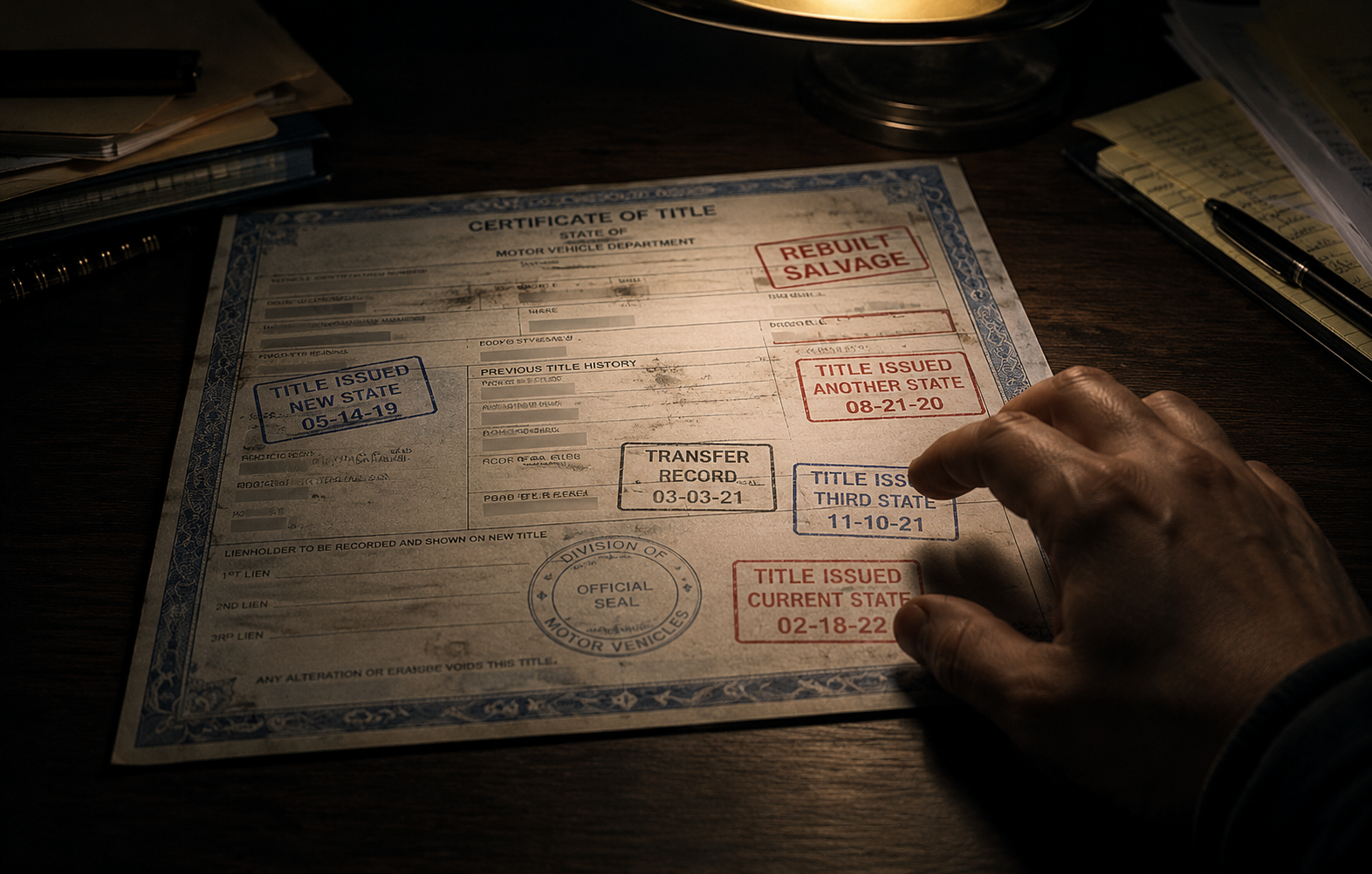
Title washing is the practice of moving a vehicle with a branded title of any kind, whether salvage, junk, flood, lemon, or rebuilt, into a state with weaker branding rules and applying for a new title that does not carry the brand forward. The car comes out the other side with what looks like a clean title and gets resold at clean-title prices, often to a buyer in a third state who has no way of knowing the vehicle was ever totaled.
The scheme depends on one legal reality. Every state issues its own titles and sets its own rules for when a wreck gets a salvage brand, and roughly half the states fix no percentage in their title statutes, leaving the call to the insurer’s total loss decision (a 50-state chart kept by a law firm, updated July 2026). The federal answer is NMVTIS, the National Motor Vehicle Title Information System, run by the Justice Department. Since 2010 every jurisdiction has had to report its title records daily and check the system before titling a car from another state (28 CFR § 25.54), and all 51 jurisdictions now take part, with 100 percent of US DMV data represented.
That closed the old gap of states that did not report. It did not close the gap in what gets reported. NMVTIS holds the brands a state applied and the total losses that insurers and salvage yards sent in, and insurers report only cars of the current model year and the four before it (28 CFR § 25.55). An older total loss reaches the system only if a salvage yard reports it, the insurer reports it voluntarily, or a state applies a brand. Where none of that happens, there is nothing for the next state’s check to find.
No agency counts how many washed titles are on US roads, which is why our statistics page lists them under what nobody counts. What the record does show is the mix: flood survivors, frame-damaged crash rebuilds, and stolen cars whose paperwork was rewritten through corrupt tag agencies. The common thread is that someone profits by selling a car for thousands more than the underlying condition justifies, and somebody else inherits the safety risk.
How the Title Washing Process Works
The mechanics are straightforward. An insurance company pays out a total-loss claim on a vehicle damaged badly enough that repair costs exceed the threshold the insurer or state has set. The insurer takes possession of the wreck and, in most cases, resells it through a salvage auction. Buyers at those auctions are sometimes legitimate rebuilders and sometimes operators looking for the cheapest possible inventory to flip.
The next step depends on the buyer. One who retitles in the same state files for a salvage or rebuilt title and accepts the brand. A washer ships the vehicle to another state and applies for a new title there. Every state must check NMVTIS before it issues that title, so the wash today relies on what the check cannot see: a total loss that was never reported, a wreck that never met the first state’s bar for a salvage brand, or forged ownership papers presented by someone inside the titling system, which is how prosecutors say both Pennsylvania cases below worked. The vehicle comes out with a clean title bearing the new state’s name.
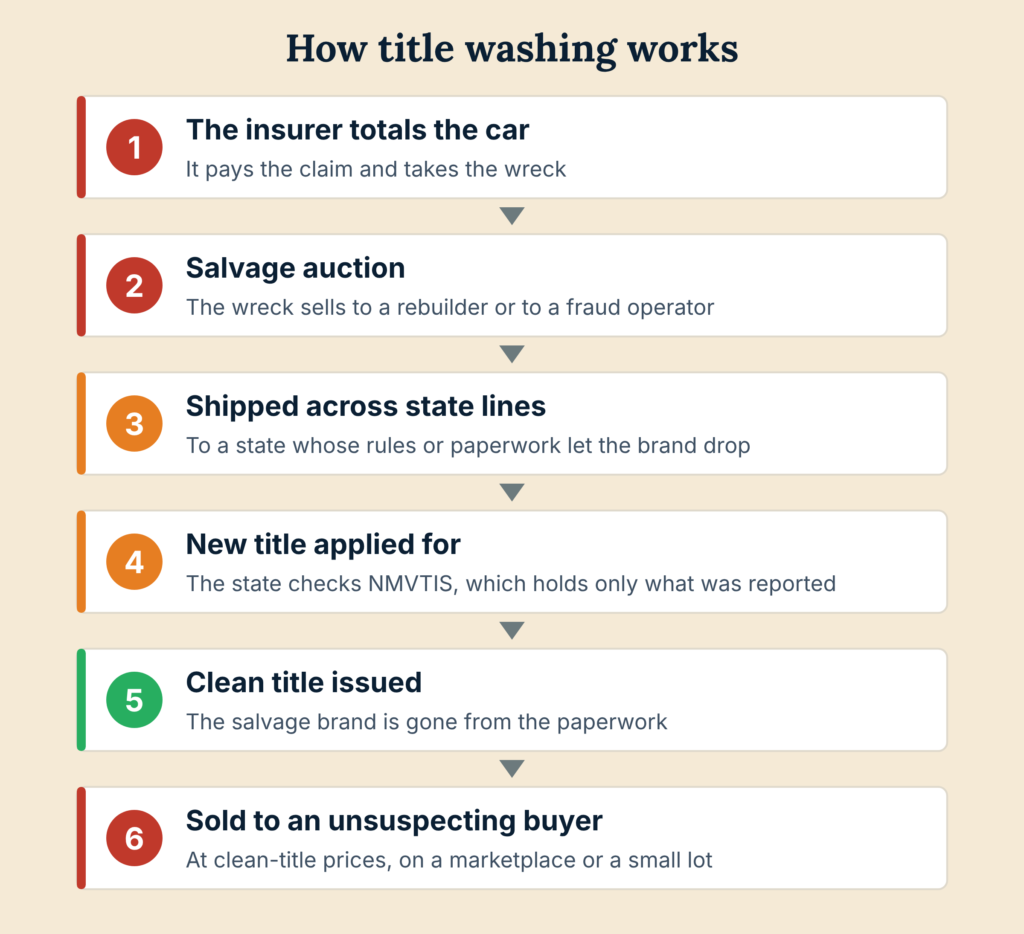
From there, the path back to a buyer is short. The car gets cleaned, repaired to whatever standard the operator chooses, and listed on Facebook Marketplace, Craigslist, dealer auctions, or a small lot. The buyer sees a clean title and assumes the vehicle has a clean history. The records that would show otherwise, the original total-loss claim, the salvage auction listing, and the earlier titles, sit in databases the buyer has to query and the seller does not volunteer.
Title washing is prosecuted under state law: Pennsylvania’s charges in both cases below include an offence named washing vehicle titles. Federal law reaches it when the car or the paperwork crosses state lines. Transporting a stolen vehicle between states carries up to ten years (18 U.S.C. § 2312), and so does carrying a forged title across them, because federal law counts a motor vehicle title as a security (18 U.S.C. § 2314, with the definition in § 2311). Where the mileage is altered along the way, federal odometer law applies as well. Prosecutions exist, and the two Pennsylvania cases below show what the trade looks like at scale.
Why Hurricanes Made Title Washing a National Problem
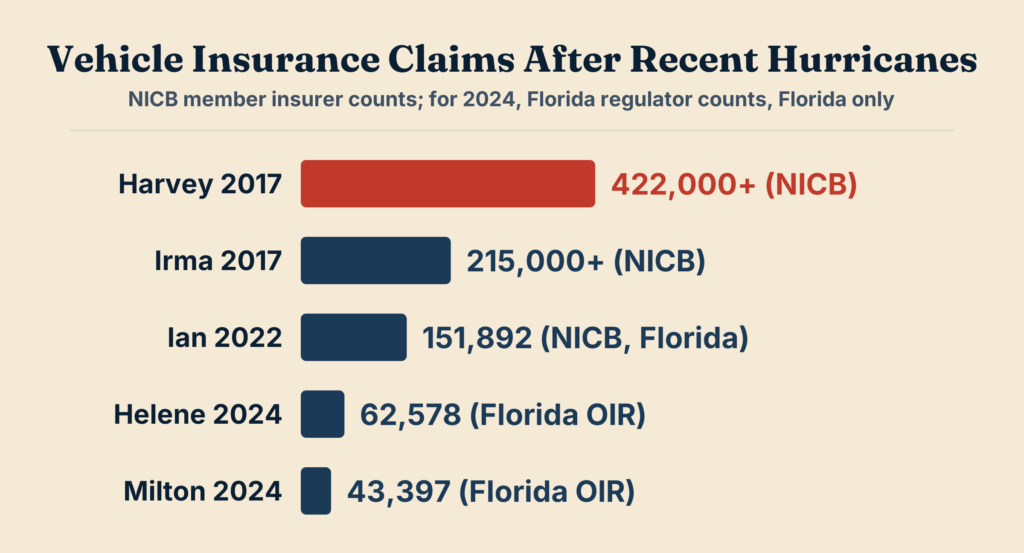
Floods changed the math. The National Insurance Crime Bureau’s tally of insurance claims runs to about 300,000 for Hurricane Katrina in 2005 and 250,500 for Superstorm Sandy in 2012, and in 2017 it counted more than 422,000 insured vehicles damaged by Harvey, which came ashore in Texas, and more than 215,000 claims from Irma in Florida (NICB, October 2017).
After Hurricane Ian in 2022, NICB identified 151,892 personal vehicle claims in Florida, and it has published no vehicle count for any storm since.
Florida’s insurance regulator has. Its catastrophe reports count 62,578 private passenger auto claims from Helene, as of June 2025, and 43,397 from Milton, as of December 2025: 105,975 for the two 2024 storms together, our addition of the regulator’s two counts. Its reports on Ian and Idalia fold auto claims into other lines, and the 2025 and 2026 storms have no such count yet. Each event sent a wave of insurance write-offs through the salvage auctions.
The pattern that follows a major storm is consistent. Insurers settle claims and send the wrecks to auction, and the cars resurface far from the water. Days after Hurricane Ian, Georgia’s Attorney General warned that sellers hide flood damage by moving a vehicle to another state where branding a title as damaged is not required, then selling it back in its home state or elsewhere with a clean-looking title. After the 2024 storms, the Massachusetts Registry of Motor Vehicles issued its own caution about buying a vehicle from another state.
How big the stock is, nobody knows. NICB and Florida’s regulator count claims one storm at a time, and no agency adds the storms up or tracks how many of those cars were repaired and resold. How flood-damaged cars enter the used car supply chain starts at the salvage auction, where insurers sell the write-offs to whoever bids, and ends on a lot or a marketplace listing in a state that saw no rain.
The damage from a flooded car is not always visible. Water damage can slowly destroy mechanical and electrical systems and cause rust and corrosion, the FTC warns, and NICB describes wiring and computer modules that fail months or years after the sale. A car that looks showroom-fresh after a detail can carry electrical faults that show up with the first cold winter.
What the Title System Catches, State by State
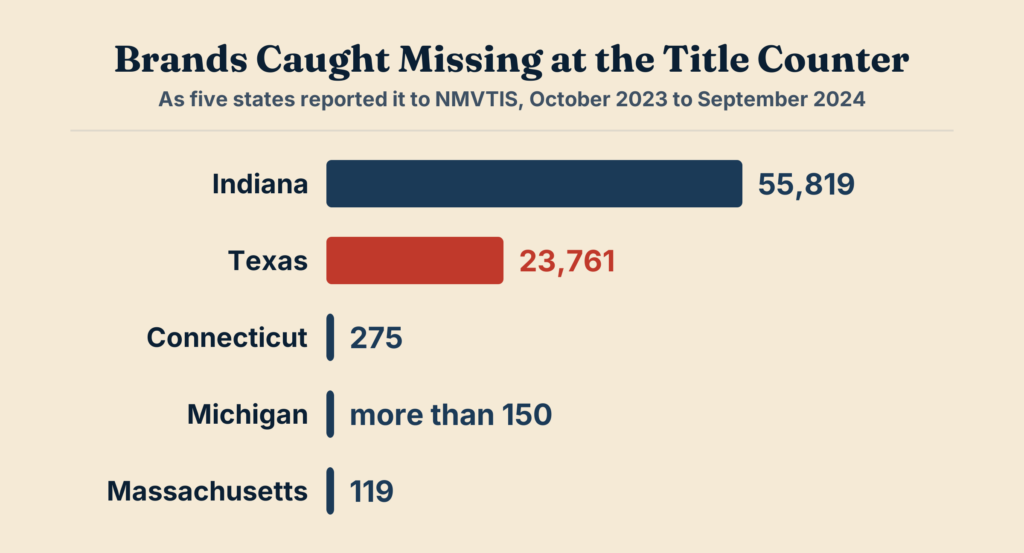
No agency publishes a count of washed titles by state. The nearest thing is the yearly NMVTIS report, in which states describe what the system caught at the counter. In the year to September 2024, Texas identified 23,761 brands as missing or recaptured, among them 2,617 titles surrendered from other states lacked a brand NMVTIS had on record, 1,316 earlier Texas titles were rebranded before new ones were issued, and 18,916 transactions were caught where a clerk had failed to carry forward a value-limiting brand printed on the surrendered document. Indiana found 55,819 brands missing from title documents and carried them forward; Connecticut found 275, Massachusetts 119, and Michigan more than 150.
Wisconsin reported the reverse case: titles received from other states that carried a salvage brand on the paper but not in NMVTIS, which it reviews one by one. These numbers are what the system caught, in the states that chose to report them. A title that reached the counter with its brand already gone and nothing in NMVTIS to contradict it is in no count at all. That is the gap a washer uses, and it is why the two Pennsylvania cases below ran through people inside the titling system rather than around it.
The old gap of states that did not report closed years ago. The Justice Department’s participation page lists all 51 jurisdictions as providing data and checking the system before issuing a title, with 100 percent of US DMV data represented. How NMVTIS tracks title brands across states is worth understanding before you rely on any report: the system holds what states, insurers, and salvage yards report into it, and nothing else.
The concentration also follows an interstate pattern. Flood cars from Florida and Texas, where the biggest recent storms came ashore, are sold at auction and shipped to states where buyers are not thinking about floods. Stolen cars move the other way: in the Troncoso case below, prosecutors say, Florida cars were retitled in Pennsylvania. The interstate corridors used to wash titles are, in the end, any route that ends with a buyer who does not ask where the car has been.
The Pennsylvania Cases That Show How Big the Money Is
Two prosecutions announced by Pennsylvania Attorney General Dave Sunday, in August 2025 and March 2026, show what title washing looks like as organized crime. Both are at the charging stage. What follows is the prosecutors’ account, and every defendant is presumed innocent unless and until proven guilty.
The first charged 13 members of a central Pennsylvania criminal enterprise, as the Attorney General’s office describes it, that, according to the charges, sold more than two dozen luxury vehicles stolen in Florida and profited more than $1 million, mostly in 2022 and 2023. Anthony E. Troncoso, 44, is charged as its leader with nine felonies and six misdemeanors, among them corrupt organizations, washing vehicle titles, and theft by deception. He was arrested in Mexico City after three months as a fugitive, the Attorney General’s office said in November 2025, and arraigned in Dauphin County.
According to the charging documents, the titling ran through licensed tag agencies and notaries in Berks, Dauphin, and Lehigh counties, and through PennDOT headquarters in Dauphin County. The group is accused of bringing stolen cars up from Florida, fabricating ownership, registration, and insurance documents, and walking out with Pennsylvania titles. The vehicles named are Porsches, Mercedes, BMWs, Land Rovers, Audis, Lexus, and Infinitis, sold, prosecutors say, to private buyers, at auction, and to dealerships. Several Florida residents among the 13 are charged with providing fraudulent documents to obtain Pennsylvania ID cards used in the titling.
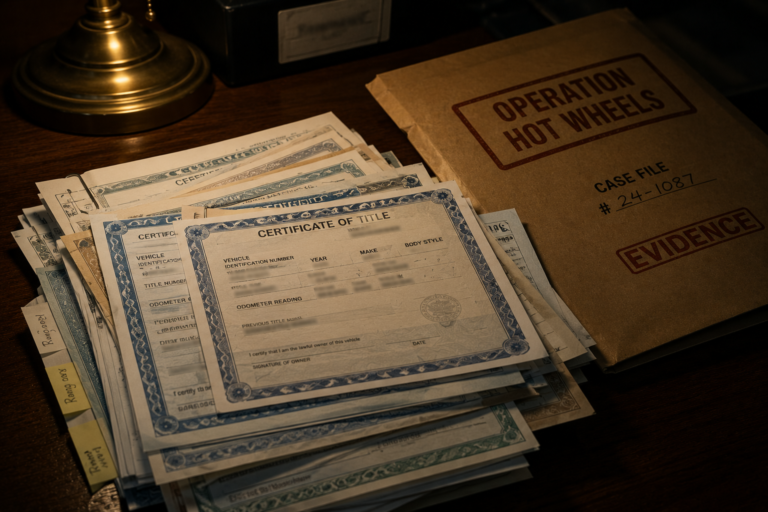
The second case, announced in March 2026, became known as Operation Hot Wheels. Adam K. Richardson, a Philadelphia tag agent authorized by PennDOT and operating Richardson Family Enterprises LLC, is charged with washing titles for 65 stolen luxury vehicles valued at more than $3.8 million. The vehicles named include a Ferrari worth roughly a quarter of a million dollars, plus Mercedes, BMWs, and Cadillacs. Richardson was arrested on 13 March, denied bail, and faces felony counts including corrupt organizations, vehicle title washing, forgery, and dealing in proceeds of unlawful activity.
In both cases, prosecutors say, the paperwork came from inside the state titling system, and both put stolen high-margin vehicles through it. The buyers differ. In the Troncoso case, prosecutors say, they included private buyers, dealerships, and auctions. In Hot Wheels, Attorney General Sunday said, many of the vehicles were sold to individuals who knew they were stolen. A clean-looking title serves both. Pennsylvania State Police Captain James Reinard said the Hot Wheels investigation revealed an organized effort to steal and fraudulently re-title 65 vehicles, and Attorney General Sunday framed the broader risk in the same announcement: washed vehicles provide criminals the means to move around and perpetrate crimes without being detected by law enforcement.
Prosecutors put the vehicles in the Hot Wheels case at more than $3.8 million and the Troncoso ring’s profit at more than $1 million: two cases, one state, seven months apart. The cars being washed include stolen vehicles and totaled wrecks alike, and both need the same thing, a title that looks clean. By 18 October 2026 we had found no report of a plea, a trial date, or a verdict in either case.
How to Protect Yourself From Buying a Washed Title
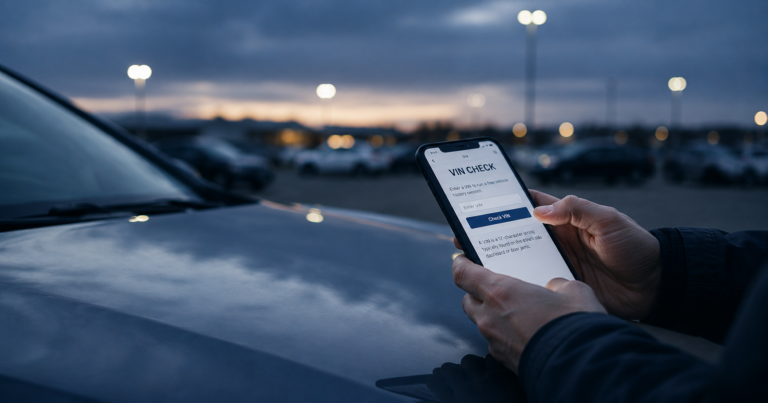
The defenses a buyer has against title washing are imperfect, but they work. Start with the free checks. NICB VINCheck shows whether a participating insurer has reported the car stolen and not recovered, or as salvage or flood damaged, five searches a day, and it asks for nothing but the VIN. Then decode the VIN yourself with NHTSA’s free decoder, which tests the check digit and confirms make, model, and year against what the seller is showing you.
The paid step is an NMVTIS report, about $10 from a provider on the Justice Department’s list. It shows the current state of title and the last title date, every brand any state has applied, the latest odometer reading in the title record, and the total loss and salvage history reported by insurers and salvage yards. A Mississippi title issued a few months after a Louisiana one, in the year after Hurricane Ida, is the kind of pattern that justifies walking away. Our guide to what a free VIN check will and will not show covers where the free tools stop and the paid report begins.
A commercial vehicle history report adds what NMVTIS was never meant to hold: repair and service records, reported accidents, recall information. None of these sources is complete on its own, and the cost of running all of them on a serious purchase is small next to the cost of a flood car. The Federal Trade Commission’s used car guide tells buyers to get a vehicle history report, and adds that a report is not a substitute for an independent inspection. We explain how to read a vehicle history report without missing the red flags in a separate guide.
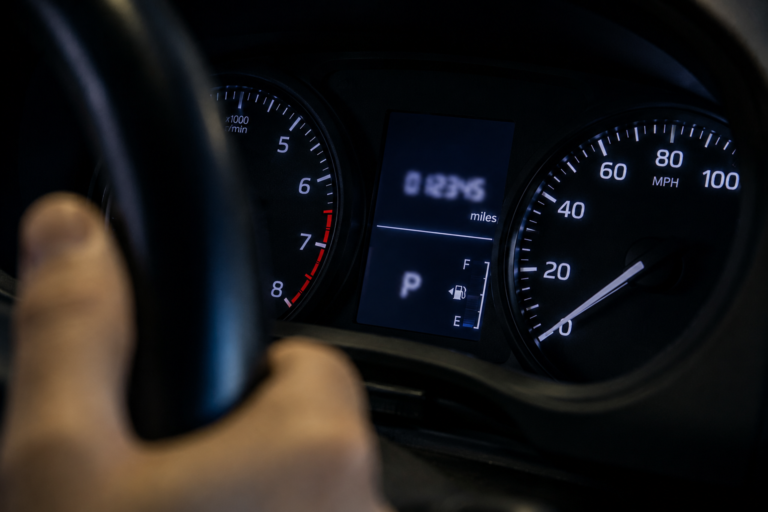
A few other checks compound the protection that history reports provide. The first is to inspect the title document itself for inconsistencies, including corrections, smudged ink, mismatched fonts, or missing watermarks. The second is to verify that the VIN on the title matches the VIN on the dashboard plate and on the certification label in the driver’s door area, where federal rules require it (49 CFR § 567.4). A mismatch between those points is a reason to walk away.
The third layer is a pre-purchase mechanical inspection by an independent shop. NICB’s checklist for flood cars is specific: water stains, mildew, sand, or silt under the carpets and behind the dashboard; rust on screws where water would not normally settle; mud in the spare tire compartment and around the alternator, starter, and relays. A thorough inspection catches what a detail hides. The cost is typically $100 to $200, which on a $20,000 used car is the cheapest insurance available.
Patterns in the listing itself also matter. A car priced well below market for its model, year, and condition is the first warning sign. Sellers who refuse to share the VIN before a meeting, refuse a pre-purchase inspection, or push for a quick sale are identifying themselves, and the same signs mark a curbstoner. Cars with earlier titles in flood-prone states deserve a harder look even when the title looks clean. Our complete buyer protection playbook covers the full sequence of checks for any used-car purchase over a few thousand dollars.
The honest framing for any buyer is that no single tool catches every case of title washing. A clean commercial history report is not proof of a clean car. A clean NMVTIS report is not proof of a clean car. A pre-purchase inspection by a trusted shop is the closest thing to definitive evidence available outside a forensic disassembly. Used together, these defenses catch most of what a seller is hiding. Used selectively, they catch some. Used not at all, the buyer is guessing, and the math of the trade says they will eventually guess wrong.
Frequently Asked Questions
What is title washing?
Title washing is the practice of moving a vehicle with a branded title, such as salvage, flood, junk, or rebuilt, to a state with weaker branding requirements and applying for a new title that does not carry the brand. The result is a car that looks clean on paper while hiding serious damage history, theft history, or both. States prosecute it under their own title and fraud statutes, and federal law applies when a stolen car or a forged title crosses state lines.
Which states are worst for title washing?
No agency publishes a ranking, and the state-by-state figures that circulate come from a vehicle history company’s own records. What the public record shows is what each state catches: in the year to September 2024, Texas recaptured 23,761 missing brands, 2,617 of them on titles surrendered from other states, and Indiana carried forward 55,819 missing brands, by their own reports in the NMVTIS annual report. A state’s exposure is better read from its rules: the salvage threshold, the brands it carries forward, and whether it inspects rebuilt cars, which our state guides cover state by state.
How can I tell if a title has been washed?
Run the free NICB VINCheck first, then an NMVTIS report, about $10 from a provider on the Justice Department’s list, and cross-check it with a commercial vehicle history report. Look for titles in more than one state, particularly in flood-prone states, and for a brand that appears in one state’s record and vanishes in the next. Match the VIN on the title to the VIN on the dashboard and the door label, and get a pre-purchase mechanical inspection from a trusted shop.
Is title washing illegal?
Yes. States prosecute it under their own title and fraud statutes; Pennsylvania’s charges in both cases above include an offence named washing vehicle titles. Federal law reaches it when a stolen vehicle or a forged title crosses state lines, with up to ten years under 18 U.S.C. § 2312 and § 2314. Federal odometer fraud statutes also apply when mileage is altered as part of the wash. Penalties in state cases can include felony convictions, prison time, and restitution to victims.
How many flood-damaged cars are on US roads?
Nobody knows. NICB counts insurance claims one storm at a time: more than 422,000 vehicles damaged by Harvey in 2017, more than 215,000 claims from Irma the same year, 151,892 personal vehicle claims in Florida after Ian in 2022, and nothing since. Florida’s insurance regulator counted 62,578 private passenger auto claims from Helene and 43,397 from Milton in 2024. No agency adds the storms up or tracks how many of those cars were repaired and resold. Flood-damaged vehicles turn up far from the storm zones, which is why Georgia’s Attorney General and the Massachusetts Registry of Motor Vehicles have both warned buyers about cars arriving from other states.
Can a salvage title be made clean again?
Not legally. NMVTIS keeps the history of every brand any state has applied to a vehicle, so a salvage brand stays in the record even after a state issues a rebuilt title. A title that drops the brand without that record is the product of title washing. The rebuilt and inspection rules differ by state; our state guides cover them state by state.
Discuss this article on r/VINvestigators. Got a listing that looks off, or a report that does not add up? Post it. Over 1,500 members, buyers and trade among them.
New guides and fraud alerts by email, a few times a month, no more. Subscribe on the home page.
Checking a specific car? Get the full vehicle history report from carVertical, an NMVTIS-approved provider, 20% off through our link. The link applies the discount automatically; if you go to carVertical later, the code VINVEST gives the same 20%. We earn a commission from carVertical if you buy; it costs you nothing extra.