What Every Character in a VIN Actually Means
Every fact, figure and legal citation in this article was checked against its original source before publication by Artūras Andriušaitis, founder and editor. Editorial Standards
Every car sold in the United States since 1981 carries a 17-character code that tells anyone who knows how to read it where the vehicle was built, what kind of engine it has, what model year it belongs to, and whether the number itself adds up. That code is the Vehicle Identification Number, and most buyers ignore it until something goes wrong. By the time it matters, they have usually already paid.
This guide walks through every VIN character position, what each one is telling you, and how to use that information to catch lies sellers tell about used cars. The same 17 characters that identify a vehicle to its manufacturer can also identify a stolen car, a salvage rebuild, or a model year that does not match what is printed on the listing. This guide anchors our VIN Guide coverage.
Why VINs Matter More Than Most Buyers Realize
Before 1981, there was no standard format. Manufacturers used different formats, different lengths, and different rules. Two cars built in the same year by competing automakers might have VINs that looked nothing alike. That changed when the National Highway Traffic Safety Administration mandated a single 17-character format, starting with the 1981 model year. The rules now sit in 49 CFR Part 565, which governs VIN structure today.
The standardization mattered because the VIN is the primary key for almost every record tied to a vehicle. Title transfers, registrations, insurance claims, recalls, service records, accident reports, and theft reports all run through the VIN. When a state DMV issues a title, it is the VIN that follows the car forever. When a recall is issued, the VIN is what tells you whether your specific vehicle is affected.
That is also why the VIN is a frontline tool against fraud. A buyer who can decode a VIN can verify, in less than a minute, whether the car in front of them matches what the seller is claiming. A 2022 Honda Civic should have a VIN that begins with a code identifying Honda as the manufacturer and a tenth character of “N” indicating model year 2022. If those digits do not line up, the conversation is over before it starts.
We will walk through the structure section by section, then explain what to do with the information.
The Four Sections of a VIN, Decoded
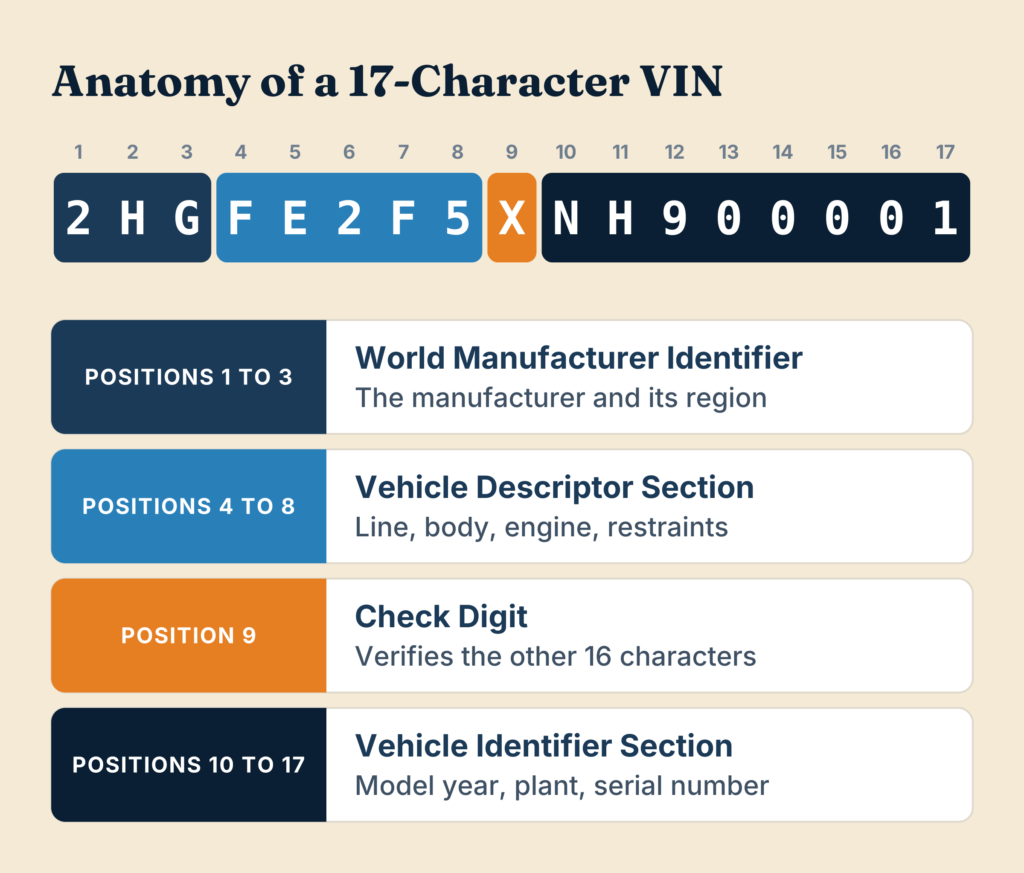
A 17-character VIN breaks into four functional blocks. The first three characters are the World Manufacturer Identifier, or WMI, which identifies the manufacturer and the type of vehicle. Positions 4 through 8 form the Vehicle Descriptor Section, or VDS, which encodes specifics like body type, engine, and restraint system. Position 9 stands alone as the check digit, a verification character calculated from a formula that uses every other character in the VIN. Positions 10 through 17 make up the Vehicle Identifier Section, or VIS, which carries the model year, the assembly plant, and the production sequence number.
Three letters are notably absent from any valid VIN. Part 565 does not allow I, O, or Q as a VIN character in any of the 17 positions. The regulation gives no reason, but the practical effect is useful: anything that looks like an O is a zero, and anything that looks like an I is a one. Position 10, which encodes the model year, also excludes the letters U and Z and the numeral 0. The check digit in position 9 serves a related purpose: it catches a VIN that was misread or mistyped.
The information density here is high, which is part of why VIN decoding is such an effective fraud check. Counterfeiters can fake a clean title or a low odometer reading, but a made-up VIN rarely survives a structured decode. A VIN copied from a real car does, which is why the decode is an early check and not the last one.
One point of confusion worth clearing up. The VIN is not the same as the engine number, and it is not the same as the chassis number, even though sellers sometimes use the terms interchangeably. The engine number identifies a specific engine block and changes when an engine is swapped. The chassis number is an older term that, outside North America, sometimes refers to the VIN itself and sometimes to a separate frame stamping. In the United States, the 17-character VIN is the controlling number for title, registration, and insurance purposes. If a seller tries to talk around the VIN by pointing at an engine number instead, that is a signal, not a substitute.
World Manufacturer Identifier (Positions 1 to 3)
The first character of a VIN points to a geographic region, usually the one where the vehicle was assembled. United States codes begin with 1, 4, or 5, and more recently 7 as well: a Tesla Model Y built in Fremont, California begins 7SA. Canada is 2, Mexico is 3. Asian codes start with letters J through R, with Japan using J. European codes use letters S through Z. South American codes use 8 and 9, and Australia uses 6.
The match is not perfect: a Mercedes-Benz Sprinter van built in South Carolina still carries a German code beginning with W. Position 11, the plant code, is the better guide to where a vehicle was actually built.
All three characters together identify the manufacturer and the type of vehicle, and a large company holds many of them. Inside General Motors, for example, the WMI 1G6 has historically pointed to Cadillac, while 1G1 has pointed to Chevrolet. Toyota’s Japan-built cars carry codes beginning JT, while its United States plants use codes such as 4T1 and 5TD.
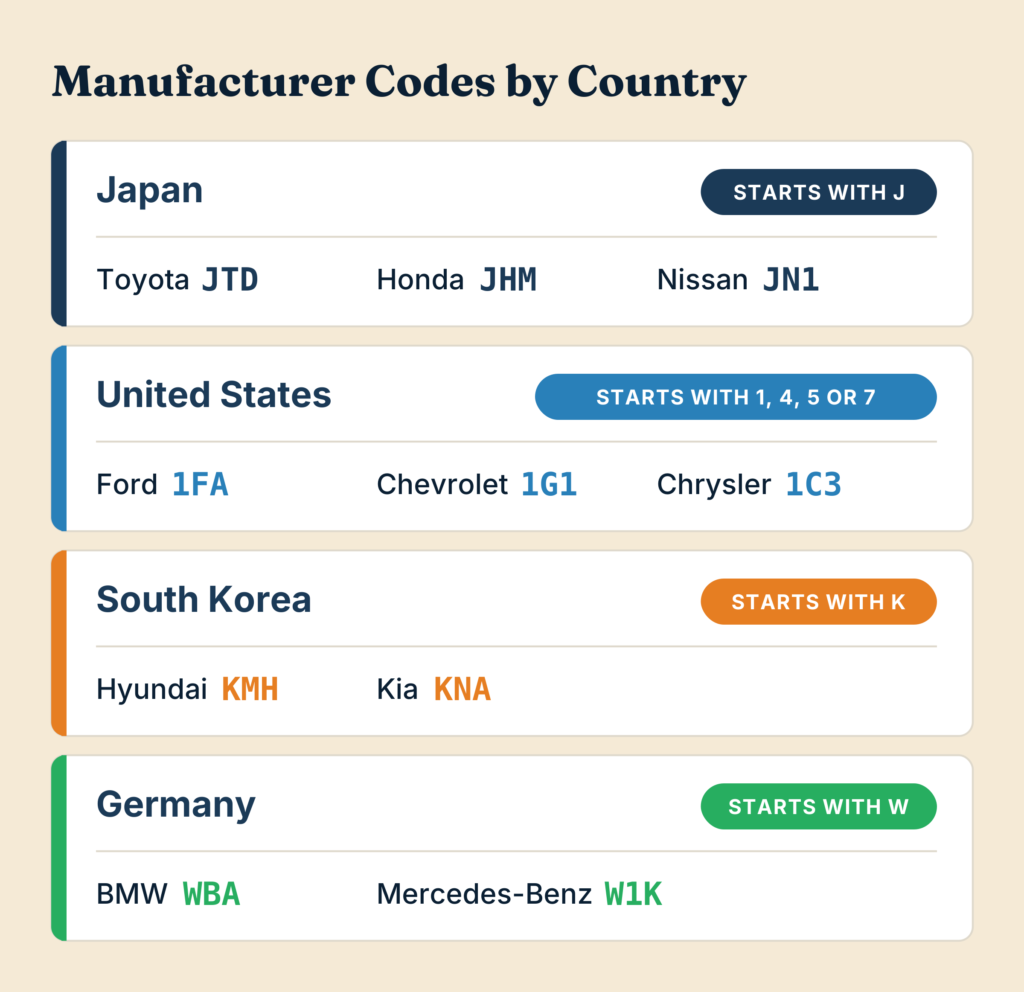
| Manufacturer | A common WMI |
|---|---|
| Toyota (Japan-built) | JTD |
| Honda (Japan-built) | JHM |
| Nissan (Japan-built) | JN1 |
| Ford (US-built) | 1FA |
| Chevrolet (US-built) | 1G1 |
| Chrysler (US-built) | 1C3 |
| Hyundai (Korea-built) | KMH |
| Kia (Korea-built) | KNA |
| BMW (Germany-built) | WBA |
| Mercedes-Benz (Germany-built) | W1K |
Manufacturers that build fewer than 1,000 vehicles of a given type per year get a 9 in the third position and use positions 12, 13, and 14 to complete their identification. NHTSA contracts with SAE International, formerly known as the Society of Automotive Engineers, to assign WMI codes in the United States.
For a buyer, the WMI is the first sanity check. If the seller says the car is a Ford and the VIN starts with JT, something is wrong. That mismatch alone is not always fraud (it could be a typo on the listing), but it is the kind of inconsistency that should pause a transaction immediately.
Vehicle Descriptor Section (Positions 4 to 8)
The next five VIN characters describe the vehicle itself. Part 565 says what they must reveal for a passenger car: the make, the line, the series, the body type, the engine type, and the restraint devices and their location. For SUVs, minivans, and trucks, the list includes the gross vehicle weight rating.
The regulation does not say which position carries which attribute. Each manufacturer decides and files its own key with NHTSA, so the same position can mean one thing on a Ford and another on a Toyota. One position is fixed: position 7 must be a letter on passenger cars, and on SUVs, minivans, and trucks rated at 10,000 pounds or less, from model year 2010 on.
Because the meaning of these positions is set by the manufacturer rather than by federal regulation, decoding the VDS accurately requires either the manufacturer’s own VIN reference document or a tool that aggregates them. The free NHTSA VIN decoder handles this for almost every passenger vehicle sold in the United States, returning a structured breakdown of body class, engine specifications, restraint type, and other federally reported details. Our own free VIN check reads the same NHTSA data.
The VDS is where buyers catch lies about what is under the hood. A Camry XSE listing claiming a V6 engine should produce a VDS that decodes to a V6. If the decoder returns “2.5L Inline 4-cylinder” instead, the seller is either misinformed or misrepresenting the vehicle. The same applies to all-wheel drive claims, hybrid configurations, and trim levels that affect resale value. The VIN does not lie about what the factory built. It only lies if someone has tampered with the plate itself.
The VDS also tells you something the seller may not realize. The codes are fixed at the factory and never change, so the engine code can confirm whether a given car was originally built with the equipment its current owner believes it has. Salvage rebuilds sometimes swap engines between different model years or trims, and the VDS will not match the swapped components. That mismatch is a signal that major parts have been replaced, and a reason to ask why.
The Check Digit (Position 9)
The ninth character is the strangest one, and a useful one for fraud detection. It is a single digit (0 through 9) or the letter X, calculated from a weighted formula applied to the other 16 characters. The Department of Transportation defines the formula in 49 CFR Part 565. Each character in the VIN gets converted to a numerical value based on a transliteration table, multiplied by a position-specific weight, and summed. The total is divided by 11. The remainder is the check digit. If the remainder is 10, the check digit is X.
The math is not the point for a buyer. The point is that the check digit makes a careless forgery easy to catch. A fraudster who wants to swap one VIN for another cannot just pick a 17-character string out of thin air. A made-up string usually fails the formula, and any ordinary VIN decoder can recompute the check digit on the spot to verify it.
Free tools that perform this verification automatically include the NHTSA decoder and most reputable third-party VIN check services. When a VIN fails check digit verification, the system returns an error, and that error is meaningful. The likely explanations are a typo in transcription, a damaged or photocopied plate that misread, or a counterfeit VIN that the forger constructed without bothering to compute the check digit correctly.
A failed check digit is the cleanest single indicator that something is wrong with the number in front of you. An honest seller with a typo can fix it on the spot. A seller who gets evasive when the VIN does not pass verification has given you a reason to walk away.
Vehicle Identifier Section (Positions 10 to 17)
The final eight characters carry the most concrete information about the specific vehicle in front of you. Position 10 encodes the model year. Position 11 encodes the assembly plant. Positions 12 through 17 form the production sequence number, which functions like a serial number on the assembly line.
The model year code on position 10 follows a specific cycle. Letters A through Y were used for model years 1980 through 2000, skipping I, O, Q, U, and Z. Digits 1 through 9 covered model years 2001 through 2009. The cycle then restarted with A in 2010 and runs through Y in 2030, followed by the digits 1 through 9 for 2031 through 2039. The letters of the current cycle are below.
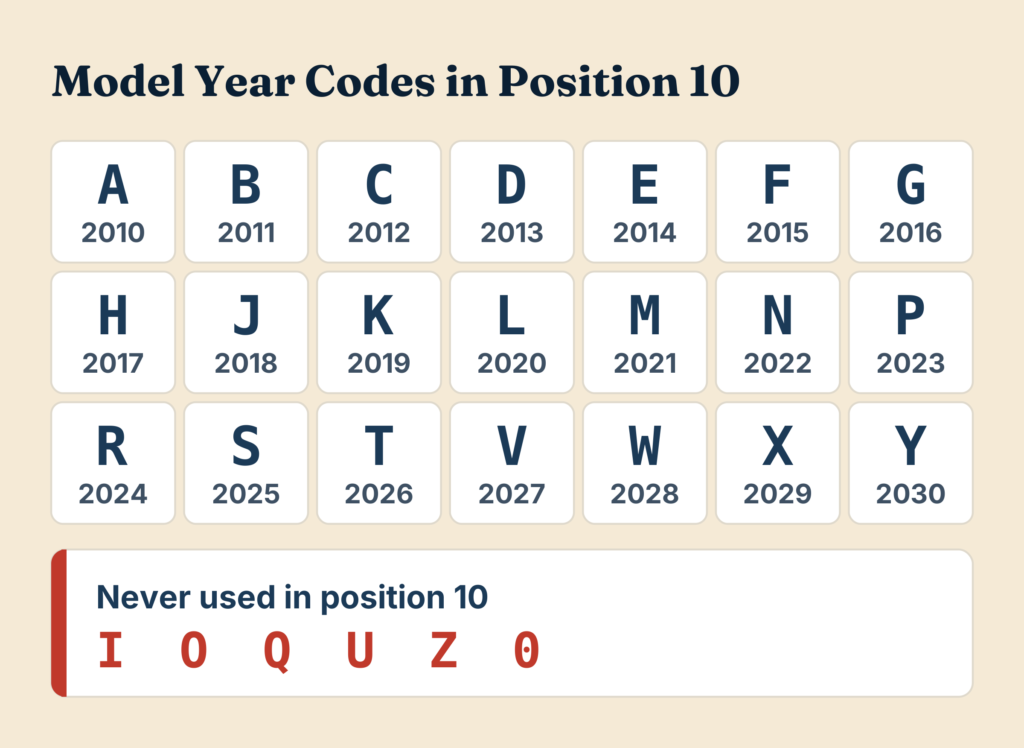
| Position 10 | Model Year |
|---|---|
| A | 2010 |
| B | 2011 |
| C | 2012 |
| D | 2013 |
| E | 2014 |
| F | 2015 |
| G | 2016 |
| H | 2017 |
| J | 2018 |
| K | 2019 |
| L | 2020 |
| M | 2021 |
| N | 2022 |
| P | 2023 |
| R | 2024 |
| S | 2025 |
| T | 2026 |
| V | 2027 |
| W | 2028 |
| X | 2029 |
| Y | 2030 |
The recycled code creates an obvious question: how do you know whether a VIN with an “A” in position 10 means 1980 or 2010? The answer is in position 7. If the character at position 7 is a letter, the vehicle is a 2010 or later model. If it is a number, the vehicle is from before 2010. The rule covers passenger cars, and SUVs, minivans, and trucks rated at 10,000 pounds or less. NHTSA added it to Part 565 in April 2008, ahead of the 2010 model year, in part to prevent ambiguity when the alphabet started over.
Position 11 identifies the assembly plant. Plant codes are manufacturer-specific. Ford’s Dearborn Truck Plant uses one code, the Kansas City Assembly Plant uses another. Toyota’s Georgetown, Kentucky plant uses different codes than its Takaoka, Japan plant. Honda assigns separate plant codes for Marysville, Ohio and Lincoln, Alabama. General Motors uses distinct codes across its Lansing Grand River, Spring Hill, and Bowling Green plants, and Stellantis does the same for Jeep’s Toledo complex and Ram’s Saltillo plant.
Plant codes matter for recall notices, which sometimes apply only to vehicles built at a specific plant during a specific window. They also matter for fraud detection, because a vehicle’s claimed origin should match the plant code in its VIN.
Positions 12 through 17 are the production sequence number. Two cars can share those six characters, but never the full 17: Part 565 bars any two vehicles built in the 60 years from model year 1980 from carrying the same VIN. This is the core uniqueness guarantee of the VIN system. Once a vehicle leaves the factory with its VIN stamped, that number normally stays with the car for life, recorded on the title, the registration, the insurance policy, and every service record the car ever generates.
How VIN Decoding Helps Spot Fraud Before You Buy
Knowing what each VIN character means is one thing. Using that knowledge to catch a problem is another. Reading the VIN closely can catch four kinds of mismatch, if the buyer bothers to look.
The first is mismatched model year. The VIN says one year, the seller says another. This happens accidentally with paperwork errors, but it can also be deliberate, when a seller passes an older car off as a newer one. The model year encoded in position 10 is set at the factory and cannot be changed without forging the plate.
The second is wrong manufacturer. The seller lists the car as one make, the WMI in positions 1 through 3 says it was built by another. This can be a rebadged vehicle or a listing error, and it can be a crude VIN swap. It is not how VIN cloning shows up: the National Insurance Crime Bureau says a cloned VIN is copied from a legally owned vehicle of the same make and model, so it decodes correctly.
The third is failed check digit. The math does not work. The VIN was most likely mis-transcribed, and it may be fabricated. Reputable decoders flag this automatically, and any seller who pushes back on running the VIN through verification is telling you something without saying it.
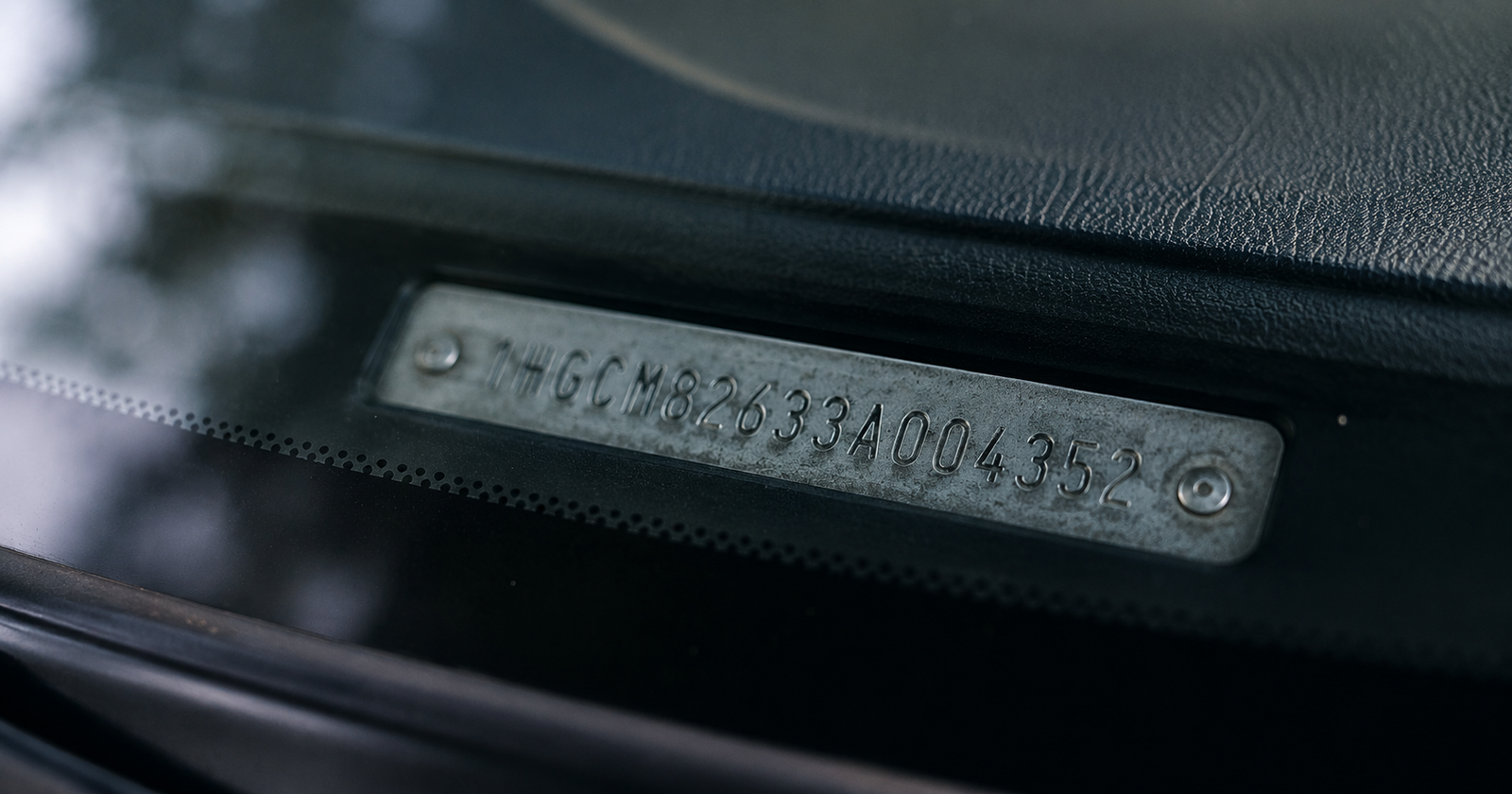
The fourth is inconsistent VIN locations. Federal rules require the VIN to be readable through the windshield on the driver’s side, and to appear on the certification label in the driver’s door area. Many vehicles also carry the VIN on major parts such as the hood, doors, and fenders, and the VIN or its last eight characters on the engine and transmission. If the dashboard VIN does not match the door jamb VIN, parts have been swapped or the car’s identity has been tampered with, and either way the seller owes you an explanation. Knowing where to find the VIN on your vehicle, in every spot, is what makes this check work.
VIN cloning, where criminals duplicate the VIN of a legitimate vehicle to disguise a stolen one, is the most sophisticated of these schemes and the hardest to detect by eye alone. Understanding how criminals clone VINs to hide stolen cars starts with one fact: the copied number is real, so a decode alone will not expose it. For broader context on the protective measures every used-car buyer should run, see our complete fraud prevention playbook.
A decode has a second blind spot. It shows what the factory built, not what has happened to the car since. A car whose salvage or flood brand was dropped by retitling it in another state, a practice called title washing, decodes exactly like a clean one. The title history needs its own check.
Mileage records are filed under the VIN too, and the federal odometer fraud apparatus exists because rollbacks are not rare. NHTSA’s estimate, which comes from a study it published in 2002, is about 450,000 vehicles sold each year with false odometer readings, at a cost to buyers of about $1 billion a year. The study found rollbacks rare in vehicles less than two years old.
For a free starting point, the National Insurance Crime Bureau’s VINCheck tool flags vehicles reported stolen and not recovered, or reported as salvage, by participating insurance companies. It is not exhaustive (not every insurer participates), but it is free and it catches the obvious cases.
To run a structured check on a specific vehicle, see our walkthrough on how to run a free VIN check, which covers what the free tools show and miss, and where a full history report fits.
In practice, before you hand over money for a used vehicle, run the VIN through NICB’s VINCheck, then decode it. Cross-reference what the decode says against what the seller says. Check the dashboard plate, the door jamb sticker, the title, and the registration to confirm they all match. If anything does not line up, stop. The VIN is a piece of evidence the seller cannot alter without committing a federal crime, and using it costs nothing.
Frequently Asked Questions
Can two cars have the same VIN?
No. Every legitimate VIN issued since 1981 is meant to be unique: federal rules bar any two vehicles built in the 60 years from model year 1980 from carrying the same one. The exception that matters to a buyer is fraud. VIN cloning, where criminals duplicate a legitimate VIN onto a stolen vehicle, creates two cars with the same number, and the buyer of the stolen one never becomes its legal owner.
Can someone steal my identity using my VIN?
No. The VIN identifies a vehicle, not a person. It encodes the manufacturer, model, year, and production sequence, but it contains no personal information about the owner. Sharing your VIN with a buyer, mechanic, or insurer is normal and necessary. Identity theft requires personal information like a Social Security number, driver’s license number, or bank account, none of which are connected to the VIN itself.
Where is the VIN located on a car?
The two most reliable spots are the dashboard plate, visible through the windshield on the driver’s side, and the door jamb sticker on the driver’s door. Federal rules put the VIN in both places. Major parts such as the engine often carry the VIN or its last eight characters, and the full number appears on the title, registration, and insurance documents. Compare them before you buy.
Do VINs have the letters I, O, or Q?
No. Federal rules exclude those three letters from every VIN character position. If you see what looks like an O or an I in a VIN, look again. It is almost certainly a 0 or a 1.
How do I check a VIN for free?
Start with the NICB’s VINCheck tool, which flags stolen and salvage records from participating insurers. Then run NHTSA’s official VIN decoder at vpic.nhtsa.dot.gov, which returns a structured breakdown of what the factory built. Both are free, take about thirty seconds, and require no account. Neither one shows accidents, liens, or service history.