How to Spot a Curbstoner Before You Hand Over Cash
Every fact, figure and legal citation in this article was checked against its original source before publication by Artūras Andriušaitis, founder and editor. Editorial Standards
A buyer who thinks they are dealing with a regular person selling their old car is sometimes really dealing with an unlicensed business that flips problem vehicles for a living. The seller looks ordinary. The listing reads like any other Craigslist or Facebook Marketplace post. The price is in the right neighborhood. What the buyer cannot see, until the title transfer fails at the DMV or the engine seizes a month after purchase, is that the seller never titled the car in their own name, never disclosed its damage history, and will be unreachable by phone soon after the sale.
This guide, part of our Scams & Fraud coverage, explains what curbstoners are, the specific red flags that distinguish them from honest private sellers, and what to do before money changes hands. The signs are well documented. The defenses are simple. The cost of recognizing one is close to zero. The cost of missing one is an unregistered car with hidden damage and little recourse.
What a Curbstoner Is and Why It Matters to Buyers
A curbstoner is an unlicensed dealer posing as a private seller to avoid dealer regulations. The name comes from the practice of parking cars for sale on a curb or in a parking lot rather than at a licensed dealership. The Minnesota Attorney General describes curbstoning as illegal in Minnesota, and other states license dealers under laws of their own.
The thresholds vary, and some states name no number at all. Here is where the line sits in seven states.
| State | When a seller needs a dealer license | Source |
|---|---|---|
| Florida | Buying, selling, offering or displaying three or more vehicles in any 12-month period raises a legal presumption of dealing. The statute names no number that is allowed. | Fla. Stat. § 320.27 |
| Minnesota | More than five vehicles sold, bought or leased in a 12-month period. | Minn. Stat. § 168.27 |
| Missouri | Six or more vehicles sold or displayed for sale in a calendar year, not counting vehicles registered in the seller’s own name. | Mo. Rev. Stat. § 301.570 |
| New York | More than five vehicles sold or offered in a calendar year, or three or more displayed at one time or within one calendar month on premises the seller owns or controls, when the vehicles were acquired for resale. | N.Y. Veh. & Traf. Law § 415 |
| New Jersey | No number. Anyone engaged in the business of buying, selling or dealing in motor vehicles must be licensed. | New Jersey Motor Vehicle Commission |
| North Dakota | No number. Nobody may engage in the business of buying, selling or exchanging motor vehicles without a dealer license. | N.D. Cent. Code § 39-22-14 |
| Oklahoma | No number. Anyone who sells used vehicles for a commission or with intent to make a profit counts as a used motor vehicle dealer and must be licensed. | Okla. Stat. tit. 47, § 581 and § 583 |
Federal law draws its own line. Under the FTC Used Car Rule, a person or business that sells or offers a used vehicle after selling or offering five or more in the previous twelve months is a dealer and must post a Buyers Guide on each used vehicle offered for sale, in every state except Maine and Wisconsin, which have similar rules of their own. Curbstoners cross these lines and ignore the obligations that follow.
The reason it matters to buyers is direct. Buying from a curbstoner means no Buyers Guide on the car, none of the disclosures a licensed dealer has to make, no dealer surety bond to claim against if the seller disappears, and no licensed business address to sue if the car turns out to be a flood vehicle or a salvage rebuild. The cars themselves are a risk too. The Minnesota Attorney General warns that curbstoners sometimes roll back odometers or sell previously wrecked, salvaged or stolen vehicles without warning, and that some of their cars have had only the bare minimum repairs needed to appear in working order.
The Red Flags That Give Them Away
The sign the state warnings agree on is the title not in seller’s name. Curbstoners often skip the step of titling the vehicle to themselves, a practice called title jumping. Wisconsin’s Department of Transportation says it makes it easier for an unlicensed dealer to commit fraud without being caught, and its advice when the title is missing or not in the seller’s name is to shop elsewhere.
Honest private sellers can show that the car is titled in their own name. There are two honest exceptions: a lender may hold the title until its loan is paid off, or the state may keep the title electronically. In both, the proof is the lender’s or the state’s own record, and the sale is completed through the lender or the title office, never on a promise that the title will follow.
Several other signs come up again and again in state warnings. Multiple vehicles listed under the same phone number is a tell, because a private seller usually has one car to sell, not three. A reverse phone search on Google or Whitepages can surface other listings tied to the number, sometimes going back months. Listings that meet at gas stations, shopping centers, or parking lots rather than the seller’s home are another listed sign. The Maryland Motor Vehicle Administration warns buyers specifically about sellers who refuse to meet at their home, and lists title mismatches, suspiciously low prices, and multiple vehicles for sale alongside it.
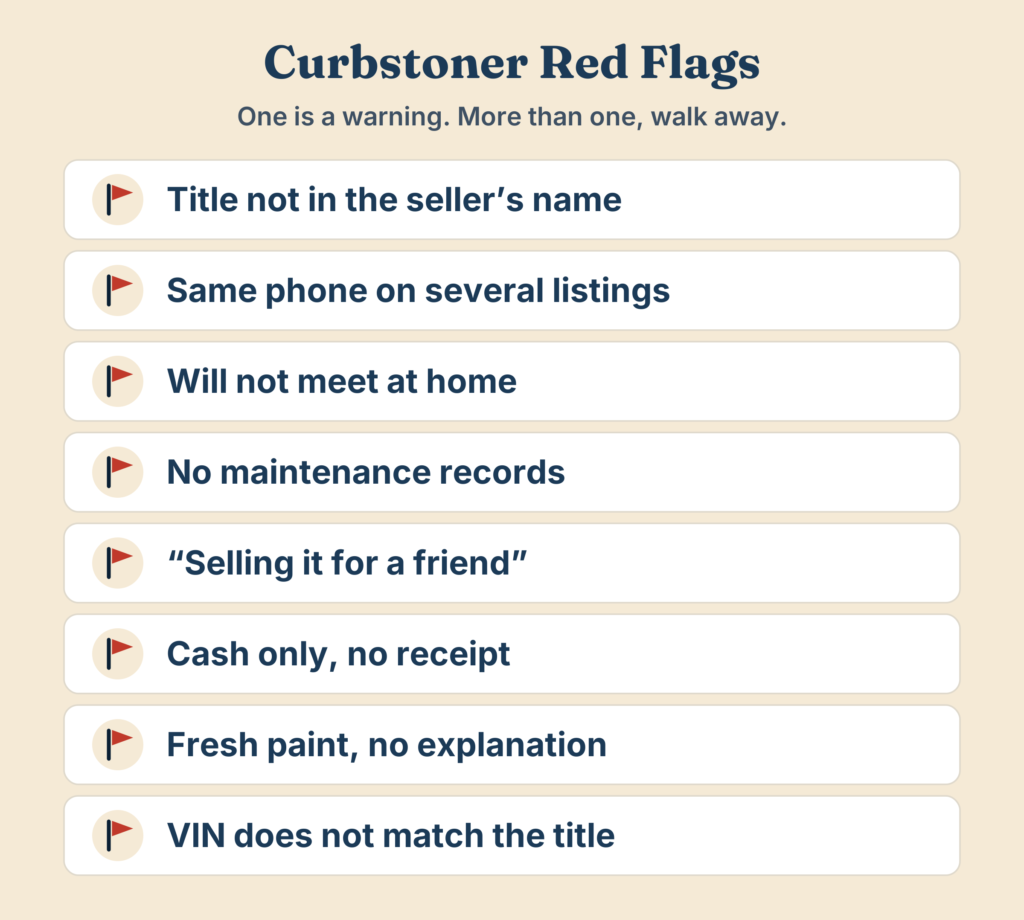
Listen to how the seller explains the car. Vague answers about previous ownership (“I bought it from a guy”), inability to produce maintenance records on a vehicle they claim to have driven for years, and generic statements about condition are characteristic. A seller who says the car is being sold “for a friend” or “for a relative” is showing another sign on the Minnesota Attorney General’s list.
Payment demands matter too. A seller who insists on cash and gives no receipt leaves the buyer with no record of the sale, and a seller who asks for a wire transfer or gift cards is asking for the payment methods the Federal Trade Commission flags as the mark of a vehicle scam. A cashier’s check from the buyer’s own bank leaves a record.
The vehicle itself often gives clues. Recently repainted panels with no clear explanation from the seller, mismatched body panel gaps, water lines under the dash or in the spare tire well, and VIN inconsistencies between the dashboard plate and the title document all suggest a car that came through a salvage channel rather than a personal driveway. Curbstoners advertise on free online classified sites as well as at the curb, so learning to recognize fake online listings that often come from curbstoners is part of the same defense before any private-seller meeting.
How to Verify Before You Pay
The first verification is documentary. Ask to see the title before any other discussion. Match the name on the title to the seller’s photo ID. If the names do not match, the conversation ends.
Some curbstoners hand over a signed but blank title, claiming the previous owner already signed off and that the buyer can fill in their own name at the DMV. This is title jumping again, and it can make it hard for the buyer to get the car titled and registered. Insist on a title in the current seller’s own name, properly assigned to the buyer at the time of sale, or on a transfer completed through the lender or the state where one of them holds the title.
Cross-check the seller’s phone number. A search on Google often returns other current or recent vehicle listings. If a “private seller” has posted two or three different cars in the past few months, treat the listing as a warning sign, however the current car is described. The same logic applies to email addresses and social media accounts that recur across listings.
Ask the seller for their home address before scheduling the meeting. Many honest private sellers will give it. One who is simply wary of strangers at the door may offer a bank lobby or a police department’s safe exchange zone instead, a fair alternative. Meeting away from home is still on the warning lists, so weigh it with the other signs, above all when the place offered is a gas station or a shopping center lot. A quick map check on any address the seller gives catches a parking lot or a vacant property before the meeting.
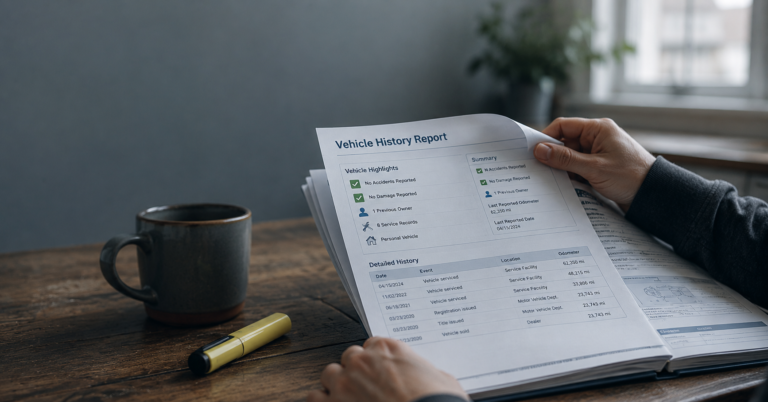
Run a vehicle history report from an NMVTIS-approved provider for about $10. The report shows previous states of titling, total-loss flags, and brand history, and our guide on how to read a vehicle history report shows what to look for. A car that was branded or declared a total loss in one state and retitled in another within months deserves hard questions.
That pattern is how title washing works: a branded car is moved to another state to come out with a clean title. There are more red flags to watch for in any private sale, and our complete fraud prevention playbook covers the full pre-purchase verification sequence.
What to Do If You Already Bought from One
If a buyer already completed the transaction and discovers the seller was a curbstoner, options exist but the timeline matters. State consumer protection statutes can apply even when the seller was operating illegally. In Florida, for example, § 320.27 makes selling a car in violation of the dealer licensing requirements an unfair and deceptive trade practice in itself. Document everything immediately: the listing, all communications with the seller, the bill of sale, the title, the seller’s phone number, and any photos taken at the meeting.
Report the seller to the state agency that licenses dealers, often the DMV or its equivalent, and to the state attorney general’s consumer protection office. Texas, for example, fines unlicensed curbstoners between $1,000 and $4,000 per vehicle depending on the circumstances of the violation, per the Texas DMV Motor Vehicle Disciplinary Matrix. The complaint may not return the buyer’s money directly, but it builds the case file that supports civil remedies and discourages the operator from continuing.
Civil action is the buyer’s clearest path to recovery if the curbstoner can be identified and located. Where the seller tampered with the odometer or gave a false mileage statement with intent to defraud, federal law adds a civil remedy of its own: three times the actual damages or $10,000, whichever is greater. Our odometer fraud guide covers that claim. An attorney specializing in consumer protection can advise on which claims apply.
The Bottom Line
The biggest defense against curbstoners is refusing to proceed when the seller cannot show that the car is titled in their own name. That single check tests the sign that Minnesota, Maryland and Wisconsin all warn about. Add a phone number search, a meeting place the seller can account for, and a vehicle history report, and a curbstoner has little left to hide behind. None of these steps cost more than the vehicle history report, and skipping them is the difference between buying a problem car you cannot return and walking away clean.