
California CARS Act Takes Effect With a Three-Day Right to Return a Used Car
Every fact, figure and legal citation in this article was checked against its original source before publication. Editorial Standards
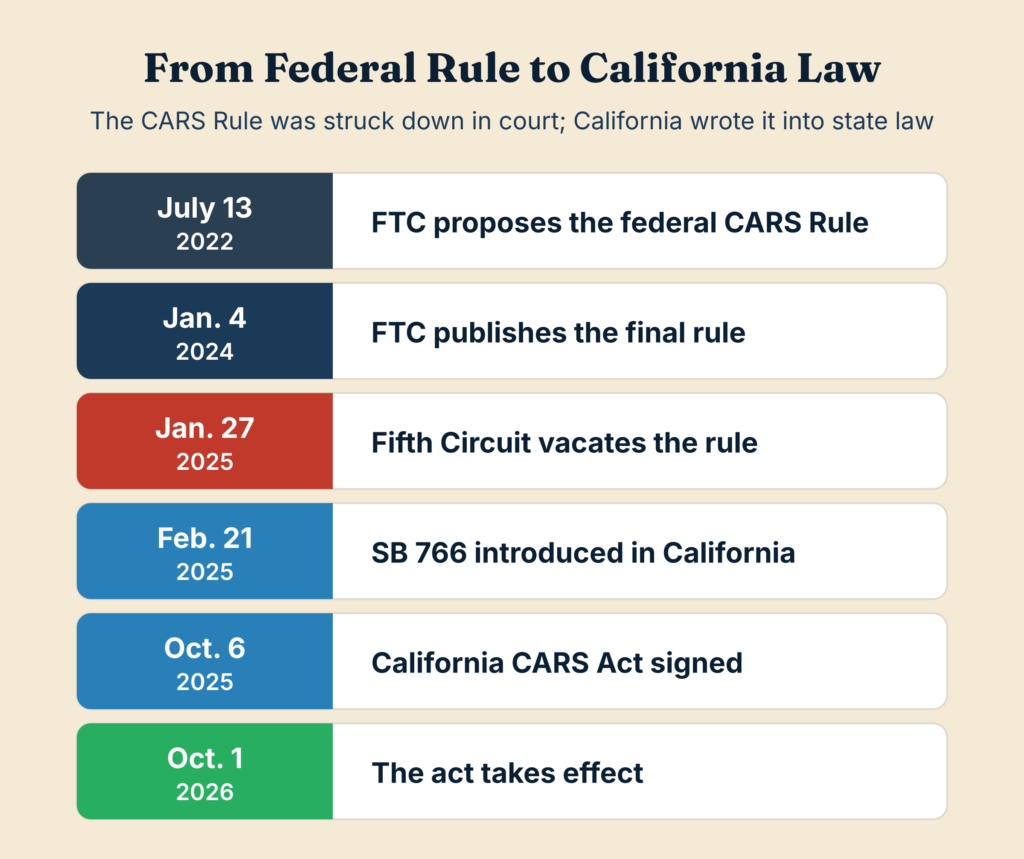
Since October 1, 2026, a California dealer must take back a used car priced at $50,000 or less within three days of the sale if the buyer asks, and refund the money within 48 hours. The rule comes from the California CARS Act, Senate Bill 766, which the Legislature passed in September 2025 and Governor Gavin Newsom signed on October 6, 2025, according to the Department of Motor Vehicles. It puts into state law the substance of a federal dealer rule that a court threw out before it ever applied, and adds a return right the federal rule never had.
The Federal Trade Commission’s Combating Auto Retail Scams Rule was published on January 4, 2024 and was due to take effect on July 30 of that year. Two dealer associations sued, and on January 27, 2025 the Fifth Circuit Court of Appeals vacated the rule by two votes to one, finding that the agency had skipped a required advance notice of its rulemaking. Senator Benjamin Allen introduced SB 766 twenty-five days later.
What the law requires of a dealer
The California CARS Act, Civil Code sections 1784.20 to 1784.44, applies to licensed dealers selling or leasing light vehicles to consumers. The DMV’s summary for buyers lists the main duties.
Any advertisement that names a specific vehicle, and the dealer’s first written reply to a shopper, must state the total price, with only taxes, registration and similar fees, finance charges and the dealer’s document fee left out. Every add-on must be disclosed in writing as optional. A dealer may not charge for an add-on the buyer cannot benefit from, and the statute names examples: nitrogen tire fills below 95 percent purity, a service contract that is void because the car already had crash or flood damage, an oil change on an electric vehicle.
The part most buyers will feel is the three-day right to cancel in section 1784.43. It covers a used vehicle sold or leased for $50,000 or less, driven no more than 400 miles since signing. The three days are calendar days, starting the day after signing; if the third day falls on a day the dealership is closed, the deadline moves to the next open day.
The dealer may charge a restocking fee of 1.5 percent of the price, no less than $200 and no more than $600, plus one dollar per mile over 250 miles up to $150. The refund, less that fee, is due within 48 hours of cancellation. Motorcycles, auction sales, fleet purchases and a lessee buying the car they already lease are outside the right.
The act repeals the arrangement it replaces. Until September 30, 2026, Vehicle Code section 11713.21 let a dealer sell a two-day cancellation option on used cars under $40,000, for an up-front fee of $75 to one percent of the price. The new right costs nothing unless it is exercised.
Under the California CARS Act, dealers must give a separate written notice headed “3-Day Right to Cancel Used Car Purchase or Lease”, and the first page of every contract must state in capitals that California has no cooling-off period for new vehicles. The DMV’s September 2026 bulletin to dealers says violations may be enforced under the Unfair Competition Law, with a civil penalty of up to $2,500 per violation, and lists license suspension or revocation among the department’s own penalties.
Why this matters for buyers
California’s Vehicle Code already regulated dealer advertising in detail (sections 11713.1 and 11713.16 stay in place), so the pricing rules change less than the headlines suggest. The return right is the real shift. Until this month, a California buyer who found a problem on the drive home had no right to return the car unless they had paid for the option.
Now the window exists in every retail used car deal under the price cap, and the buyer’s job is to use the three days: an independent inspection, a check of the title and the NMVTIS report the dealer must have obtained and hands over on request, a second look at the add-ons. Our California guide sets out the deadlines and the complaint routes, and our explainer on what an as-is sale means covers what the return right does not change: the car is still sold without a warranty unless the dealer gives one in writing.
The Senator’s October 7, 2025 release, citing the economists who analyzed the federal rule, put the savings for California buyers at $234 million a year, beside $3.4 billion a year for the federal rule. Both are projections. The vote was not close: the Assembly passed the bill 76 to 1 and the Senate 30 to 8 on its final vote, according to the Legislature’s bill record.
What happens next
The federal rule has not come back. The Fifth Circuit struck it on procedure, not on substance, and the Senator’s release said in October 2025 that the commission had not reissued it. The federal rule would have covered every state; the California CARS Act covers sales by California dealers. Enforcement actions under it, when announced, go in our news section.
In California the next months are about enforcement. Dealers must keep their advertisements, disclosures and cancellation notices for two years, a paper trail for the DMV’s investigators. Complaints go to the DMV’s complaint page, linked in our California guide, and the act says its remedies add to any other remedy under other law; the DMV’s bulletin names the Consumers Legal Remedies Act among them.
Two state pages had not caught up when we checked on October 15, 2026: the Attorney General’s car buying page still described the old two-day option, and the DMV’s dealer bulletin calls the deadline “three business days” where the statute says three calendar days. The code wins; a buyer should count calendar days. The fraud prevention playbook has the checks that fit inside the window, and the questions to ask the seller belong before signing.
Discuss this article on r/VINvestigators. Got a listing that looks off, or a report that does not add up? Post it. Over 1,500 members, buyers and trade among them.
New guides and fraud alerts by email, a few times a month, no more. Subscribe on the home page.
Checking a specific car? Get the full vehicle history report from carVertical, an NMVTIS-approved provider, 20% off through our link. The link applies the discount automatically; if you go to carVertical later, the code VINVEST gives the same 20%. We earn a commission from carVertical if you buy; it costs you nothing extra.
