How to Check If a Car Title Is Real Before You Buy
Every fact, figure and legal citation in this article was checked against its original source before publication by Artūras Andriušaitis, founder and editor. Editorial Standards
A car title is a piece of paper, and paper can be faked. A Houston family paid $7,000 for a Toyota Camry and showed the police a title when the car’s real owner came for it four days later; the car was a rental, and the title was forged, KPRC 2 reported in July 2026 (KPRC 2). This guide is how to check if a car title is real using the four things a forger cannot change: the VIN on the car, the seller’s own identity, the state’s title record and the federal records behind it.
Read the title against the car and the seller
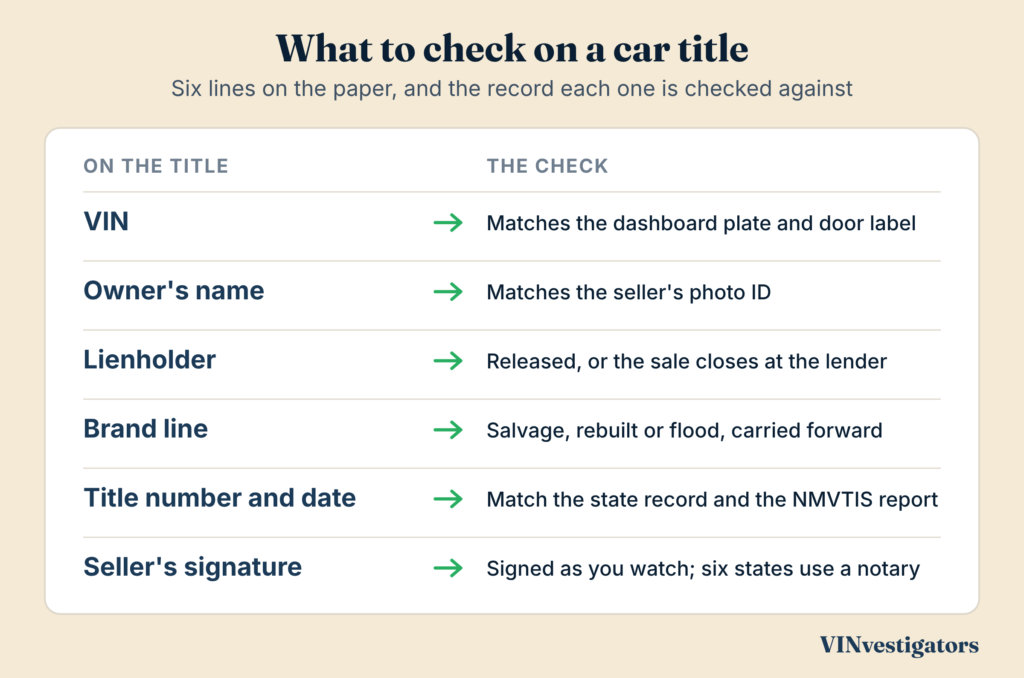
Start with the VIN. The 17 characters on the title have to match the plate at the base of the windshield and the certification label in the driver’s door area, which federal rules require to state the VIN (49 CFR 567.4). A title whose VIN matches the dashboard plate but not the door label is a car to walk away from. A cloned VIN, copied from a legally owned car of the same make and model, reads like the real car’s in every database, so comparing the car’s own plates with each other and with the title is the one check no record does for you, and a car that turns out to be cloned is never legally yours (NICB).
Then the name. The owner printed on the title is the person who signs it over, and in a private sale that is the person in front of you, photo ID in the same name, as Harris County advised after the Camry sale. Someone else may sign only when a paper gives them the right, a licensed dealer, an executor or a holder of a power of attorney, and then that paper is what you read. A title already signed by an owner who is not the seller is an open title, the mark of title jumping, and a seller who “is selling it for a friend” is asking you to buy from someone you have never met.
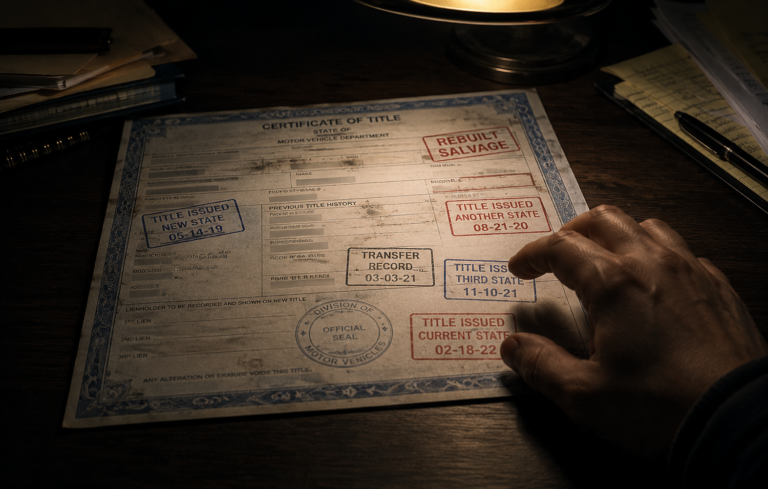
Read the rest of the page. A lienholder named on the title means a lender still has a claim, and the loan is paid off before the title can be signed over. A brand printed on the title, such as salvage, rebuilt or flood, is a fact about the car’s past that the next title is supposed to carry forward, and a brand that has gone missing is what title washing produces. And compare the title number and the issue date with what the state’s record says, which is the next check.
Check the state’s own title record
A seller can fake the paper in an afternoon, not the state’s record, though a record can lag or carry an error, which is why the federal records come next. Reading it is the part of how to check if a car title is real that buyers skip. Our dealer license lookup and car title check by state names each state’s check. Seven states let anyone read the title record online, Arizona, Florida, Louisiana, Massachusetts, Nebraska, New York and Ohio, each showing some of the issue date, liens, brands, odometer or validity. Three more show liens only, five only whether an application has been processed, and in the rest we found no free check, or none we could confirm.
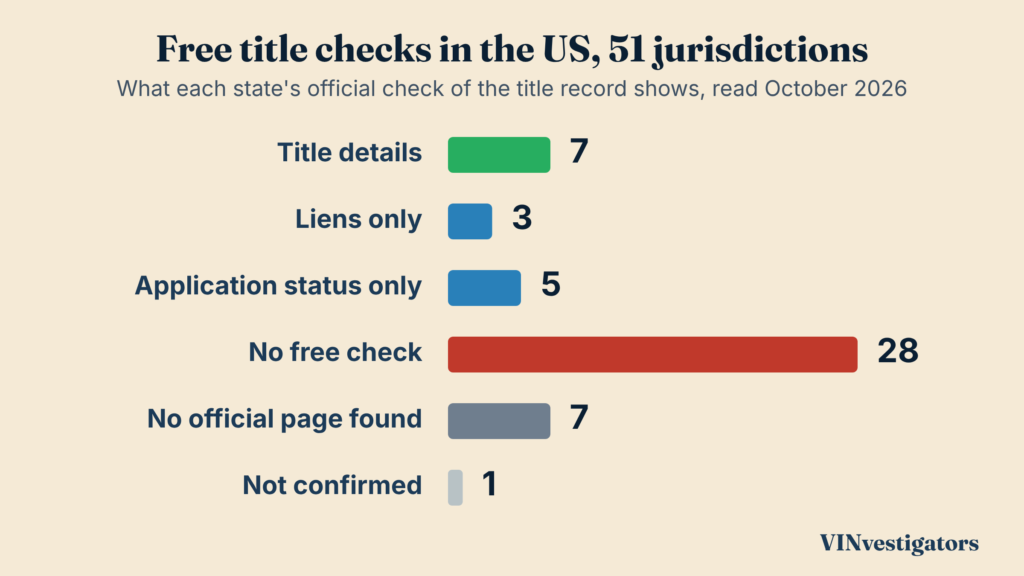
Where the state offers a check, run it before you meet the seller, with the VIN from the listing (Louisiana’s also needs the title number and date, so that one waits for the seller’s paper). A title number or an issue date that does not match the paper in the seller’s hand is the end of the conversation.
Where the state offers nothing, the police say the same thing. In a case handled by police in Corona, California, after a buyer paid $23,000 for a rented car whose DMV paperwork looked right when read over at a bank, and which police say the seller had forged, the police department’s advice was to verify vehicle documentation with the DMV before completing any transaction (Corona Police Department). A DMV office can read its own record while you stand there.
Check the federal records too
The federal records are the third part of how to check if a car title is real. NMVTIS is the Justice Department’s title system, fed by every state’s titling agency, and a consumer report from it costs about $10, depending on the provider, from one of the approved providers on the Justice Department’s list. The report shows the current state of title and the last title date, the brands any state has applied, the latest odometer reading in the title record and any total loss or salvage history. If the paper says the car was titled in Texas in 2024 and the report says the current title is in Arizona from 2025, the paper has some explaining to do.
Theft is the other record. Run the VIN through NICB VINCheck, which lists vehicles reported stolen and not recovered, or reported as salvage or flood damaged, by participating insurers, and then through a free VIN check, which confirms that the VIN decodes to the year, make and model on the title.
A young man of 18 in Orange County, California, bought a car on Facebook Marketplace for $4,500, had the title, registered the car with the DMV without a problem, and in January 2024 was ordered face down at gunpoint outside his parents’ house when officers told him it had been reported stolen (CBS News). The same report showed a consumer advocate how AI can make a fake car title. The paper and even the registration went through; the theft record is the one check that looks past the paper.
Sign where the state records the transfer
A title that a seller cannot put on the table is a sale that closes somewhere else. In most states a lender holds the title as an electronic record while the loan is open, and the sale then closes at the lender or through an escrow service, after the payoff. In Arizona, Florida, Indiana, Ohio, Oklahoma and Virginia an owner with no loan can hold an electronic title too, a record in the state’s system, not a printout. Never pay on a promise that the title will follow.
In Kentucky, Louisiana, North Carolina, Ohio, Oklahoma and Wyoming the seller signs the title before a notary (in Louisiana two witnesses or an officer of the buyer’s bank will also do), and in Pennsylvania both parties sign at an authorized agent. Elsewhere the state sets no place, as far as we could find, and several agencies recommend meeting at a licensing office, where the transfer is recorded while you are both there; in Texas that is a tax office, which Harris County advised after the Camry sale. Our state page has the rule for every state, and the State Guides map leads to the rest of each state’s rules on dealers, warranties and complaints.
The fake title is one of the car scams to look out for this year; our used car scam log holds seven official warnings and cases about forged, fake or washed titles between January and September 2026.
The rest of this year’s cases, by scam type, are in our Scams & Fraud section.
The Bottom Line
How to check if a car title is real comes down to one rule: the paper is the claim, and the records are the proof. Match the VIN on the title to the dashboard and the door label, and the name on the title to the seller’s ID. Read the state’s title record where it is public, and the NMVTIS report and NICB VINCheck everywhere. Then sign where the state records the transfer, and pay nothing before you do.