5 Physical Signs of an Odometer Rollback
Every fact, figure and legal citation in this article was checked against its original source before publication. Editorial Standards
Nobody counts odometer rollbacks as they happen: the only federal estimate dates from 2002, and our statistics page lists the crime under what nobody counts. What has changed is the method. A digital odometer rollback takes a hand-held tool and a few seconds, and leaves nothing on the dashboard to see.
In 2026 a newer variant got attention: mileage blockers, small devices wired into the car’s electronics that interrupt the signals the mileage counter relies on, so the miles are never recorded while the device is active. The car still drives, still wears, still ages, but the digital record stays frozen, and the sellers market the devices as undetectable for that reason. Selling, installing or using one is already prohibited by federal law, 49 U.S.C. § 32703.
That shift makes physical inspection more valuable, not less. The odometer lies but the car does not. Pedals wear at a rate set by the driver’s foot. Steering wheels age with the oils on the driver’s hands. Seat bolsters fray from the friction of getting in and out. Tires carry the date they were made. None are visible to an OBD-II tool, and none respond to a software command. The five physical signs of an odometer rollback below take about three minutes during a test drive and cost nothing, the cheapest check in our scams and fraud coverage. Cross-referenced against the vehicle history report and displayed mileage, they expose what the dashboard hides before money changes hands.
The Wear Pattern Test (Pedals, Steering Wheel, and Seat)
The first three signs are surface wear on the parts of the car that the driver actually touches. They are diagnostic because wear accumulates with miles, and a low-mileage car cannot fake fresh-looking touch points without physical replacement, which itself leaves evidence.
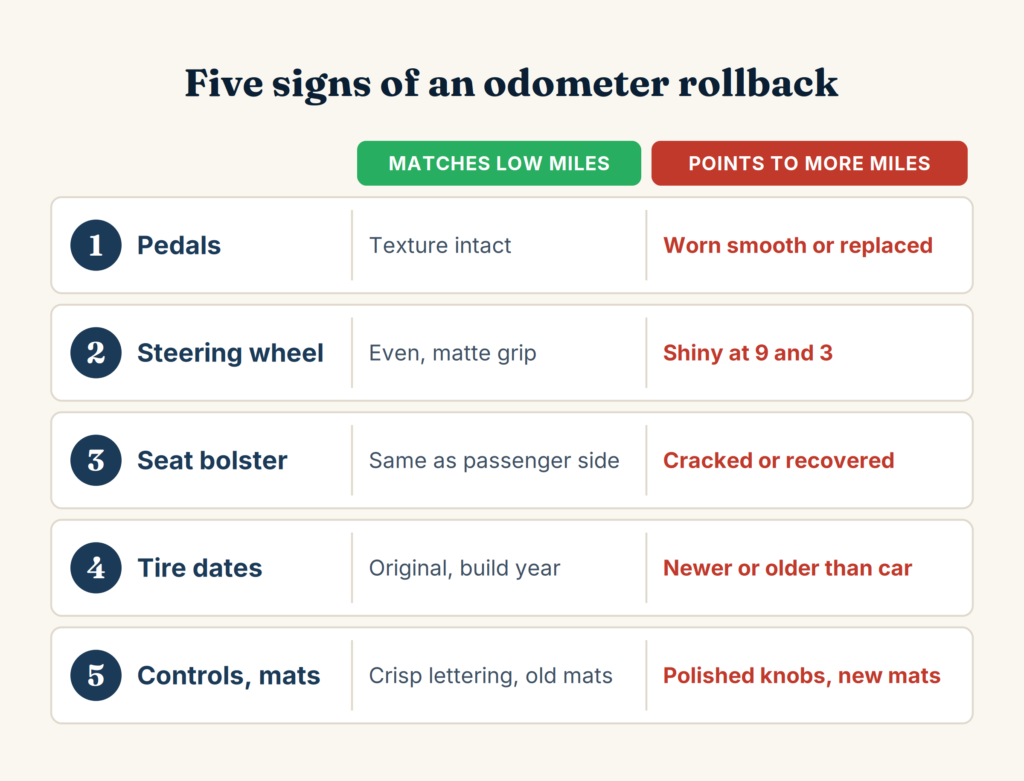
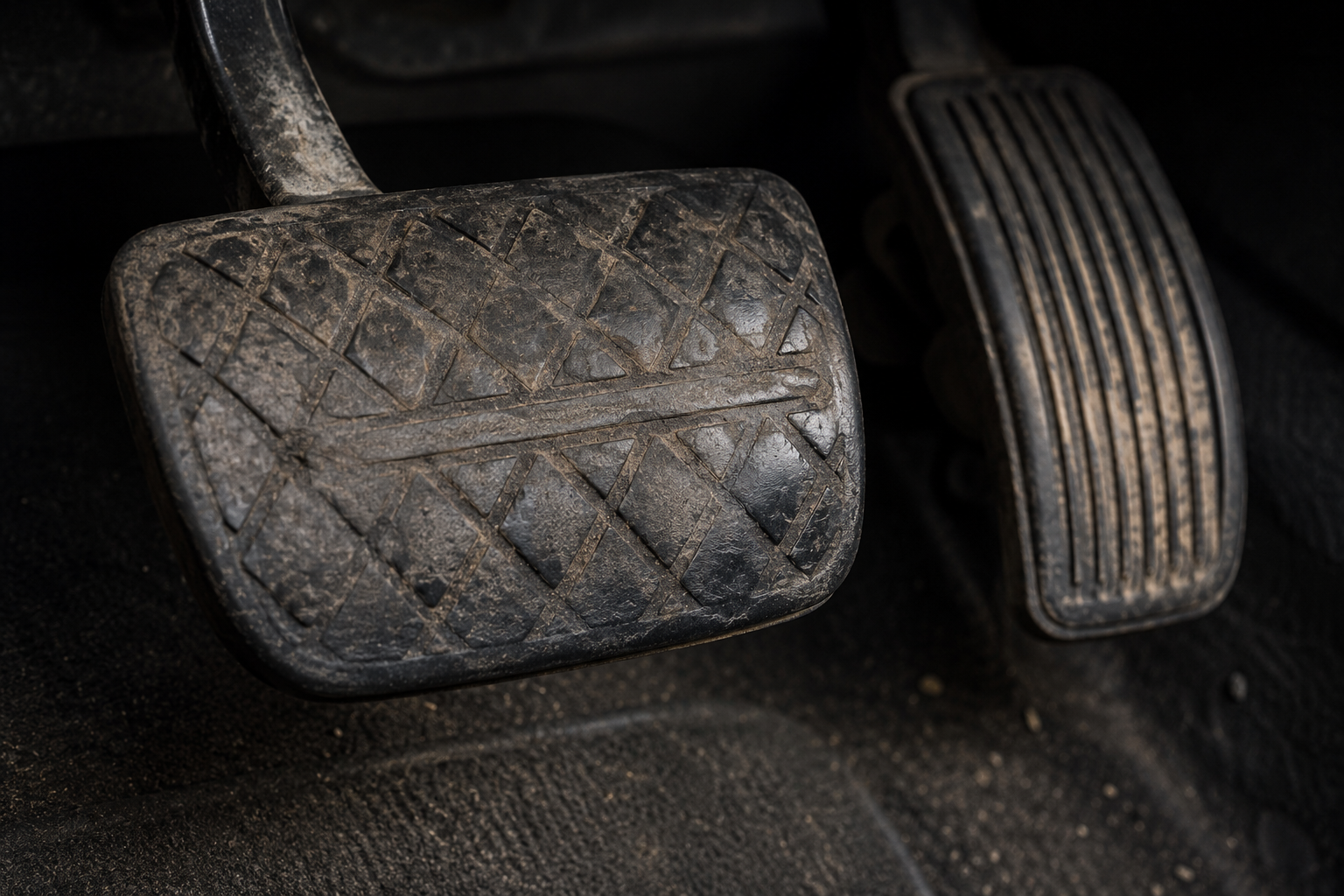
The first check is the brake pedal rubber and the gas pedal. NHTSA explicitly recommends examining pedal wear to verify it matches the displayed mileage. New pedal rubber on a car displaying 30,000 miles is consistent with the mileage. Pedal rubber that is worn smooth, with the textured pattern flattened or rubbed off entirely, suggests significantly more use. Replaced pedal rubber is a flag in itself, because pedal pads almost never need replacement at low mileage. A buyer who notices new-looking pedal rubber on an older car should ask why.
The second check is the steering wheel grip. Hands deposit oils on the wheel at the 9 and 3 positions where drivers hold it, and over tens of thousands of miles those positions develop visible shine, smoothing of the grip texture, or in leather-wrapped wheels, cracks and flaking on the exact spots where hands rest. A car displaying 25,000 miles should have a steering wheel that still looks essentially new. A wheel with worn shine on the grip zones, on a car claiming low mileage, indicates more time at the wheel than the dashboard suggests.
The third check is the driver’s seat bolster, the side cushion the driver slides across when entering and exiting the car. Seat bolsters wear faster than other seat surfaces because the driver pushes off them during every entry and exit. Cracking, fading, or fabric wear on the driver’s-side bolster, paired with a passenger-side bolster that looks new, indicates a high-use driver’s seat regardless of the mileage shown on the dash. Reupholstered or recovered seats are themselves a flag; new upholstery on an otherwise original interior raises the same question pedals and steering wheels do.
The Tire Age Test
Tire age is the cross-check most buyers do not know to use, and it is one of the harder signs for a fraudster to defeat. Every tire sold in the United States carries a DOT date code molded into the sidewall in a four-digit format. The first two digits indicate the week of manufacture, the last two indicate the year. A code reading “1422” means the tire was made in the 14th week of 2022. The full DOT identification number is required on one sidewall only (49 CFR 574.5), so if the code is not visible on the side facing the buyer, check the inside sidewall.
The math is straightforward. NHTSA’s consumer guidance specifically notes that a vehicle displaying 20,000 miles or fewer should still have its original tires, and original tires carry a date code from the year of build or shortly before. Replacement tires on a car claiming 20,000 miles mean the originals were worn out, damaged or swapped, and the buyer should ask which. Date codes older than the car itself mean the tires came from somewhere else. Original tires worn down to the wear bars on a car claiming 20,000 miles are the simplest tell of all: tread goes with miles, not with years.
The test is not bulletproof. A genuinely garaged low-mileage vehicle can have older original tires from age rather than wear, and a curbstoner can fit fresh tires to mask a high-mileage car, which then fails the first test instead. But pairing tire age against the odometer reading is one of the cleanest sanity checks available for free. A 10-year-old vehicle still on its original tires at 30,000 miles is unusual and warrants questions.
The Cover-up Test
The fifth sign is a cluster of high-touch wear points and the cover-up tactics fraudsters use to hide them. Buttons, knobs, dials, and the gear shift knob all wear with use. Radio buttons lose their lettering. Climate dials develop shine in the rotation arc where the driver’s fingers rest. Gear shift knobs polish smooth on the side where the hand grasps. A car claiming low mileage should show none of this on its primary controls.
Cover-up tactics deserve as much attention as the wear itself. Brand-new floor mats on a used car often indicate that the original mats were so worn the seller swapped them out before listing. Lift the floor mats and check the carpet underneath. Worn carpet hidden under fresh mats, on a car displaying low mileage, is a clear signal. The same logic applies to a steering wheel cover (which conceals worn grip) and to seat covers (which conceal bolster wear). A replacement gear shift knob, when the original would still have been serviceable, is another flag. Shift knobs are not consumables; replacing one suggests the original wore through.
The overall principle is that fraudsters can replace components, but every replacement is itself a signal because the component should not have needed replacement at the displayed mileage. The presence of new replacement parts on a “low-mileage” car is the cover-up giving itself away. The NICB’s vehicle-buying guidance sends flood-car shoppers to the same places for the same reason: under the carpets and floor mats, where the evidence a seller cleaned up on the surface tends to survive.
How the Signs Work Together
No single sign is conclusive on its own. A worn steering wheel can come from a previous owner with calloused hands. A seat bolster can split because of poor leather. A new floor mat could replace one ruined by a coffee spill. The diagnostic value comes from the pattern. A car at 28,000 miles with worn pedal rubber, a shiny steering wheel grip, a frayed driver’s-side bolster, and tires from five years ago is not displaying its actual mileage. Two signs warrant questions. Three or more signs, paired with documented mileage discrepancies, make a rollback the likeliest explanation.
The next step after a physical inspection is data cross-reference. Pull a vehicle history report from an NMVTIS-approved provider and look for the mileage discontinuities that signal an odometer rollback. We cover how to spot mileage jumps in a vehicle history report in detail in a separate piece. Beyond that, how odometer fraud works and why digital odometers are not tamper-proof explains the mechanics that make these inspection signs the buyer’s most reliable tool. For high-value purchases, a professional inspection adds the one check a buyer cannot do alone: what a professional mechanic checks during a pre-purchase inspection includes the mileage stored in the car’s other control modules, which a rollback tool may leave untouched.
The arrival of mileage blockers makes this layered approach more important. If the sellers’ claims hold, a blocker leaves every module showing the same frozen mileage, so the cross-module check returns clean on a blocker-equipped car. Physical wear is the only signal left. The seat does not lie.
The Bottom Line
The five physical signs cost nothing to check and take three minutes during a test drive. Pedal wear, steering wheel grip, driver’s seat bolster, tire DOT date codes, and high-touch controls and cover-up tactics together make a fraud filter the dashboard cannot pass, because wear cannot be reset. Pair the physical inspection with a vehicle history report and a professional pre-purchase inspection on vehicles over ten thousand dollars, then run the rest of our fraud prevention playbook before signing. The car tells the truth if the buyer knows where to look.
Discuss this article on r/VINvestigators. Got a listing that looks off, or a report that does not add up? Post it. Over 1,500 members, buyers and trade among them.
New guides and fraud alerts by email, a few times a month, no more. Subscribe on the home page.
Checking a specific car? Get the full vehicle history report from carVertical, an NMVTIS-approved provider, 20% off through our link. The link applies the discount automatically; if you go to carVertical later, the code VINVEST gives the same 20%. We earn a commission from carVertical if you buy; it costs you nothing extra.