Car Scams to Look Out For When You Buy or Sell a Used Car
Every fact, figure and legal citation in this article was checked against its original source before publication by Artūras Andriušaitis, founder and editor. Editorial Standards
Before she paid for a 2019 Nissan Rogue at a used car dealership in 2023, a buyer in Orange County, Florida, ran a vehicle history report, and its VIN matched the plate on the dashboard. The plate was fraudulent. In December 2025 deputies found a second VIN on the SUV, then a third that matched a vehicle reported stolen in April 2019, and the car went back to the rental company it had been stolen from, WKMG News 6 reported in August 2026. The Sheriff’s Office now treats her as a fraud victim, and she is still paying off the loan.
Her case is one of 36 official warnings and case announcements about used car scams that we logged from January to September 2026, from the Justice Department, the FTC, NICB, attorneys general, motor vehicle agencies, sheriffs, police and prosecutors. This guide goes through the car scams to look out for in that record, how each one works and the checks that stop it, for buyers and for private sellers. Charges are allegations, and everyone charged is presumed innocent unless proven guilty. The status of each case is as we found it on 22 October 2026.
The car scams to look out for, by the numbers
Our used car scam log records every official warning about a used car scam and every enforcement action, from an arrest or charges to a plea, a sentence or a settlement, that we find in public announcements, one row for each with a link to its source. A news report counts when it carries an agency’s statement or reports a court record. The log counts what agencies announced and what we found, not how many scams happened: most victims never report, and one case can produce several announcements. The method and every row are on the log’s page, which we update each month.
From January to September 2026 the log holds 36 announcements, 14 warnings and 22 enforcement actions, from agencies in 18 states and the District of Columbia, plus two national warnings. Stolen cars and false papers made up the largest share: 9 announcements about cloned VINs, 7 about fake, forged or washed titles and 1 about a stolen car offered for sale, 17 in all. Dealers’ treatment of used car buyers came next with 5, then fake dealer websites, fake listings and scams on private sellers with 4 each, and odometer fraud and flood cars with 1 each.
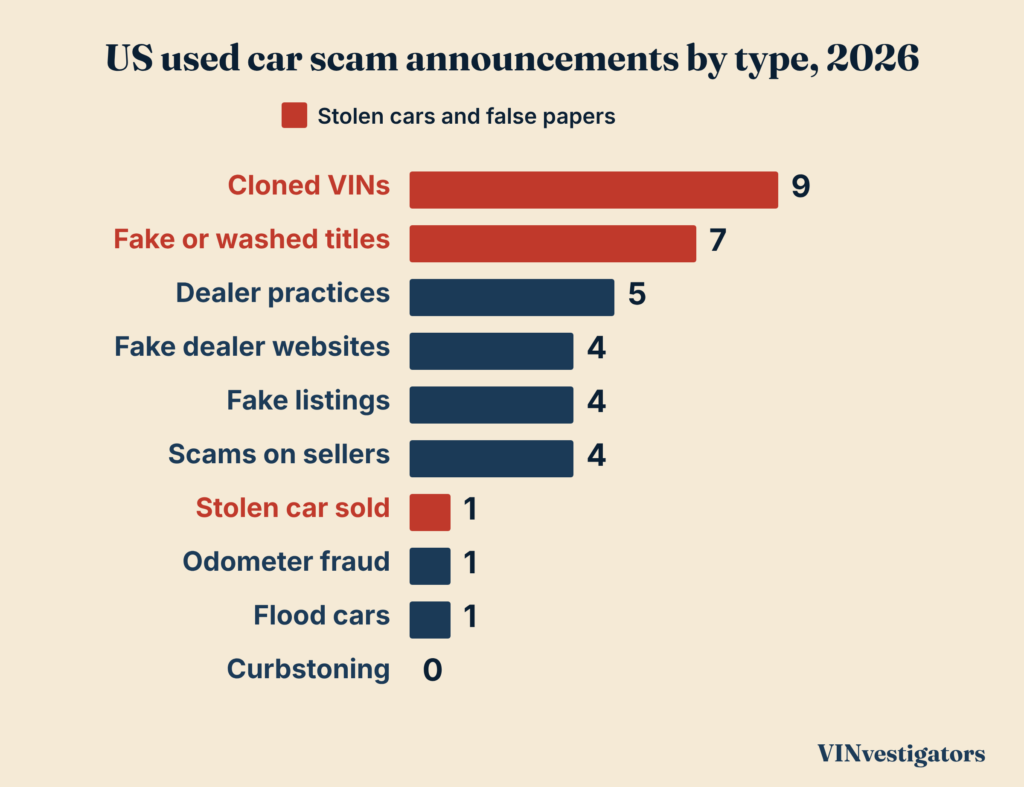
Facebook Marketplace is named in 13 of the 36 announcements, more often than any other platform, and Craigslist only once. Seventeen came from county and city agencies such as sheriffs, police departments and prosecutors, and 17 of the 36 reached us only through a local news report quoting the agency or a court record, because no release of the agency’s own could be found or read. By state, Pennsylvania had the most announcements, 5, then Texas with 4 and Washington with 3, and the log’s page shows them on a map.
Some older scams were quiet. The Justice Department, which published seven odometer announcements in 2025 by the count on our used car statistics page, published one in the first nine months of 2026, and we found no announcement about curbstoning at all. Both figures count what was caught and announced, not what happened.
Stolen cars sold with cloned VINs
VIN cloning gives a stolen car the identity of a legal one. The Minnesota State Patrol describes the method: the car is stolen, often in another state, given a VIN taken from a similar make, model and year, fitted with new VIN plates and sold with forged papers, often across state lines, which leaves “two vehicles out there with the same identity.” NICB, the insurance industry’s fraud bureau, states the buyer’s position plainly: the car “is never legally yours, even if you paid for it,” and it goes back to its owner or to the insurer that paid the theft claim (NICB).
The 2026 cases show the method at scale. In April, nine people in the Philadelphia area were charged over at least 50 stolen vehicles that, according to the criminal complaint and the police, were given inactive VINs and falsified out-of-state titles and sold at low prices to buyers who had no idea they were stolen (NBC10). In May, Pennsylvania’s Attorney General announced the capture of the man prosecutors identify as the ringleader of the crew, in what investigators called Operation Zombie VIN, with ten people charged (the Attorney General’s release).
In June, federal prosecutors in Manhattan charged 13 people over about 100 cars stolen in New York City. The indictment says the group covered the real VINs, swapped the federal certification labels for labels with fake numbers, made fraudulent titles and had the cars serviced to build false histories before selling them through a social media marketplace to unsuspecting buyers (the release). By 22 October 2026 we had found no later announcement in the Pennsylvania or the Manhattan case.
Smaller cases follow the same path. In August the Tom Green County Sheriff’s Office in Texas recovered two GMC pickups that had been stolen in the Dallas-Fort Worth area, given altered VINs and sold on Facebook Marketplace with counterfeit titles to buyers who traveled from San Angelo. Both trucks were seized and are expected to go to a court hearing on who owns them (KTXS). The sheriff’s warning signs are a vehicle listed in a small market that has to be collected in a big city, a price far below market, and a seller who will not finish the sale at a tax office or another government office.
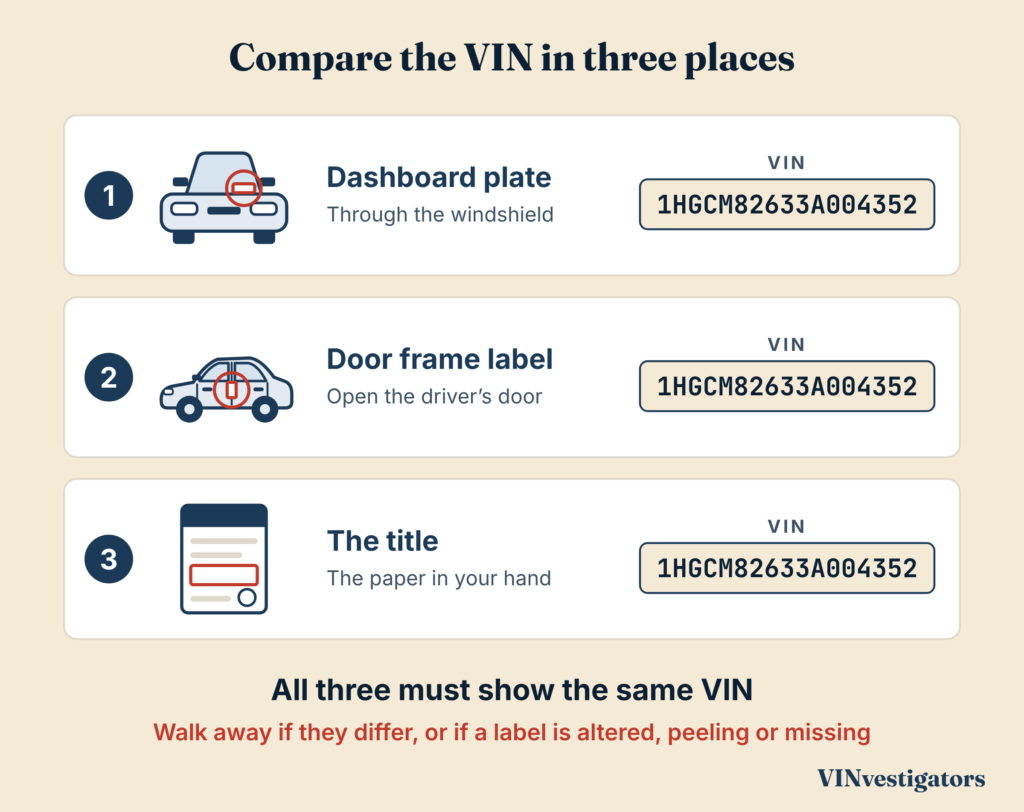
The first check is to compare the VINs before any money changes hands. The number on the dashboard plate should match the one on the federal certification label in the driver’s door frame and the one on the title, and altered, peeling or missing labels, scratches around the plate and unusual rivets are signs of tampering. NICB’s free VINCheck shows whether a participating insurer has reported a VIN stolen and not recovered, though it does not search police records.
A history report is looked up by the VIN you enter, so when the plate is a copy, the report describes the car the number belongs to. The Florida buyer’s report matched her dashboard plate and could not show that the plate was fraudulent. The Minnesota State Patrol suggests asking the local police to check a VIN, and the Orange County Sheriff’s Office tells buyers to photograph the seller and the seller’s driver’s license.
Fake and forged titles
A title is a piece of paper, and paper can be faked. In January the Jackson County Prosecutor in Missouri charged a Kansas City man with selling cars on Facebook Marketplace under an alias, handing each buyer what looked like a valid title and bill of sale, and then taking the cars back. Police had logged eight stolen vehicle reports with the same pattern in May and June 2025, with losses above $24,000 (the charges). He pleaded guilty to six counts of tampering and eight of forgery and was sentenced in April to four years in prison, FOX4 Kansas City reported from court records.
In July a Houston rental business owner found her Camry, rented out and never returned, in the driveway of a family that had bought it four days earlier for $7,000. It had been sold with a forged title, and a fake ID was involved. Harris County Constable Precinct 4 told KPRC 2 that fake titles are more common than people realize, and Harris County’s advice to buyers is to match the seller’s ID to the title and complete the sale at a tax office (KPRC 2).
Forged papers can also wash a brand off a title. A Salt Lake City dealer faces 15 Wyoming felony counts of altering, forging or counterfeiting title documents. Investigators allege that he bought hail-damaged cars that insurers had written off as total losses, many through online salvage auctions, and obtained duplicate Wyoming titles without the salvage brands, using forged signatures, counterfeit notary seals and, in one case, the name of a woman who had died before the storm. The cars were then sold to buyers in Utah with unbranded titles, the affidavit says. In August a judge sent the case to district court, where no plea had been entered by then (Cowboy State Daily), and we found no later report.
The same thing can happen inside the titling system. In March, Pennsylvania’s Attorney General charged an authorized tag agent in Philadelphia with submitting falsified paperwork for 65 stolen vehicles, a case we cover in the tag agent charged with washing 65 stolen luxury cars. The agent is presumed innocent, and the office’s release says many of those cars went to buyers who knew they were stolen.
The defense is to let the state’s record check the paper. The name on the title should match the seller’s government ID, the VIN on the title should match the car, and the title should be in hand at the sale, not promised by mail. An NMVTIS report, usually about $10 from a provider on the Justice Department’s list, shows the current state of title and the last title date.
Tennessee’s Department of Commerce and Insurance notes that a seller who claims an out-of-state title when the report shows a Tennessee title or no history is probably holding a fake. Harris County and Tom Green County both tell buyers to finish the deal at the county tax office, and the Tom Green sheriff calls a seller who refuses a “major warning sign.”
Fake dealer websites and cars that do not exist
On 1 September 2026 the FTC warned that scammers are cloning real dealership websites, “often using AI,” down to the logos, listings and photos, some with fake customer testimonials and some using rare muscle cars or hard-to-find classics as bait. Buyers pay up front for a car they never get and arrive at the dealership to find no record of the order (the FTC alert). Tennessee’s Attorney General had warned in March about sites posing as classic car and heavy equipment dealers, run by people who answer the phone, send videos and produce fake business licenses, and noted that scammers sometimes copy the names or addresses of defunct businesses (the warning).
Local police saw the same thing. In February, police in Boerne, Texas, investigated a site listing more than 40 high-end cars at $44,000 to $104,000 under the address of a shuttered Boerne dealership, after buyers from out of town lost nearly $40,000 (Boerne Star). In March, police in Veazie, Maine, warned that Casco Bay Classic Cars, which listed a 1969 Camaro RS for $37,900 at the address of a private warehouse, had no cars and no dealer license. An AI detection site rated its photos 98 percent likely to be AI-generated (Bangor Daily News).
In Bucks County, Pennsylvania, a buyer wired $34,000 for a 1969 Camaro that police say may not exist. Lower Southampton police have an arrest warrant for a suspect who, they say, registered shell companies in the United States, used fake websites and AI-generated images, and then ran the sale from abroad (6abc). A real address is no guarantee either: in June a Philadelphia used car salesman was sentenced to 41 months for taking more than $2.5 million from over 100 customers for wheelchair-accessible vehicles he never delivered, once selling the same van to 16 buyers (the sentencing).
The FTC’s advice comes down to checking the dealer, not the website: search the dealer’s name with words like “scam,” “review” or “complaint,” see the car and the dealership in person or have a mobile inspection service check a distant car, and walk away from a dealer who takes payment only by wire. Boerne police add one more step: look up the dealer’s phone number yourself instead of using the one the seller gives. Tennessee’s office suggests confirming the business in the Secretary of State’s records and paying by check or credit card where possible. Our dealer license lookup for every state gives the official record to check in each state.
The oil in the engine scam and other traps for sellers
Most car scams to look out for are aimed at the buyer, but some target the seller. California’s San Luis Obispo County Sheriff’s Office described the oil in the engine scam in March 2025: a “buyer” who answers a Facebook Marketplace or Craigslist ad arrives for a test drive, often with two or three others posing as friends or mechanics, one distracts the seller while another secretly pours oil on the engine, the engine smokes on the test drive, and the “buyer” offers a very low price for a car that now seems damaged (the warning). Its detectives later counted more than 20 reported incidents between November 2024 and March 2025, with about $60,000 lost (the arrests).
In 2026 the arrests came further north. In April the Grays Harbor County Sheriff’s Office in Washington reported three arrests and the seizure of $57,000 in cash and more than 20 car titles (KIRO 7). In May, Placer County deputies in California arrested three men on suspicion of attempted theft by false pretenses, attempted elder fraud, vandalism and conspiracy, in a crew the Sheriff’s Office says worked in eight counties, often targeted elderly sellers and resold the cars at full value (KTVN 2News).
That resale makes a second victim. FOX40 reported in September that the three Placer County men had pleaded guilty and that the Sheriff’s Office had returned $12,000 to a family who bought one of the crew’s cars, which was seized (FOX40). We found no announcement of the pleas from the Sheriff’s Office or the district attorney. In Washington, detectives told KIRO 7 they had identified at least 26 victims in the region, with cars listed at $10,000 sold for as little as $500, and the station reported that buyers of such cars become victims too, because a car obtained by fraud is treated as stolen (KIRO 7).
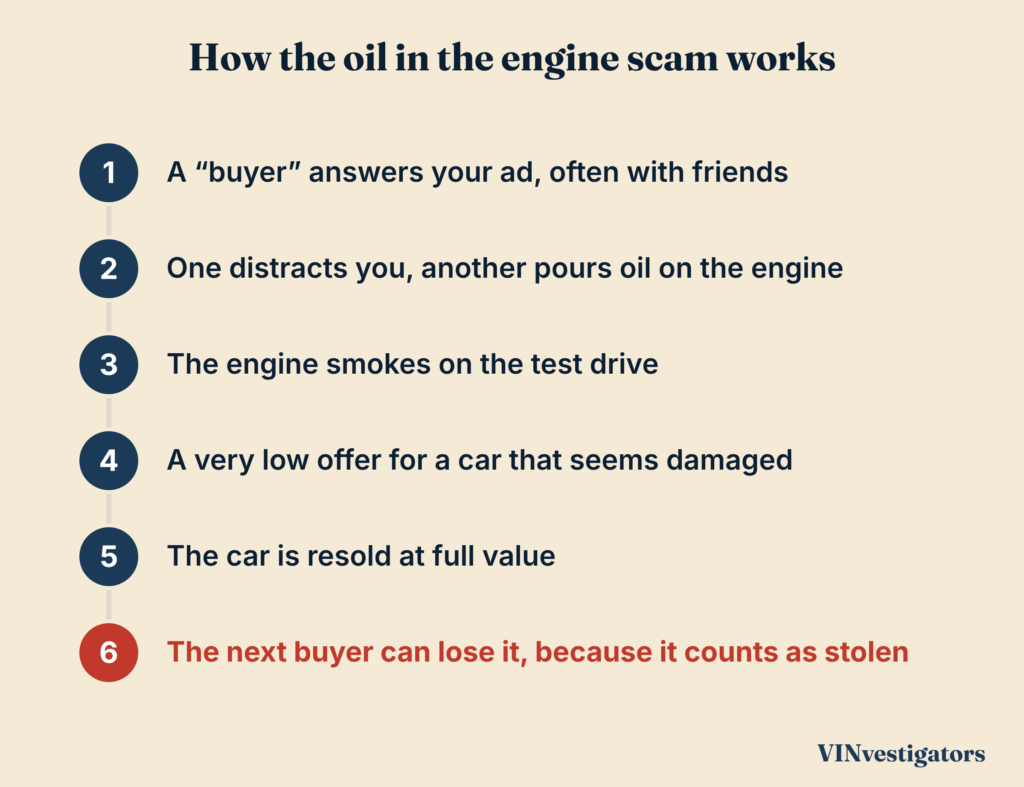
The rule for sellers is to never leave a buyer alone with the car. The San Luis Obispo sheriff’s advice is to meet in a public place, bring a friend or family member, stay with the car through the test drive, and refuse to cut the price for a supposed fault until a trusted mechanic has looked at it. A Grays Harbor detective put it more simply: “If your car wasn’t broken when you showed up, it probably isn’t broken when you’re leaving.”
The other trap is the payment. Tennessee’s Department of Commerce and Insurance warned in March of Facebook Marketplace buyers who pay with a fake cashier’s check or a wire that is later recalled and drive away with the car, and added that most insurers will not cover a theft by fraud when the owner handed over the keys. Its advice is to call the issuing bank or meet at the buyer’s bank, and to release the car only after the payment has cleared.
Dealer settlements and the older scams
Five announcements in the log concern dealers and used car buyers, and all five are settlements: over undisclosed fees and add-ons, falsely “certified” cars, and titles filed late or never delivered. In August the FTC and Connecticut settled with Manchester City Nissan for $4 million in refunds over allegations that it double-charged buyers for “certified pre-owned” used cars and added charges without consent (the FTC’s release). In March, six California district attorneys settled with CarMax for $1.1 million over allegations that its dealerships missed the 30-day deadline to transfer used cars’ registration and ownership to their buyers. CarMax did not admit the allegations (the Riverside County District Attorney).
Under the Manchester City Nissan order, which a federal judge signed on 19 August (the order), the dealer must show the maximum total price, apart from government charges, as its most prominent figure and get express, informed consent for every charge. Any buyer can ask a dealer for the same: the out-the-door price in writing before signing. The rest of the checks for a dealer sale are in our guide to how to avoid used car scams.
Odometer fraud produced one announcement in the log: the March sentencing of a Washington man, convicted at trial, who replaced the odometers of at least 21 high-mileage cars with units from wrecking yards and resold the cars (the sentencing). How rollbacks are done and what gives them away is covered in our guide to odometer fraud.
Flood cars come back after every storm season. In August NICB warned that flood-damaged vehicles frequently return to the market after major disasters, sometimes hundreds of miles from the flooding, and that dishonest sellers routinely hide that history with superficial repairs and “title washing.” It told buyers to run the VIN through VINCheck, which it built after Hurricane Katrina (NICB). How a salvage or flood brand disappears from a title, and how to find it again, is the subject of our guide to title washing.
Curbstoning, dealing in cars without a license while posing as a private seller, produced no announcement we could find in the first nine months of 2026, and its signs are in how to spot a curbstoner. Guides to the other car scams to look out for are collected under Scams & Fraud.
Frequently Asked Questions
Are car scams on Facebook Marketplace common?
Facebook Marketplace is the platform named most often in our scam log: 13 of the 36 official announcements from January to September 2026 mention it, from stolen cars sold with fake titles to the oil in the engine scam on sellers. No agency counts Marketplace scams, so the figure shows what was announced, not how often scams happen. The checks are the same as in any private sale: see the car in person, compare the VINs, match the seller’s ID to the title and finish the sale at a government office.
What happens if you buy a stolen car without knowing?
The car goes back to its owner, or to the insurer that paid the theft claim, and NICB’s line is that it “is never legally yours, even if you paid for it.” The money has to come back from whoever sold it: the Florida buyer at the top of this guide has sued the dealership that sold her the re-VINed SUV and is still paying her loan.
What is the safest way to pay a private seller for a used car?
Not by wire transfer or gift card: the FTC says that if anyone tells you to pay that way, “it’s a scam. Every time” (FTC). Minnesota’s Attorney General suggests a secure escrow service of your own choosing and warns against an unfamiliar one the seller insists on (Minnesota Attorney General). In Texas, the Harris County constable and the Tom Green County sheriff both say to complete the payment and the title transfer at the county tax office.
Is it safe to give a buyer your car’s VIN?
A buyer checking a car’s history will ask for the VIN, and anyone can read it on the car itself. The warning sign is a buyer who insists that you buy a vehicle history report from one particular website: the FTC warns that this can be a ruse to get your personal information, including your credit card number, and its advice is to ask why and think twice (FTC).
Where do I report a car scam?
Start with the police department where it happened, and ask for a case number. An online purchase scam can also be reported to the FBI’s Internet Crime Complaint Center at ic3.gov, which Tennessee’s Attorney General recommends, and any scam to the FTC at ReportFraud.ftc.gov.