
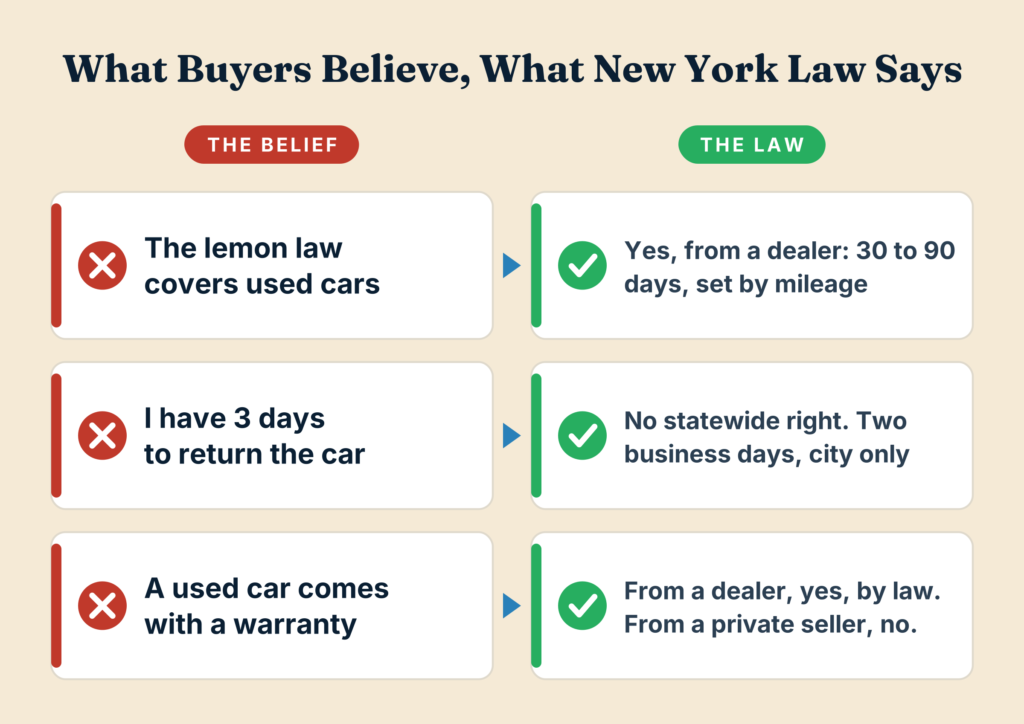
A used car bought from a dealer in New York comes with a written warranty by statute: General Business Law § 198-b requires 30 to 90 days of coverage, set by mileage, on anything sold for $1,500 or more with 100,000 miles or fewer, and the seller cannot cancel it with the words “as is”. What the state does not give is a right to return the purchase: no three-day cancellation exists statewide, and only inside the largest city must the lot offer a two-business-day option. The lemon law’s refund, a state arbitration program with a $120 filing fee, and a motor vehicle agency that recovers titles and refunds for buyers are the strengths; a branding system that marks only cars eight model years old or newer is the gap.
This guide answers the same questions about New York used car laws as every page in our state guides series, so the rules here can be set beside any other. Each statute below links to the official code, directly or through its chapter in the resources list, and the dates of our checks are at the end.
On this page
- New York at a glance
- What a seller must give you
- Warranties and the lemon law
- Title brands and total loss
- Odometer law
- Dealer licensing and the bond
- Used car scams
- Your remedies
- The numbers and the cases
- What sets New York apart
- How to file a complaint
- Official resources
- Frequently asked questions
- Sources and verification
New York at a glance
| Question | New York |
|---|---|
| Used car warranty law | Yes: a dealer’s used car sold for $1,500 or more with 100,000 miles or fewer carries a written warranty of 90, 60 or 30 days, set by the mileage at sale (General Business Law § 198-b) |
| Can a dealer sell as-is | No: the dealer certifies in writing that the car is fit for the road at delivery, and the Attorney General says that certification cannot be waived (Vehicle and Traffic Law § 417); a clause waiving the lemon law warranty is void (§ 198-b(d)) |
| Lemon law and used cars | Two laws: the used car lemon law gives its own warranty and refund (§ 198-b); the new car lemon law follows the car to a later owner within 18,000 miles or two years of first delivery (§ 198-a) |
| Consumer protection law | Deceptive acts and false advertising, General Business Law §§ 349 and 350-e: actual damages or $50 (or $500 for advertising), up to three times damages for a willful violation, capped at $1,000 ($10,000 for advertising), attorney’s fees, no pre-suit notice, three years to sue; Attorney General penalties up to $5,000 per violation (§ 350-d) |
| Odometer tampering | State offense: a misdemeanor, with no class named in the section (General Business Law § 392-e); fines of up to $500 per false mileage statement, $1,500 if knowing; civil remedy: none in that section, so 49 U.S.C. § 32710 (three times damages or $10,000, whichever is greater) and § 349 against the seller |
| Dealer license needed after | Selling or offering more than five vehicles in a calendar year, or displaying three or more at one time or within a month (Vehicle and Traffic Law § 415(1)); the lemon law treats as a dealer anyone who has sold or offered three or more used vehicles in the previous twelve months (§ 198-b(a)) |
| Dealer bond and recovery fund | Bond $20,000 for a dealer that sold 50 or fewer vehicles the previous year, $100,000 above that, $50,000 for a new car dealer (§ 415(6-b)); recovery fund: none that we found |
| Salvage threshold | Repair costs of more than 75 percent of the retail value at the time of loss, on a car eight model years old or newer, certified by the owner on the title (15 NYCRR 20.20(c)); DMV); older cars are generally not branded |
| Title brands issued | REBUILT SALVAGE: NY; SALVAGE REBUILT with another state’s abbreviation; RECONSTRUCTED; NON-USA-STD; the lemon law buyback notice; the mileage legends; no flood brand of its own; the full list is in the brands table below |
| Return or cooling-off right | None under state law, and no three-day right to cancel; inside New York City a dealer must offer a two-business-day contract cancellation option, during which it may keep the car (NYC Administrative Code § 20-268.2) |
| Small claims limit | $10,000 in New York City; $5,000 in city courts elsewhere and in Nassau and Suffolk; $3,000 in town and village courts (court system) |
| Where to complain | DMV Bureau of Consumer and Facility Services, form VS-35, CSR@dmv.ny.gov, 1-518-474-8943; Attorney General’s vehicle complaint form, 1-800-771-7755; in the city, 311 |
| Official lookups | Dealer licenses: Find a DMV-regulated Business; title and brand history: no free state check, use an NMVTIS report |
| Last verified | October 18, 2026, the 2026 consolidated laws; next review October 2027 |
What a New York seller must give you before you sign
Two documents frame a dealer sale. The first is federal: the FTC Used Car Rule puts a Buyers Guide window form on every used vehicle a dealer offers. The second is the state’s own: under Vehicle and Traffic Law § 417 the seller hands over a written certificate that the car is “in condition and repair to render, under normal use, satisfactory and adequate service upon the public highway at the time of delivery”. A false certificate, or one issued “without making an appropriate inspection”, is a violation.
That certificate rests on a state inspection within 30 days of the sale, with the sticker on the car before delivery (15 NYCRR 78.15). The DMV’s brochure, Let the Buyer Be Aware, adds that defects visible before the sale fall outside the certification.
Prior use is disclosed in writing. Where the seller knows or has reason to know that a passenger car served as a taxicab, a rental, a police vehicle or a driver education car, or was a lemon law buyback, § 417-a requires a statement of that use; a buyback also carries a notice in ten-point capitals that the vehicle “DID NOT CONFORM TO ITS WARRANTY”, in that statement and on the title.
Damage is disclosed through the title. Every seller, private or trade, completes the statement on the back of the certificate (or form MV-103 where it lacks one), declaring whether the vehicle was ever wrecked, destroyed or damaged so that repairs cost more than 75 percent of its retail value at the time of loss; on a car eight model years old or newer that answer brands the next title. A dealer selling a rebuilt salvage vehicle also confirms the notice on the bill of sale, and the DMV advises asking the buyer to initial it. Failing to disclose a salvage history carries, the DMV’s page says, a fine of up to $2,000 plus any Penal Law penalty.
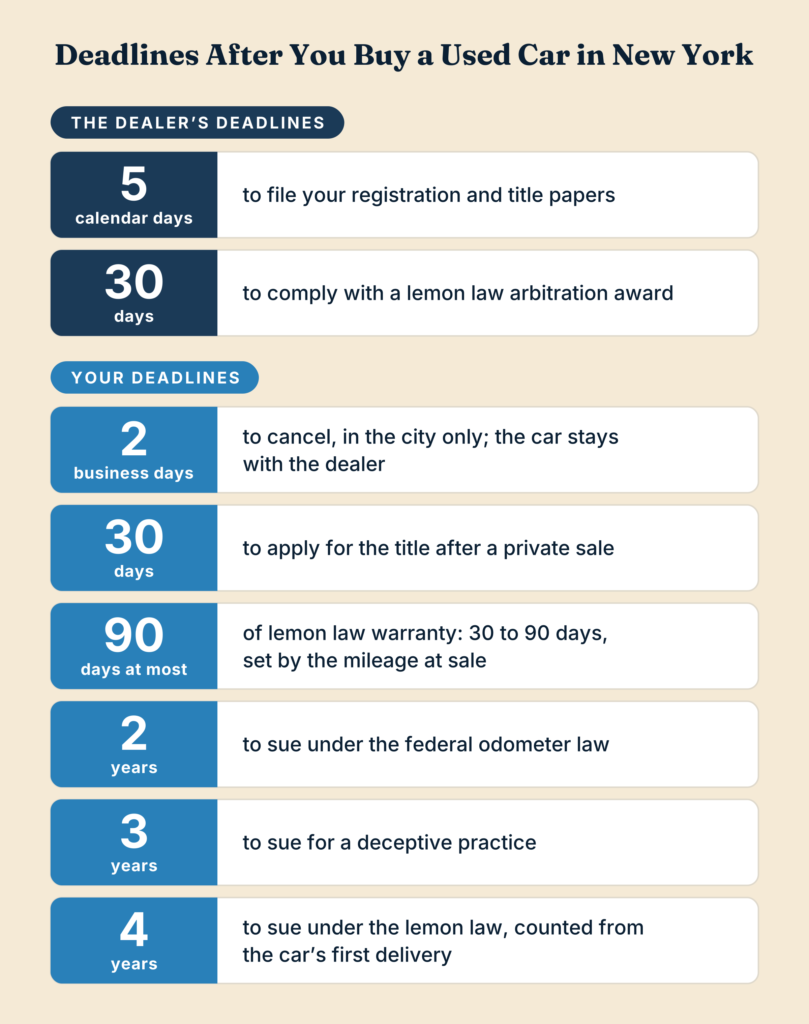
Paperwork moves fast on paper. A dealer that handles the registration files the title application within five calendar days after delivery (15 NYCRR 78.11), and must “promptly execute the assignment and warranty of title” to the buyer (§ 2114). A temporary certificate of registration from a dealer (form MV-TCR) is valid for 45 days, and no second one may go to the same person for the same vehicle (15 NYCRR 78.20).
In a private sale the seller assigns the certificate to the purchaser by name, who then has 30 days to apply for a new one (§ 2113). A motor vehicle office rejects a title with an altered or crossed-out name.
Dealer charges are narrow. The one the DMV caps is the amount for securing the registration and title: at most $175, only if the dealer files the papers, never including the agency’s own costs, and the invoice must print “THIS IS NOT A DMV FEE” (15 NYCRR 78.19). The Attorney General’s advertising guidelines call a price deceptive unless it is the actual purchase price “exclusive of registration and title fees and taxes”. We found no other cap.
On returns the answer is no. State law gives a buyer no right to return a used car and no three days to cancel; the Attorney General’s buying guide says there is no right to cancel a contract “unless the dealer fails to conspicuously post the refund policy”. One exception is local: inside New York City a dealer must offer every purchaser a cancellation option of two business days, described below.
Warranties, as-is sales and the lemon law
The New York used car lemon law, General Business Law § 198-b, is the statute most states lack. It reaches a vehicle bought or leased from a dealer for $1,500 or more, with 100,000 miles or fewer at sale, and driven mainly for personal, family or household purposes. Secondhand here means transferred after 18,000 miles or two years from first delivery, whichever came first; anything still inside that window falls under the new car statute instead. The warranty is given in writing at or before signing, and a seller that fails to do so “shall be deemed to have given” it anyway.
The coverage runs by the odometer reading when you buy, whichever limit comes first:
| Miles at sale | Warranty the dealer must give |
|---|---|
| 36,000 or fewer | 90 days or 4,000 miles |
| 36,001 to 79,999 | 60 days or 3,000 miles |
| 80,000 to 100,000 | 30 days or 1,000 miles |
The statute lists the covered parts system by system: the engine (its lubricated components, water and fuel pumps, manifolds, block and head), the transmission, the drive axle, the brakes, the radiator, the steering, and the alternator, generator, starter and ignition, the battery excluded. The dealer repairs a covered failure free or, at its election, reimburses the reasonable cost; the document may exclude damage from abuse, collision, neglect or an altered odometer.
The refund follows a presumption. If the same defect has been repaired three or more times within the warranty and still exists, or the vehicle has been out of service for a cumulative 15 days or more (45 where parts delays explain the wait), the dealer is presumed to have had a reasonable chance to fix it. When the defect substantially impairs the value, the seller refunds the full purchase price with sales tax and fees, less an allowance for damage beyond normal wear; the Attorney General’s guide notes there is no deduction for mileage. Any clause waiving these rights is void, and a court may award attorney’s fees to a consumer who prevails.
Disputes go to arbitration. If the dealer runs a procedure that meets the federal informal dispute rules, it may insist that the buyer use it before any refund; its decision does not bind the buyer, who may still apply to the Attorney General’s program, where the office decides eligibility and an arbitrator from the panel it appoints hears the case within 35 days of filing, with the decision mailed within 45. The current application form sets a $120 filing fee, requested by the administrator only after the office accepts the form and refunded to a consumer who wins.
The seller then has 30 days to comply with an award, owes $25 per business day of delay up to $500, and risks its DMV registration if it deliberately fails to pay. Any action under the article must be brought within four years of original delivery.
The “as is” deal other states allow does not exist at a New York dealer. In the Attorney General’s words, “No dealer can sell you a car ‘as is'”, because the § 417 certification of roadworthiness cannot be waived even by a signed contract. The ordinary implied warranty of merchantability arises on a merchant’s sale (UCC § 2-314) and the code lets a seller exclude it with conspicuous words (§ 2-316), but the two statutory protections sit on top of that bargain. A private seller is bound by none of this: the DMV’s brochure says a defective car from a private transaction is a matter for the courts, not for the agency. What the phrase means elsewhere is in our guide to as-is sales and when you still have rights.
The new vehicle lemon law, § 198-a, runs for 18,000 miles or two years from original delivery, and its definition of “consumer” includes a transferee, so a second owner inside that period has the manufacturer’s refund or replacement remedy after four repair attempts or 30 days out of service. A written guarantee on a used car also brings in the federal Magnuson-Moss Warranty Act: a seller who gives one cannot disclaim the implied protections. How the 51 jurisdictions compare is in our pillar on lemon laws and used cars by state.
Dealer guarantees beyond the statute must be in writing, with their scope and limits stated (15 NYCRR 78.14), and the Attorney General’s advertising guidelines reserve “certified” for a car that passed a manufacturer’s inspection program. Inside New York City a 2024 rule makes that label, or “certified pre-owned”, deceptive unless the certification rests on criteria set by someone other than the seller, that body is disclosed and the buyer is given the criteria (6 RCNY 5-14).
Title brands, total loss and how to check a New York title
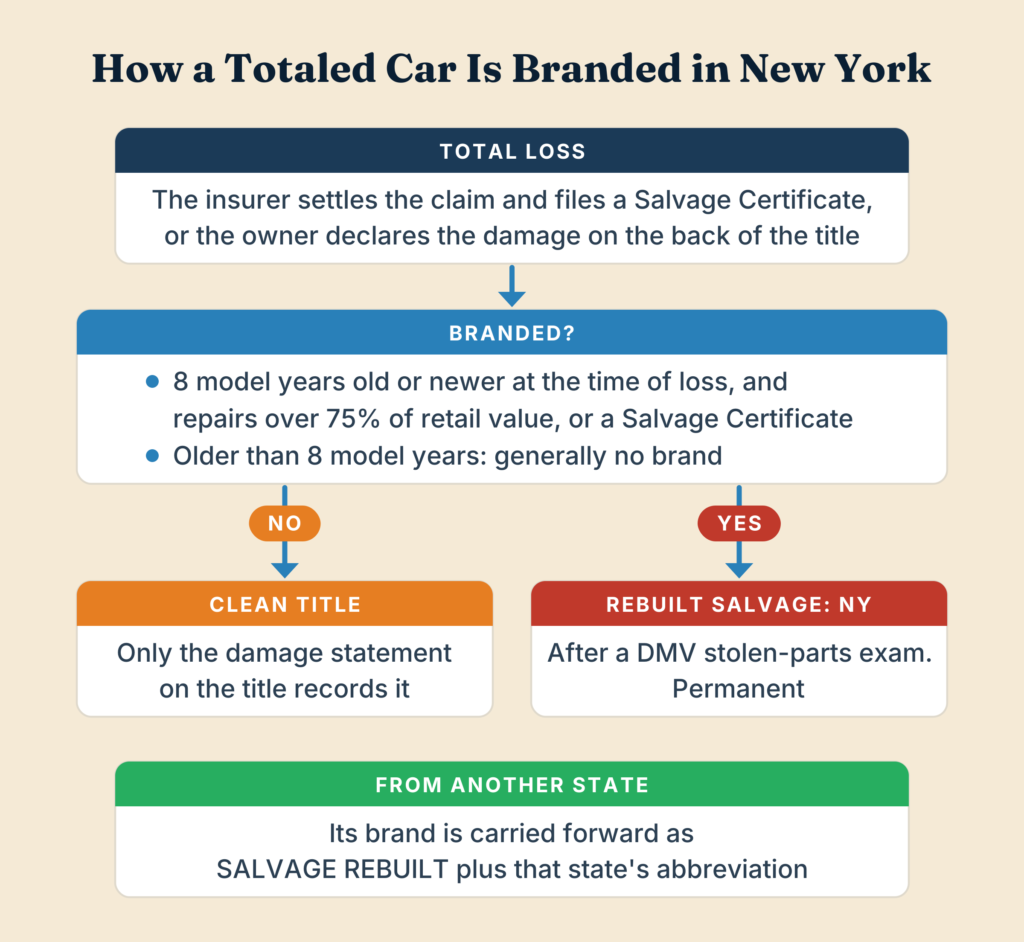
The state issues one brand of its own and carries others forward. Under 15 NYCRR 20.20), a certificate is marked REBUILT SALVAGE: NY when a vehicle eight model years old or newer on the date of loss is titled after any of three events: a Salvage Certificate (form MV-907A) was filed for it, repair costs including parts and labor exceeded 75 percent of its retail value at the time of the damage, or the owner declared it a write-off. The 75 percent figure is the branding rule, not the insurer’s decision to pay a claim. The DMV’s own page says it plainly: titles for vehicles older than eight model years are, generally, not branded.
The route back to the road runs through the state’s examiners. An insurer that takes a car in a claim settlement sends the DMV a statement of acquisition with the title (Vehicle and Traffic Law § 429), and the ownership document becomes the Salvage Certificate. Before a new certificate is issued, § 430 requires a physical examination, with a $150 fee in the statute, which the DMV describes as a search for stolen cars and stolen parts, “not a safety inspection, an emissions inspection, or an insurance examination”. The application is form MV-83SAL with a payment of $200 when the proof of ownership is an MV-907A, or $205 otherwise; the new document follows in three to five weeks if the vehicle passes.
The brand is permanent. The DMV writes that REBUILT SALVAGE “will remain on the title for as long as the vehicle exists”, and the regulation says RECONSTRUCTED and NON-USA-STD stay “regardless of time or improvements”. A mark from another jurisdiction appears on the New York certificate as SALVAGE REBUILT with that jurisdiction’s abbreviation, the regulation treating junk, parts-only and water-damage designations as equivalent. That is the state’s whole answer on flood cars: it has no flood brand of its own, so a flooded car arrives as an out-of-state mark, a 75 percent damage declaration, or nothing at all. There is no nonrepairable title either; a vehicle scrapped for parts has its identification number plate removed and destroyed or surrendered to the DMV (§ 429(3)).
| What the title shows | What it means | Rule |
|---|---|---|
| REBUILT SALVAGE: NY | Eight model years old or newer at the loss, and a Salvage Certificate was filed, repairs exceeded 75 percent of retail value, or the owner declared it salvage; examined for stolen parts before retitling; stays for the life of the car | 15 NYCRR 20.20(c)); VTL § 430 |
| SALVAGE REBUILT plus a state abbreviation | The vehicle carried a salvage, rebuilt, junk, parts-only or water-damage brand from another jurisdiction, carried forward | 15 NYCRR 20.20(b)(4) |
| RECONSTRUCTED | Repaired or built with a glider kit; stays on every later title | 15 NYCRR 20.20(b)(1), (b)(2) |
| NON-USA-STD | Not built to United States emission or safety standards | 15 NYCRR 20.20(b)(1) |
| Lemon law notice | Returned under a lemon law or settlement; printed on the current and every future title, in capitals under § 417-a | 15 NYCRR 20.20(a); VTL § 417-a(2) |
| NOT EQUIPPED WITH A TAMPER-RESISTANT ODOMETER | A 1992 or later model the dealer knows or has reason to know lacks one; the notice goes on the title and in a written statement to the buyer | VTL § 417-b |
| EXCEEDS MECHANICAL LIMITS | The odometer rolled past its maximum and started over | DMV brochure |
| NOT ACTUAL MILEAGE, WARNING ODOMETER DISCREPANCY | The true mileage is unknown; the Attorney General says to be “very wary” of this title | DMV brochure; AG guide |
| Salvage Certificate (MV-907A) | Not a title: the ownership document of a vehicle an insurer took as a total loss; a title is issued only after the examination | VTL § 429; DMV |
Reading the certificate is the check. Brands are printed in capitals on the front, the mileage from the last transfer is printed there too, and the damage and odometer statements are on the back. A motor vehicle office will not accept a document with a disclosure left blank or a name, number or signature altered, erased or crossed out, so a seller who offers to “fix the paperwork later” is offering nothing. The DMV’s brochure adds the lien release; its October 2024 warning adds the match between the identification number plaque on the car and the title.
A New York used car buyer has no free state lookup of a brand or odometer record. The working check is an NMVTIS report, bought from an approved provider for about $10; the Justice Department’s page on reading the report lists its five indicators: the current titling state and last title date, the brands, the odometer reading, total losses and salvage. It will not show a flood that was never claimed or a nine-year-old car that was never marked, so it is read beside the vehicle, not instead of it. How marks travel between jurisdictions, and why a clean certificate proves less than it seems, is covered in our pillar on how title washing works nationwide.
Odometer law in New York
The state offense sits in the General Business Law, not the vehicle code. § 392-e, “Using false statements or altering mileage registering devices”, makes it a misdemeanor to misrepresent a vehicle’s miles to a buyer, whether in writing or by disconnecting or changing the odometer to read lower; the section names no class. A seller who knows the reading understates the miles must write “True mileage unknown” on the transfer papers. A separate subdivision adds fines for a misrepresentation before a transfer, up to $500 per violation and up to $1,500 where the act was knowing or willful.
The section gives the buyer no damages of its own. The civil remedy is federal: under 49 U.S.C. § 32710 a person who tampers with intent to defraud owes three times the actual damages or $10,000, whichever is greater, plus costs and attorney’s fees, in a suit brought within two years. The federal offense itself carries a civil penalty of up to $10,000 per vehicle and, for a knowing and willful violation, a criminal fine and up to three years in prison (49 U.S.C. § 32709).
Disclosure follows the federal rule. The odometer statement on the back of the title, or on the dealer’s MV-50, is completed for a vehicle of model year 2011 or later that is 20 years old or newer; 2010 and older are exempt (49 CFR Part 580). A dealer selling a 1992 or later car that lacks a tamper-resistant odometer must say so in a written notice under § 417-b, which also goes on the title.
Who enforces: the DMV’s complaint unit takes reports against registered dealers (form VS-35, below), and a private seller’s fraud is a matter for the police. The DMV’s warning of October 2024 on online sales names a mileage drop in a vehicle’s history as a “red flag”. The last federal odometer prosecution we found in the state was a Brooklyn dealer sentenced to 60 months in June 2021. How rollbacks are done and found is in our pillar on odometer fraud, and the signs on the car itself are in five physical signs of a rollback.
Dealer licensing, curbstoning and the dealer bond
The licensing line is drawn twice. For the DMV, Vehicle and Traffic Law § 415(1) makes a dealer of anyone who sells or offers for sale more than five motor vehicles, motorcycles or trailers in a calendar year, or who displays three or more at one time, or within one calendar month, on premises they own or control, when the stock was acquired for resale. So five sales in a year stay under the registration line and the sixth needs one; three cars offered on one lot cross it. For the lemon law, a person who sells a used car after selling or offering three or more in the previous twelve months is a dealer under § 198-b, and owes the warranty.
Unregistered dealing, which the trade calls curbstoning, is met with civil penalties under § 415(16): $1,000 for operating without registration (all but $500 of it avoided by registering within ten days of the penalty), $1,000 again on a second finding, $4,010 on a third within thirty months, $300 per vehicle parked for sale on a public highway, and more where a buyer’s financial loss is shown. The DMV’s statewide warning of October 2024 reports “a rise in illicit vehicle sales by unlicensed dealers” and tells buyers to be wary of “licensed dealers” with no place of business or with out-of-state paperwork or plates. How to tell a private owner from a trader is in our guide to spotting a curbstoner.
Every dealer posts a bond. Under § 415(6-b) the amount is $20,000 for a first-time applicant or a business that sold 50 or fewer vehicles in the previous calendar year, $100,000 for one that sold more than 50, and $50,000 for a new motor vehicle franchise. Anyone with a judgment against the bonded party for an act the bond covers may claim on it, up to its face amount in total. There is no recovery fund for buyers of a dealership that closes; the DMV’s own consumer unit fills part of that gap, as the numbers below show.
Penalties against a registered business run through the DMV’s hearings: up to $1,000 per violation, up to $1,500 for a repeat within thirty months, and $350 to $1,500 plus any financial loss for fraud or misleading advertising (§ 415(12)), with suspension or revocation on top. The agency’s open data file, updated October 5, 2026, listed 7,635 used vehicle sales facilities with an unexpired registration on October 18, 2026, our count of the rows coded DLU whose expiration date is on or after that day, beside 1,030 new car dealers (code DLN). In New York City a second license is required from the Department of Consumer and Worker Protection, which told the City Council in 2022 that it licensed 522 secondhand automobile dealers.
Used car scams in New York
The state’s agencies publish no single list of motor vehicle fraud types. The Governor’s releases on the DMV’s work describe action against dealers for selling vehicles without disclosing significant defects to the buyer; the DMV’s October 2024 warning describes stolen cars with “altered identification numbers and forged titles” sold through online marketplaces. The Attorney General’s recent dealer cases are about fees. The table adds patterns from the city’s enforcement and from the salvage rules; we found no official ranking by frequency, so the order is ours.
| Scam | What the record shows | How to check |
|---|---|---|
| Stolen car sold online with a forged title | DMV, October 2024: of 228 stolen vehicles the agency recovered that year to mid-October, 149 had been bought by a victim after a listing on Facebook Marketplace or a similar site; the 2025 total was 384 recovered vehicles worth $10.4 million. State law: a knowingly false statement in a title endorsement, or possessing a vehicle known to be stolen, is a class E felony (VTL § 426); a systematic scheme that takes more than $1,000 is scheme to defraud in the first degree, a class E felony (Penal Law § 190.65) | The title must be in the seller’s name with any lien released; the identification number plaque on the car must match the title; no temporary registration unless the DMV or a licensed facility issued it (DMV warning) |
| Flood car retitled in another state | DMV warnings of October 2022 and July 2025: “Some sellers take vehicles from flooded areas and retitle them in another state”, and a title from an unflooded state “does not guarantee that a vehicle is damage-free”. The DMV’s page puts the fine for failing to disclose a salvage history at up to $2,000 plus Penal Law penalties. State law: a knowing false statement on a title application made to defraud a later buyer carries a civil penalty of up to $2,000 (VTL § 429) | Look for SALVAGE REBUILT with a state abbreviation on the title; be wary of a title issued in a storm month; read the damage statement on the back; musty odors, water stains, rust and corrosion are the DMV’s listed signs (DMV, July 2025) |
| Odometer rollback | The Attorney General’s buying guide lists the signs a buyer should look for: a title with erasures or numbers written over, a loose dashboard, a broken speedometer, digits on the left that do not line up, and the legend “not the actual mileage”. State law: a misdemeanor and fines up to $1,500 (GBL § 392-e). Federal: a civil suit for three times damages or $10,000 | Compare the mileage printed on the front of the title with the odometer and the service records; the DMV calls a mileage drop in the history a “red flag” |
| Add-on fees and a price above the advertisement | Attorney General, September 2026: two Westchester dealerships agreed to refund more than $1.17 million and pay $700,000 in penalties over a 2 percent “sales commission fee” that no salesperson received and a bundled add-on sold as mandatory (release); eight Nissan dealers paid $3.2 million in May 2025 over fees added at lease buyouts. State law: deceptive acts and false advertising, GBL §§ 349 and 350; in the city, the right to refuse add-ons (NYC Administrative Code § 20-268.1) and, under the Bill of Rights, to buy at the advertised price | Ask for every charge in writing before signing; the only DMV-capped fee is $175 for registration and title work, marked “THIS IS NOT A DMV FEE”; an advertised price must include everything but registration, title and tax |
| Car sold with undisclosed defects | The Governor’s releases say the DMV took action against dealers in 2024 and 2025 for “selling vehicles without disclosing significant defects to the buyer”, and that it recovered $1.6 million for 538 consumers from dealers and repair shops in 2025. State law: the § 417 certification that the car is roadworthy at delivery, and the § 198-b warranty | Ask for the § 417 certificate and the inspection certificate dated within 30 days; keep every repair order; report within the warranty period |
| Unregistered dealer posing as a private seller | DMV, October 2024: “a rise in illicit vehicle sales by unlicensed dealers”, the signs being out-of-state paperwork or plates and no place of business. State law: civil penalties of $1,000 and up under VTL § 415(16); the buyer loses the § 417 certificate, the lemon law warranty and the bond | Look the seller up in Find a DMV-regulated Business; a registered dealer shows a red and white facility sign; insist on a title in the seller’s own name |
| Cars taken by a tow operator and resold with false papers | Attorney General, February 2026: a Capital Region tow operator pleaded guilty to grand larceny and was sentenced to two to six years for towing 17 vehicles from parking lots and selling them within days; a used car dealer who, the office says, created fraudulent ownership documents to resell them pleaded guilty to criminal possession of stolen property and received five years of probation (release) | The release says a tow operator must notify the owner within five days and hold the vehicle 30 days before claiming title, so a recently towed car offered for sale with a fresh title is a warning |
Every row leads to the remedies and the complaint steps below.
Your remedies under New York law
The general consumer statute is short and well used. General Business Law § 349 declares “unfair, deceptive, or abusive acts or practices” in any business unlawful (the words “unfair” and “abusive” were added in 2026), and lets any person injured by a deceptive act or practice sue for actual damages or $50, whichever is greater; where the violation was willful or knowing the court may raise the award to three times the actual loss, up to $1,000, and may award a prevailing plaintiff reasonable attorney’s fees. False advertising has its own remedy, § 350-e(3), with a floor of $500 and a treble cap of $10,000. Neither requires notice before suit. An action on a statutory liability must be brought within three years (CPLR 214(2)).
Two vehicle statutes add their own damages. A dealer that omits the prior use or lemon buyback disclosure of § 417-a, or the tamper-resistant odometer notice of § 417-b, owes three times actual damages or $100, whichever is greater, with attorney’s fees. Common-law fraud remains available for a lie that induced the sale: the limitation is the greater of six years from the transaction or two from the day the purchaser discovered the deceit or could have with reasonable diligence (CPLR 213(8)).
The Attorney General enforces for the public. Under Executive Law § 63(12) the office may sue over “repeated fraudulent or illegal acts” for an injunction, restitution and damages, and the civil penalty for a deceptive practice is up to $5,000 per violation, with up to $10,000 more where the conduct targeted people aged 65 or older (§ 349-c). Most dealer cases end in an assurance of discontinuance, a settlement rather than a finding; the office does not represent individual buyers.
Small claims is tiered by place: up to $10,000 in New York City, $5,000 in the city courts elsewhere and in Nassau and Suffolk counties, and $3,000 before a town or village justice; no lawyer is needed, and only individuals, not companies, may sue there (court system). A finance contract may contain an arbitration clause; we found no state statute that bars one in a car sale, so read the agreement before relying on a judge. A judgment against a dealer is also the key to its bond.
The federal remedies apply everywhere: the odometer act’s three times damages or $10,000 within two years, and the Magnuson-Moss Warranty Act’s suit for breach of a written warranty with attorney’s fees (15 U.S.C. § 2310(d)). The shortest deadlines are the dealer’s five calendar days to file your papers, the two business days to cancel inside the city, and the 30 to 90 of statutory coverage, counted from delivery.
The numbers and the cases in New York
The federal picture first. In the FTC’s Consumer Sentinel data book for 2024, New Yorkers filed 278,662 fraud and other reports, 1,402 per 100,000 residents, the 13th highest rate among the states, with $534.0 million in reported losses and a median loss of $429. “Auto Related” complaints were 3 percent of the state’s total, ninth among its top ten categories; it is a share of all reports, not a count of fraud.
The state’s own complaint count puts cars higher. The Attorney General’s top ten of 2025, released March 2, 2026, ranks “Automobile” third with 4,521 complaints, covering “car sales, service, financing, and repairs”, up from 3,761 and the same place in 2024. The DMV’s consumer work is counted in dollars: in 2025 it helped 604 people recoup titles, services and refunds worth more than $3.2 million, of which 538 recovered $1,604,460 from dealerships and repair shops, and it retrieved 66 ownership certificates worth $1,589,983 (Governor’s office, March 2026).
Theft feeds the used market. The DMV recovered 384 stolen vehicles worth more than $10.4 million in 2025 and 303 worth $8.35 million in 2024, and its October 2024 release counted 149 of 228 recoveries that year as good-faith purchases by a victim after an online listing.
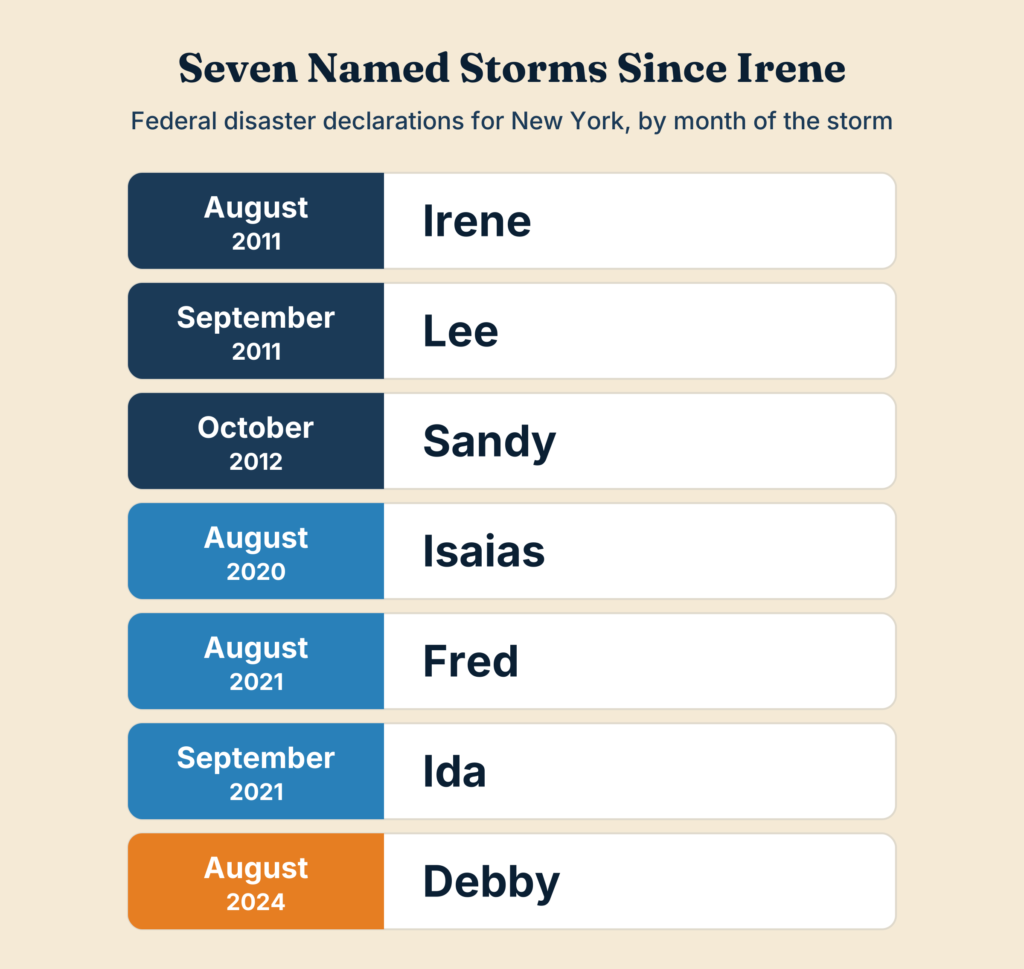
Weather is the state’s title washing exposure. FEMA’s database lists 85 major disaster declarations here since 1954, 13 of them for hurricanes or tropical storms and 26 for flooding, our count of distinct entries on October 18, 2026, including one tribal request (the dataset). Seven named storms have been declared disasters since 2011, four of them in August: Irene in 2011, Isaias in 2020, what was left of Fred in 2021 and of Debby in 2024; the others were Lee’s remnants in September 2011, Sandy in October 2012 and Ida’s remnants in September 2021. After Hurricane Ian in 2022 and the flooding across the country in 2025, the DMV issued statewide warnings about flood cars retitled in other states. This page uses the OpenFEMA API but is not endorsed by FEMA.
The enforcement log below is a selection of dated cases from the last three years, newest first; a settlement is an agreement, not a finding, and charges in a live case are allegations.
September 16, 2026. The Attorney General announced a settlement with two DARCARS dealerships in Mt. Kisco over a 2 percent “sales commission fee” charged as if mandatory and an add-on bundle sold the same way: more than $1.17 million in refunds, and $700,000 in penalties (release).
June 3, 2026. The Attorney General settled with Nissan’s finance arm over lease buyout overcharges at the remaining Nissan dealerships in the state, after agreements with 15 of them had brought $1 million in penalties and $4.5 million in restitution to 3,100 consumers (release).
May 14, 2026. The city’s Department of Consumer and Worker Protection announced that a Bronx used car dealership admitted wrongdoing and agreed to pay $129,999 in penalties and restitution over more than 350 violations, among them cars sold above the advertised price, sales while unlicensed and withheld cancellation options (release).
March 11, 2026. The Attorney General and the NYPD announced a 92-count indictment of five people accused of running a ring that sold stolen vehicles in the state and New Jersey, with more than 40 recovered, worth more than $1 million; the defendants are presumed innocent unless and until proven guilty (release).
February 24, 2026. The Attorney General announced the sentencing of a Rensselaer County tow operator to two to six years in prison after a guilty plea to grand larceny for towing and selling 17 vehicles worth $230,000, and of a used car dealer, who pleaded guilty to criminal possession of stolen property, to five years of probation (release).
What sets New York apart
The New York used car warranty is the first difference. Six states require a dealer to warrant a secondhand vehicle by mileage bands, and this is one of them; the coverage here starts at 90 days under 36,000 miles and ends at 30 near 100,000. Paired with it are the § 417 certification, read by the Attorney General as a ban on “as is” sales by dealers, and an arbitration program the Attorney General screens and appoints rather than one left to the manufacturer. A pending bill, A8594-A, would stretch the first band to a year and 12,000 miles and reach cars up to 200,000; by October 2026 it had passed neither house (bill history).
The second is the city within the state. A dealer in New York City needs a license from the Department of Consumer and Worker Protection on top of its DMV registration, and local law adds duties no state rule imposes. A buyer gets a contract cancellation option of two business days, during which the dealer may keep the vehicle and its title, and a cancellation delivered in person brings a full refund including sales tax (a trade-in needs a refundable $100 deposit; using it during those days costs a further $50 and is capped at 250 miles). A written financing disclosure must show the lowest annual percentage rate offered by any lender it approached, and signed pre-contract disclosures, issued as the Used Car Consumer Bill of Rights, come in the language of the negotiation where a translation exists (Local Law 197 of 2017).
The city also requires a copy of any recall information printed from the federal recall website, signed or initialed by the purchaser (Local Law 85 of 2017); that is a disclosure, not a ban on selling a recalled car. The Bill of Rights adds the right to buy at the advertised price and to refuse add-ons, and the city’s rules forbid a dealer’s contract from limiting its § 417 duty.
The third is a gap. Because the salvage brand attaches only to vehicles eight model years old or newer at the time of loss, a nine-year-old car written off in a flood can be repaired and sold on a clean New York title. With no flood brand and no free title lookup, the older half of the market rests on the NMVTIS report and the inspection, which our pillar on the complete buyer’s fraud prevention playbook sets out step by step.
The fourth is an agency that acts as a collector. The DMV’s Bureau of Consumer and Facility Services recovered titles for 66 buyers and $1.6 million from dealers and repair shops in 2025, through complaint handling backed by the threat of a hearing. It cannot force a facility to pay restitution and it will not act on a private sale, but for a purchaser whose dealership closed before the paperwork arrived it is the first call.
How to file a complaint in New York
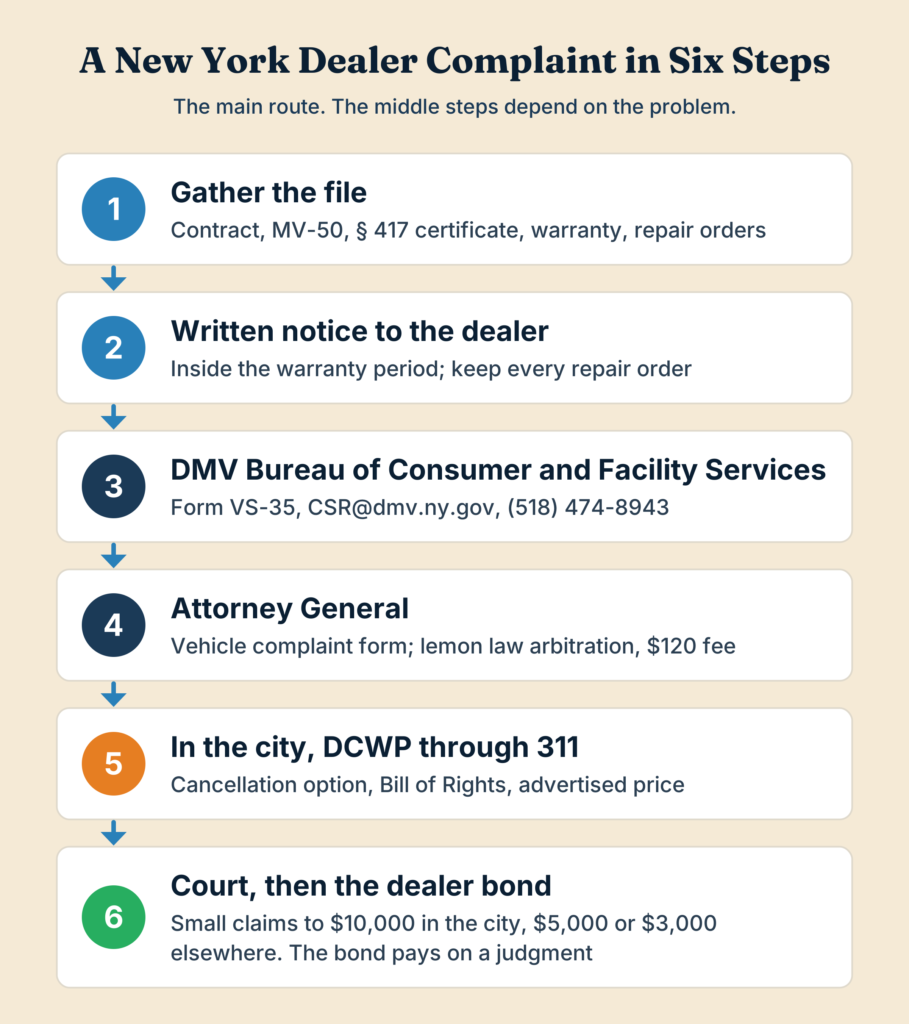
- Gather the file: the sales contract, the MV-50 Retail Certificate of Sale, the § 417 certificate, the written warranty and the Bill of Rights, the Buyers Guide, every repair order, and every message with the seller. The agencies ask for copies, and the DMV will not investigate an anonymous complaint.
- Tell the dealer in writing, inside the warranty period. The lemon law counts repair attempts and days out of service, so each visit needs a dated repair order; the DMV asks buyers to try the dealership’s management first and keep proof. No statute requires a pre-suit notice before a deceptive practices claim.
- File with the DMV against a registered dealer: form VS-35, Vehicle Safety Complaint Report, by email to CSR@dmv.ny.gov or by mail to the Complaint Unit, Bureau of Consumer and Facility Services, P.O. Box 2700-ESP, Albany, NY 12220-0700; 1-518-474-8943. The agency tries to settle the case in six to eight weeks; an investigation and a hearing can suspend or revoke the registration and impose fines; the agency “cannot force a shop to pay restitution”.
- If the dealership has closed or never delivered your title, the same DMV unit is the route: in 2025 it recovered 66 of them for buyers in that position. For an unregistered seller, a forged title or a stolen car, report to the police where the sale happened and to the DMV.
- File with the Attorney General: the vehicle complaint form online, or by mail to the Office of the Attorney General, The Capitol, Albany, NY 12224-0341; help line 1-800-771-7755. The office builds cases and brings them for the public; it does not act as your lawyer.
- For a lemon law dispute, apply to the Attorney General’s arbitration program on its used car form, by email to NYAG.LemonLaw@ag.ny.gov or by mail to the Lemon Law Arbitration Unit, 28 Liberty Street, 15th Floor, New York, NY 10005; the $120 filing fee is requested after acceptance and refunded if you win, and no lawyer is required, though the form suggests consulting one.
- Inside New York City, call 311 or file at nyc.gov/dcwp for a seller that refused the cancellation option, skipped the Bill of Rights or the financing disclosure, or sold above the advertised price.
- The Department of State’s Division of Consumer Protection mediates complaints with businesses not already in court: file online or call (800) 697-1220, weekdays 8:30 a.m. to 4:30 p.m.
- Sue in small claims for up to $10,000 in the city, $5,000 in other city courts and on Long Island, or $3,000 before a town or village justice; a judgment is also what a claim on the dealer’s bond needs.
- A large-scale odometer scheme: the NHTSA Vehicle Safety Hotline, 888-327-4236; an individual case goes to the state, not to the federal agency (NHTSA). Any fraud: ReportFraud.ftc.gov. An online scam or a fake escrow: the FBI’s Internet Crime Complaint Center, ic3.gov.
- A lawyer makes sense when the loss is above the small claims limit, when a dealer ignores an arbitration award (confirmed in court within one year), or when the claim shifts fees: § 349, the lemon law and § 417-a each let the court make the other side pay your attorney. How the steps compare across states is in how to file a complaint against a car dealer.
Official resources
- General Business Law § 198-b: the used car lemon law, with the warranty bands, the covered parts, the refund and the arbitration rules.
- General Business Law § 198-a: the new car lemon law, which follows the car to a later owner inside 18,000 miles or two years.
- General Business Law §§ 349, 349-c, 350-d and 350-e: deceptive acts, false advertising, the private suits and the Attorney General’s penalties.
- General Business Law § 392-e: the odometer offense and the mileage statement rules.
- Executive Law § 63(12): the Attorney General’s power to sue over repeated fraudulent or illegal acts.
- Vehicle and Traffic Law § 415: dealer registration, the definition of a dealer, the bond and the penalties.
- Vehicle and Traffic Law §§ 417, 417-a and 417-b: the dealer’s certification of roadworthiness, the prior use and lemon buyback disclosures, and the tamper-resistant odometer notice.
- Vehicle and Traffic Law § 426: false statements in a title transfer and stolen vehicles, a class E felony.
- Vehicle and Traffic Law §§ 429 and 430: the salvage statement of acquisition, the examination before a rebuilt vehicle is titled, and the examination fee in the statute.
- Vehicle and Traffic Law §§ 2113 and 2114: transfer of a title by an owner and by a dealer.
- Uniform Commercial Code §§ 2-314 and 2-316: the implied warranty of merchantability and how a seller may exclude it.
- CPLR 213 and 214: the six-year fraud and three-year statutory limitation periods.
- Penal Law § 190.65: scheme to defraud in the first degree.
- Assembly bill A8594-A and A2176: the pending lemon law expansion and the pending dealer recall repair bill, neither law.
- 15 NYCRR Part 78, the dealer regulations: the DMV’s own publication, with the five-day filing rule, the 30-day inspection rule, the $175 fee cap and the required sale documents.
- 15 NYCRR, the Commissioner’s regulations): the official compilation, where Part 20 and its § 20.20 on title brands are read.
- Let the Buyer Be Aware: the DMV’s used car brochure on dealer duties, disclosures, brands, private sales and complaints.
- Buying a Salvage Vehicle, the Salvage Vehicle Examination and the salvage disclosure: the DMV’s pages on the 75 percent rule, the brand, the examination and the seller’s duty.
- Form MV-103: the odometer and damage disclosure statement.
- DMV warning on online car sales scams and the flood car warnings of October 2022 and July 2025: the agency’s own advice and its figures.
- Report a problem with a DMV-regulated business, what to expect and form VS-35: the DMV complaint route.
- Find a DMV-regulated Business: the dealer and repair shop lookup, with the search tool.
- DMV dealer facilities dataset: the open data file behind our dealer count.
- Governor’s releases on DMV consumer recoveries, March 2026 and January 2025: the stolen vehicle, title and refund figures.
- Attorney General, used car lemon law guide, fact sheet and arbitration form: coverage, the bands, the “as is” statement, the program and the $120 fee.
- Attorney General, Buying a car? and advertising guidelines for auto dealers: the office’s consumer tips and its rule on advertised prices.
- Attorney General, vehicle complaints: the online form for purchase and lease disputes, and the lemon law forms.
- Attorney General, top ten complaints of 2025: the complaint ranking cited above.
- NYC Local Law 197 of 2017 and Local Law 85 of 2017: the city’s cancellation option, financing disclosure and recall disclosure laws, on the City Council’s legislative record.
- NYC Used Car Consumer Bill of Rights, the cancellation option form, the department’s buying tips, its 2024 rule, its 2022 testimony and complaint page: the city layer.
- New York State courts, small claims: the limits by court.
- Department of State, Division of Consumer Protection: mediation and the helpline.
- FEMA disaster declarations summaries: the dataset behind the storm counts.
- FTC Consumer Sentinel Network Data Book 2024: the state page with the report counts and the “Auto Related” share.
- FTC Used Car Rule, 16 CFR Part 455 and the FTC’s Buying a Used Car From a Dealer: the Buyers Guide and the federal buying advice.
- NHTSA, odometer fraud: the federal rules, the disclosure exemption and the hotline.
- 49 U.S.C. § 32709, § 32710, 49 CFR Part 580, 15 U.S.C. § 2308 and § 2310: the federal odometer penalties and remedy, the disclosure rule and the Magnuson-Moss Warranty Act.
- NMVTIS, approved report providers: where to buy the national title report, and what it shows.
- FBI Internet Crime Complaint Center and ReportFraud.ftc.gov: the federal reporting routes for online and other fraud.
Frequently Asked Questions
Does New York have a used car lemon law?
Yes. The New York used car lemon law, General Business Law § 198-b, requires a dealer to give a written warranty of 30 to 90 days, set by mileage, on a vehicle sold or leased for $1,500 or more with 100,000 miles or fewer. If a covered defect survives three repair attempts or keeps the car off the road 15 days, the seller owes a refund. Private sales are outside it.
Can you return a used car in New York?
Not under state law. There is no three-day right to cancel and no return period once the contract is signed. Inside New York City a dealer must offer a two-business-day cancellation option, during which it may keep the car, and a cancellation in person brings a full refund with sales tax.
Does a used car come with a warranty in New York?
From a dealer, yes, by law, for 30 to 90 days depending on the mileage, on a car sold for $1,500 or more with 100,000 miles or fewer, and the seller must also certify in writing that the vehicle is fit for the road at delivery. From a private owner, no.
Are dealer fees capped in New York?
One is. The charge for securing your registration and title is capped at $175 by the DMV’s rules and must be marked “THIS IS NOT A DMV FEE” on the invoice. We found no cap on other charges; a sum you never agreed to is a deceptive practice claim, and inside the city a dealer may not sell above its advertisement.
How many cars can I sell in New York without a dealer license?
Five in a calendar year. Vehicle and Traffic Law § 415 makes you a dealer at more than five sold or offered in a year, or at three or more displayed for sale at one time or within a month on premises you control. The lemon law uses a lower line: a person who sells a used car after selling three or more in twelve months owes the buyer its warranty.
How do I file a complaint against a New York dealer?
Send form VS-35 to the DMV’s Bureau of Consumer and Facility Services (CSR@dmv.ny.gov, 1-518-474-8943) with your documents; the agency can fine or suspend a registered dealer and recovers titles and refunds. File the Attorney General’s vehicle complaint form online or call 1-800-771-7755; a lemon law dispute goes to its arbitration program. Inside New York City, call 311 as well.
What is the Attorney General’s used car arbitration program?
A state-run alternative to court for lemon law claims. You apply on the Attorney General’s form; once the office accepts it, the program administrator asks for a $120 filing fee, refunded if you win, and schedules a hearing within five weeks. The decision binds the dealer, which has 30 days to comply and owes $25 per business day of delay up to $500.
What title brands does New York use?
REBUILT SALVAGE: NY, for a vehicle eight model years old or newer at the time of loss that was declared a write-off, damaged beyond 75 percent of its retail value or covered by an MV-907A certificate. The others are SALVAGE REBUILT with another state’s abbreviation, RECONSTRUCTED, NON-USA-STD, the lemon law notice, the tamper-resistant odometer notice and the two mileage legends. There is no flood brand.
Is New York a destination for title-washed cars?
The DMV says the risk is real and does not count it: its warnings of 2022 and 2025 describe flood cars retitled in other states and tell buyers that a title from an unflooded place proves nothing. Its own brand reaches only vehicles up to eight model years old and there is no water-damage brand, so an older flooded car can arrive on a clean certificate.
Sources and verification
Statutes: the 2026 consolidated laws as published on the State Senate’s legislation site, read on October 18, 2026 (every section cited above). Regulations: 15 NYCRR Part 78 in the DMV’s own publication (form CR-78); 15 NYCRR 20.20 in a published copy, linked to the Department of State’s official compilation. Federal provisions on govinfo.gov, ecfr.gov and Cornell’s copy of Title 49. Agency material read the same day: the DMV’s brochure, salvage and complaint pages and news releases; the Attorney General’s guides, arbitration form, advertising guidelines and complaint pages; the City Council’s legislative record and the Department of Consumer and Worker Protection’s forms; the courts’ small claims page; the Division of Consumer Protection’s page. Figures: the FTC’s Consumer Sentinel data book for 2024; the Attorney General’s complaint rankings of March 2025 and March 2026; the Governor’s releases of January 31, 2025 and March 3, 2026; the DMV’s release of October 22, 2024; the dealer and storm counts are ours, by the methods stated. Cases: from the releases linked; a settlement is an agreement, not a finding, and charges in a live case are allegations until proven. Next review: October 2027. Changes: October 18, 2026, first version under this standard. How we check every fact against its source is set out in our editorial standards.