10 Questions to Ask Before Buying Any Used Car
Every fact, figure and legal citation in this article was checked against its original source before publication by Artūras Andriušaitis, founder and editor. Editorial Standards
Many used car problems show up in the first ten minutes of conversation, if you know what to ask. The questions to ask when buying a used car are the ones a seller cannot answer vaguely: it is easier for a seller to leave something out than to tell a direct lie, and the right questions force them to either commit to specific answers or get evasive. Either response tells you something useful.
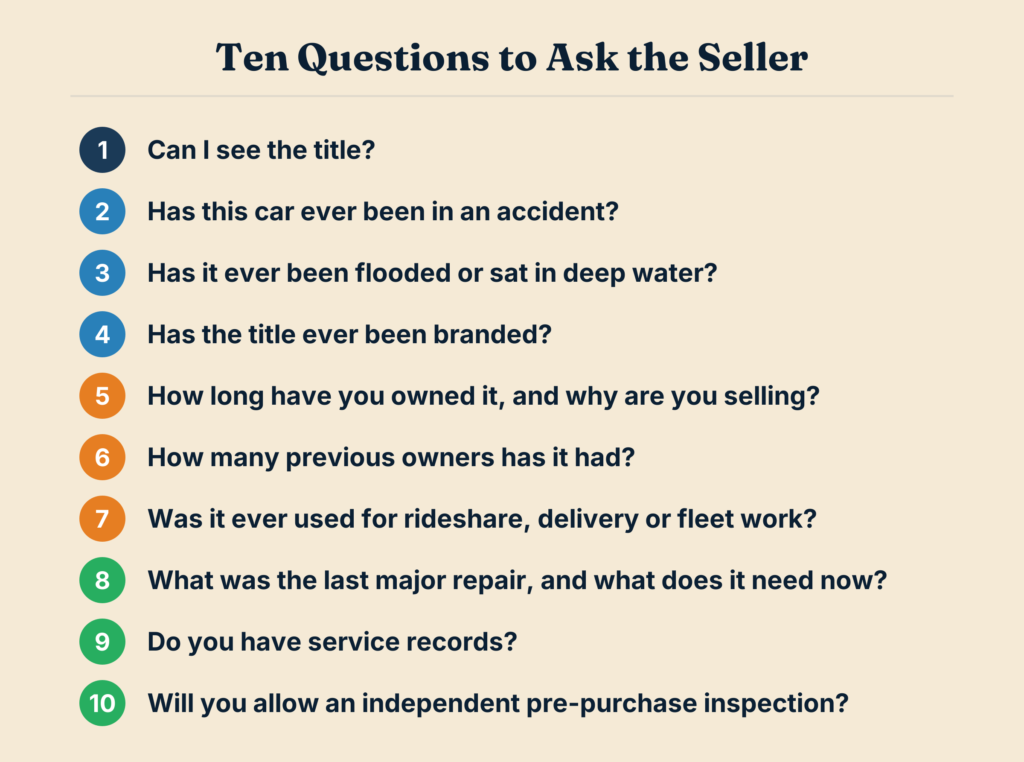
The ten questions below cover history, ownership, condition, and paperwork. Ask the first one first and the rest in any order, but ask all of them. The cost of an awkward conversation is zero. The cost of skipping these questions and buying a problem car can run into thousands of dollars.
Start With the Title
Before anything else, ask one question. “Can I see the title?” This is the single most important sentence in any used-car transaction. The title proves the seller actually owns the car, shows whether the title carries any brands like salvage, rebuilt, flood, or lemon, and reveals whether a finance company still holds a lien against the vehicle.
If a private seller cannot show a title in their own name, no money goes to the seller until that is settled. If they do produce a title but it’s in someone else’s name, you may be dealing with a curbstoner. Common explanations include “it’s in the mail,” “the bank has it,” “I lost it but I can transfer with a duplicate,” and “we’ll handle that at the DMV.” Any of them can be true: a lender usually keeps the title until its loan is paid off, and in some states a title may exist only as an electronic record.
None of them is a reason to pay the seller on a promise. A clean private sale happens where the title can be dealt with directly: with a paper title in the seller’s name in hand, at the lender’s office when a loan has to be paid off, or through the motor vehicle agency when the title is electronic.
Whatever form the title takes, check that the name on it matches the seller’s ID. Verify the VIN on the title against the VIN on the dashboard plate (visible through the windshield) and the VIN on the driver’s door jamb sticker. All three should match exactly. Mismatches indicate a clone, a stolen vehicle, or paperwork that has been altered. Before the meeting, run a free VIN check before you visit so you already know what the public records say.
Questions About the Car’s History
Questions two through four cover the car’s past. Sellers who ran the car for years usually answer these without hesitation. Sellers who recently acquired the car or who are hiding something tend to hedge. The pattern of the answer matters as much as the content.
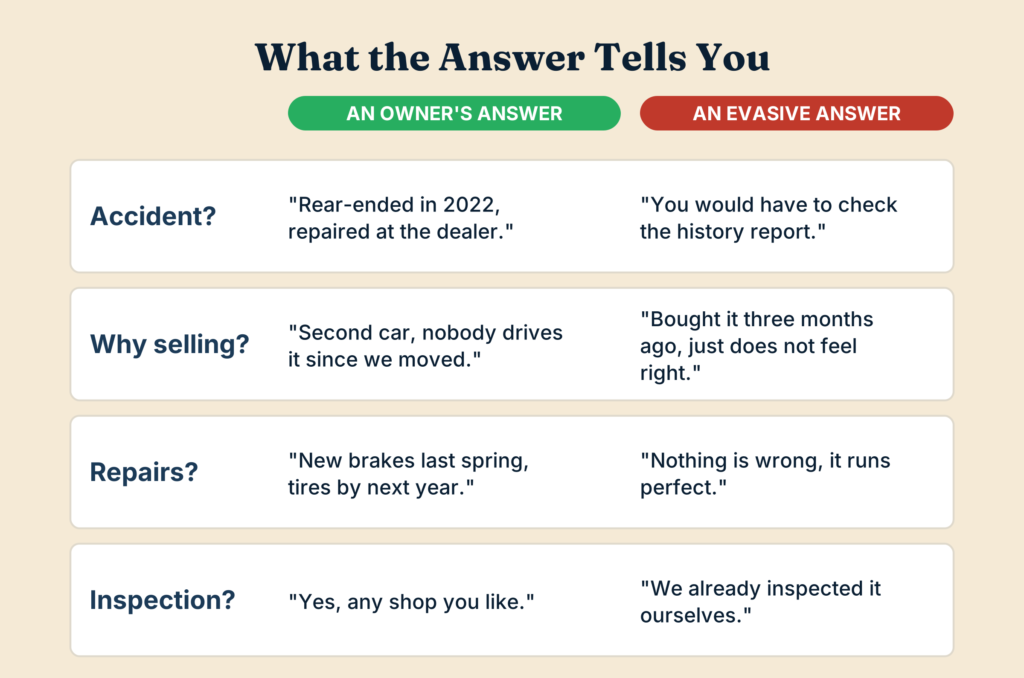
“Has this car ever been in an accident?” Listen to how they respond. A short “no” or a short “yes, rear-ended in 2022, repaired at the dealer” is a confident answer. Wandering responses, “I don’t think so” answers, or “you’d have to check the history report” deflections suggest the seller either does not know or does not want to say. Cross-check against a vehicle history report afterward.
“Has it ever been flooded or sat in deep water?” Worth asking even if the seller is in Arizona, because flood vehicles travel. Days after Hurricane Ian, Georgia’s Attorney General warned that sellers move flood-damaged cars to a state that does not brand the title, then sell them back home or anywhere else with a clean-looking title. A car with a prior registration in Florida, Texas or another storm state deserves closer inspection regardless of what the seller says.
“Has the title ever been branded?” Specific brand language matters here. Ask about salvage, rebuilt, flood, lemon, and junk by name. Some titles get washed across state lines and come out clean even when the brand history is real, which is why a cross-check against an NMVTIS-approved provider matters more than the title document on its own.
Questions About the Seller’s Story
Questions five through seven reveal whether the seller is the long-term owner they appear to be, or a flipper trying to offload a problem vehicle. The story a seller tells about why they are selling, how long they have owned the car, and what they used it for is harder to fake than paperwork. People who own a car for years can talk about it in detail. People who bought it a month ago to flip cannot.
“How long have you owned it, and why are you selling it?” A coherent story about why someone is selling is normal: upgrading, downsizing, kids out of the house, moving, a second car nobody drives. Incoherent or vague stories are a flag. The biggest warning sign is short ownership combined with no clear reason. “Bought it three months ago, just doesn’t feel right” usually means the seller hit a problem and wants out before the next buyer notices. The pattern is one of several red flags when buying from a private seller that experienced buyers learn to spot.
“How many previous owners has the car had?” More owners means more transitions, more chances for skipped maintenance, and more chances something was concealed in a sale. A 2018 vehicle on its second owner is reasonable. The same vehicle on its fifth owner is a different proposition entirely. Compare the seller’s count with a vehicle history report, which normally shows the number of owners; some reports count dealers that held the car in between. The Consumer Reports used-car inspection checklist covers the physical signs of how those owners treated it.
“Was it ever used for rideshare, delivery, or any commercial purpose?” Uber, Lyft, DoorDash, Amazon Flex, and similar gig-economy vehicles can pile up miles far faster than a personal-use car, on top of heavier wear from constant stop-and-go driving and idling. A ride-share consultant told Consumer Reports that drivers put as much as 1,000 miles a week on their cars. Taxi service, fleet use, and rental returns are worth asking about too. Some vehicle history reports flag commercial use; some do not. Ask directly, and watch the answer.
Questions About Condition and Maintenance
The final three questions get to what the car is actually like to own. Honest sellers welcome these. Dishonest ones do not. The answers also tell you what to budget for in the first year of ownership, which is information you need whether the seller is honest or not. Dealers field these questions every day, and how they respond is one of the surer red flags when buying from a dealership, alongside the pressure tactics most buyers already know about.
“What is the most recent major repair, and what does the car need now?” Any vehicle more than five years old has a repair history. A seller who claims “nothing’s wrong, runs perfect” on a seven-year-old car is either inattentive or dishonest. A truthful answer sounds like “new brakes last spring, the AC compressor is starting to make noise, probably needs tires by next year.” That kind of detail is what an actual owner says about their own car.
“Do you have service records or maintenance documentation?” Records are the difference between a seller’s claim and a verified history. Receipts from oil changes, timing belt service, transmission fluid changes, brake jobs, and major component replacements turn a vague “well-maintained” into evidence. No records means every maintenance claim the seller makes is just a claim. Discount the asking price accordingly when records are missing.
“Will you allow a pre-purchase inspection by an independent mechanic?” This question filters legitimate sellers from problem ones faster than any other. A confident “yes” from a private seller or dealer suggests they have nothing to hide. A “no,” a delay, a “we already inspected it ourselves,” or a “you can have it checked after you buy it” answer means walk away. The Federal Trade Commission’s mandatory Buyers Guide on nearly every dealer-sold used car explicitly tells the buyer to ask the dealer whether the mechanic can inspect the vehicle on or off the lot. An inspection costs about $100 to $200, the cheapest insurance available against the alternative.
The Bottom Line
The ten questions take about fifteen minutes to ask and answer in person. Their value is that they force the seller to commit to specific facts before money changes hands. Anything later contradicted by paperwork, a vehicle history report, or a mechanic’s inspection can become evidence of fraud rather than buyer’s remorse. Spoken answers are hard to prove later, so ask the most important questions again by text or email. A seller who answers all ten without hesitation is probably honest. A seller who cannot or will not is telling you something. Treat the conversation as the first inspection. For the full sequence of checks every buyer should run, see our complete fraud prevention playbook.