
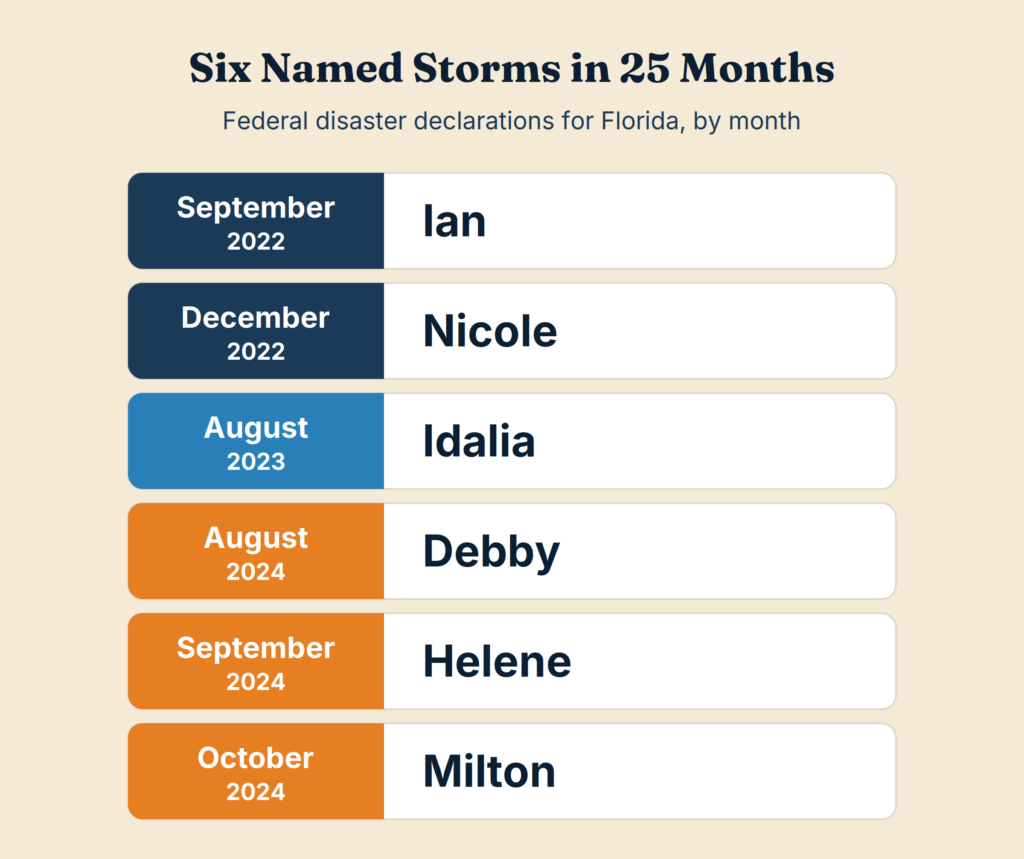
A Florida used car comes with less statutory cover than the state’s fraud record would suggest. The Federal Trade Commission’s latest data book ranks it first among the states for reports per resident, and six named storms, from Ian to Milton, brought federal disaster declarations within 25 months. Against that, the code offers no warranty law for secondhand vehicles, no three-day right to return one, and a lemon law that reaches a later owner only inside the first two years. Its strength lies elsewhere: title brands that follow a damaged car for life, a felony for odometer tampering, and a free official lookup that shows what a certificate carries before any money moves.
This guide answers the same questions about Florida used car laws as every page in our state guides series, so the rules here can be set beside any other. Each statute below links to the official code, directly or through its chapter in the resources list, and the dates of our checks are at the end.
On this page
- Florida at a glance
- What a seller must give you before you sign
- Warranties, as-is sales and the lemon law
- Title brands and how to check a title
- Odometer law
- Dealer licensing, curbstoning and the dealer bond
- Used car scams in Florida
- Your remedies
- The numbers and the cases
- What sets Florida apart
- How to file a complaint
- Official resources
- Frequently asked questions
- Sources and verification
Florida at a glance
| Question | Florida |
|---|---|
| Used car warranty law | None. Dealers may sell as-is with the FTC Buyers Guide; the implied warranty of merchantability applies unless disclaimed (§ 672.314). |
| Can a dealer sell as-is | Yes. “As is” excludes implied warranties (§ 672.316(3)(a)); the disclaimer must be written, conspicuous and in lay terms (§ 501.976(6)). |
| Lemon law and used cars | Chapter 681 covers new and demonstrator vehicles; a used car only when it changes hands within 24 months of the first delivery (§ 681.102). |
| Consumer protection law | Florida Deceptive and Unfair Trade Practices Act, § 501.204 and § 501.211: actual damages, no multiplier; attorney’s fees to the prevailing party (§ 501.2105); a written demand letter to a dealer 30 days before suit (§ 501.98); four years to sue (§ 95.11(3)(e)). |
| Odometer tampering | State offense: third-degree felony, up to five years and a $5,000 fine (§ 319.35); civil remedy: none in that section, so 49 U.S.C. § 32710, three times actual damages or $10,000, whichever is greater; against a dealer, also actual damages under § 501.211 for the practice listed in § 501.976(12). |
| Dealer license needed after | No fixed number of sales is allowed. Buying, selling, offering or displaying three or more vehicles in any 12 months raises a rebuttable presumption of dealing, so two stay under it (§ 320.27(1)(c)). |
| Dealer bond and recovery fund | Bond $25,000 (§ 320.27(10)); recovery fund: none for car buyers (§ 320.781 covers mobile homes and recreational vehicles only). |
| Salvage threshold | Insured vehicle: any claim paid to replace it. Uninsured vehicle: repair cost of 80 percent or more of replacement cost. Late-model vehicle worth $7,500 or more with repairs at 90 percent or more of retail value: certificate of destruction (§ 319.30(3)). |
| Title brands issued | On a salvage title: Rebuildable, Rebuildable Flood, Salvage Theft. On a certificate of title: Rebuilt, Flood Damaged, Total Loss Vehicle, Assembled from Parts, Manufacturer’s Buy Back, and prior use as taxicab, police vehicle or short-term lease vehicle (§ 319.14, § 319.30, FLHSMV procedures TL-36 and TL-37). The full list is in the brands table below. |
| Return or cooling-off right | None, and no three-day right to cancel. FLHSMV: “There is no cooling off period under Florida law” (Buying from a Licensed Dealer). |
| Small claims limit | $8,000, not counting costs, interest and attorney’s fees (Florida Small Claims Rule 7.010); county court up to $50,000 (§ 34.01). |
| Where to complain | FLHSMV Bureau of Dealer Services regional office, form HSMV 84901; Motor Vehicle Fraud Unit, 850-617-2907; Attorney General, File a Complaint, 1-866-966-7226. |
| Official lookups | Motor Vehicle Information Check (brands and odometer on a Florida title, free); lists of licensed dealers; NMVTIS for other states. |
| Last verified | 1 to 3 October 2026, against the 2026 Florida Statutes; next review October 2027. |
What a Florida seller must give you before you sign
Federal law supplies the first document. The Used Car Rule, 16 CFR Part 455, makes any business that has sold or offered five or more secondhand vehicles in the previous twelve months display a Buyers Guide on each one, stating whether it comes with a warranty or as-is. We found no state window form that replaces it.
The state’s own disclosure statute is § 319.14. Before the sale closes, the seller must tell the purchaser in writing that the car served as a taxicab, in a police fleet or on short-term lease, that it is rebuilt, assembled from parts or flood-damaged, or that a manufacturer bought it back under the lemon law. An advertisement has to say the same. Knowingly selling in breach is a second-degree misdemeanor, which § 775.082 punishes with up to 60 days in jail.
That duty has a limit. Under subsection 10 it ends once a former lease car has passed to an owner for private use, and that owner may ask the department for a corrected title without the statement. A manufacturer buyback in private hands gets the same treatment after 36,000 miles or 34 months, whichever is later.
We found no statute that makes a seller disclose an earlier accident on a secondhand car as such; the damage disclosure in § 501.976, subsection 19, covers new stock only. For used sales the same section bars a dealer from misstating previous usage or status, and from saying a car has no structural damage unless that is said in good faith after an inspection. Knowingly selling or installing a fake airbag is a second-degree felony under § 860.146.
Mileage is disclosed on the certificate itself. Every Florida title carries an odometer statement, and § 319.225 requires the transferor to complete it and the transferee to sign; failing to do so is a second-degree misdemeanor. The section exempts anything above 16,000 pounds gross rating or not self-propelled, model year 2011 and newer once a vehicle turns 20, and 2010 and older after 10.
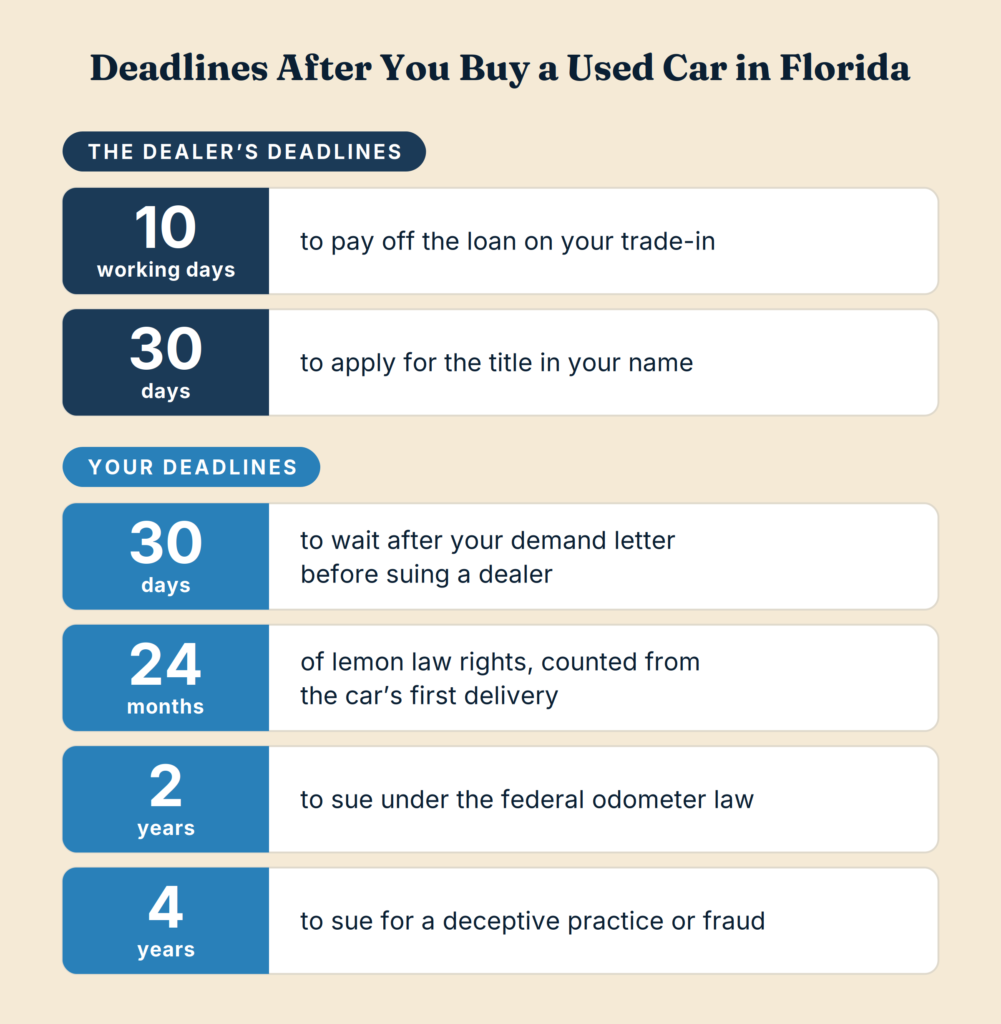
A licensed dealer must apply for the title in the buyer’s name within 30 days of delivery (§ 319.23, subsection 6). The paper plate issued meanwhile is a temporary tag, valid for the same period, with normally no more than two per person and vehicle (§ 320.131). A trade-in that still has a loan against it must be paid off within 10 working days of the business acquiring it (§ 319.24(5)).
Open titles are barred. In a private sale the person selling must be the owner named on the face of the certificate, or it will not be accepted for transfer (§ 319.22, subsection 3). Passing on a title that does not show the purchaser’s name is illegal, and doing so knowingly with intent to commit fraud is a first-degree misdemeanor. Whoever sells without delivering an assigned certificate faces a fine of up to $500, six months, or both under § 319.34.
No provision we found caps a dealer’s own fee, whether billed as documentary or “predelivery service”. What the law limits is which items may be billed and how they are shown. An advertised price must include every charge the customer has to pay except taxes, tag, registration and title fees (§ 501.976(16)).
Subsection 11 bars adding to the cash price anything beyond what § 520.02 and rule 69V-50.001 of the Florida Administrative Code allow, and the permitted additions must be disclosed in every binding contract. FLHSMV adds that dealers “can charge only the actual amount of fees paid for tax, tag and title transfer”. Each document with a predelivery line must print a set sentence saying that the amount represents costs and profit to the dealer.
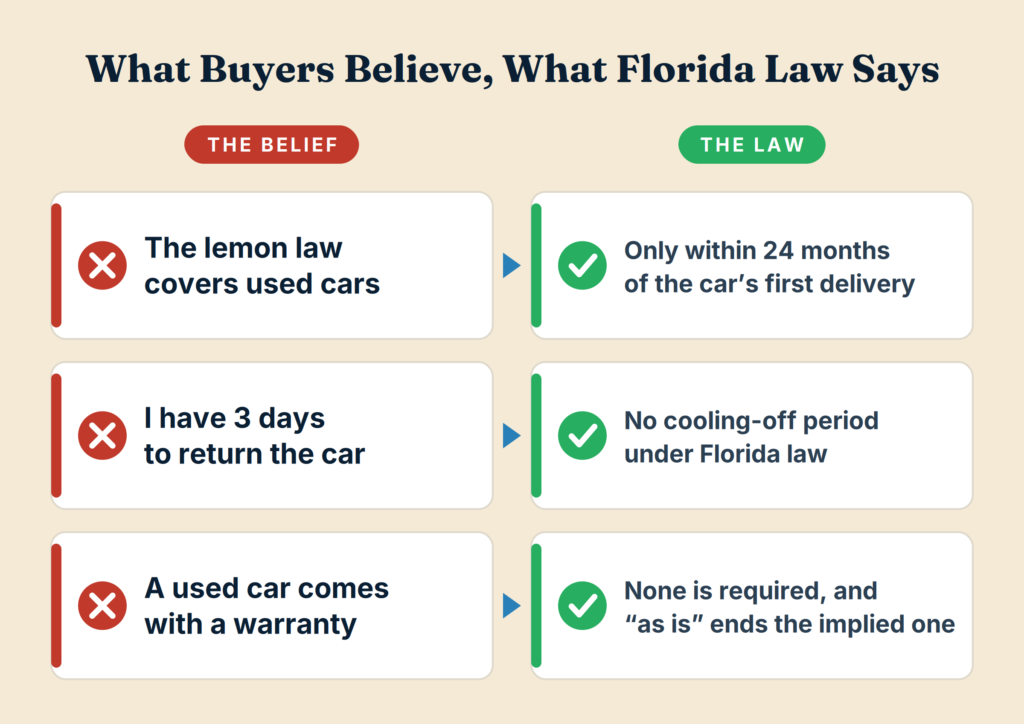
State law gives no right to return a used car. FLHSMV’s dealer page, linked in the table above, puts it in two sentences: “Many consumers mistakenly believe they have three days to cancel the purchase contract. There is no cooling off period under Florida law.” The one statutory exit is narrow. Where the sale is financed through the dealer on a retail installment contract, a customer who has not yet received the vehicle may rescind, and get back all payments and the trade-in, until the seller has delivered or mailed a copy of the signed agreement (§ 520.07, subsection 1).
Florida has no periodic safety or emissions inspection: Title XXIII of the statutes, which holds the motor vehicle chapters, contains no such chapter. The only check tied to a transfer concerns identity. A car arriving from another state needs its VIN verified, by a sworn affidavit of seller and purchaser or on form HSMV 82042 after a physical examination by a law enforcement officer, a licensed dealer, a license inspector or a Florida notary (§ 319.23(3)).
Warranties, as-is sales and the lemon law
No statute requires a warranty on a secondhand car in this state. FLHSMV says it in one line, “Used vehicles are not required to have a warranty”, and the Attorney General’s consumer page adds that “there is no Used Car Lemon Law”. What a buyer has by default is the implied promise of merchantability in § 672.314, the state’s version of the Uniform Commercial Code: goods sold by a merchant must be fit for their ordinary purposes.
That promise binds merchants only, so it attaches to a dealer’s sale and not to a private one; the Attorney General’s guidance says private sellers “do not provide implied warranties under state law”. It can also be signed away. Under § 672.316, subsection 3, expressions like “as is” or “with all faults” exclude it, and § 501.976(6) requires the disclaimer to be in writing, conspicuous and in lay terms.
Two limits protect the purchaser. A seller that gives a written warranty, or enters into a service contract within 90 days of the sale, cannot disclaim the implied terms at all under the federal Magnuson-Moss Act (15 U.S.C. § 2308). And failing to honor a promise that was not properly disclaimed is itself a deceptive practice under § 501.976(7).
Chapter 681, the Motor Vehicle Warranty Enforcement Act, covers new and demonstrator vehicles sold in the state. § 681.102 sets a “Lemon Law rights period” of 24 months from the original delivery and counts as a consumer anyone to whom the car is transferred for the same personal, family or household use during that time. A used purchase inside those two years therefore carries the remaining rights with it; a later one has none. That is Florida’s whole answer to the question of lemon laws and used cars by state.
The presumption in § 681.104 is three repair attempts for the same defect, then written notice to the manufacturer by registered or express mail and one final attempt. The alternative is 30 cumulative days out of service, with notice due at 15. The remedy is a refund or a replacement within 40 days, and “the consumer has an unconditional right to choose a refund”.
Disputes go first to the manufacturer’s own program if the state has certified it, then to the Florida New Motor Vehicle Arbitration Board, which sits within the Attorney General’s office. § 681.109 sets the deadline: a request for arbitration no later than 60 days after the rights period ends, or within 30 days after the certified procedure’s final action, whichever date is later. The Lemon Law Hotline is 1-800-321-5366, and a $2 fee on each new vehicle sale or lease funds the program (§ 681.117).
A car the maker took back cannot be resold unless the defect is clearly disclosed and its correction is warranted for one year or 12,000 miles, whichever comes first (§ 681.114). Its title is stamped “Manufacturer’s Buy Back”.
State law sets no standard for “certified pre-owned” that we could find. The general rules apply: a dealer may not describe a vehicle’s condition or servicing unless the claim is true and supportable (§ 501.976(4)) and may not misrepresent warranty coverage or its transfer terms (subsection 8).
Title brands, total loss and how to check a Florida title
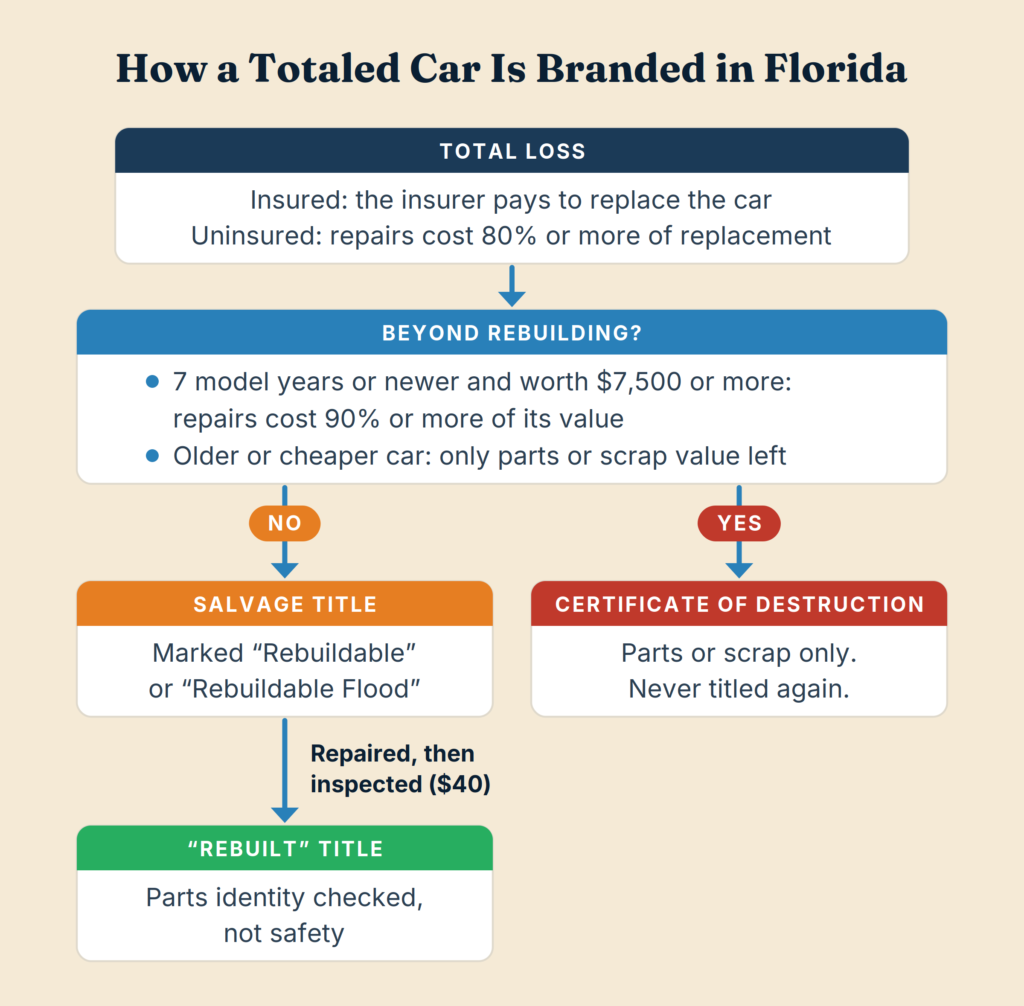
Everything starts with the definition of total loss in § 319.30, subsection 3. An insured vehicle is one when the insurer pays the owner to replace it with another of like kind and quality, or pays on its theft. An uninsured one qualifies when the repair bill is 80 percent or more of the cost of replacing it. So the salvage threshold is a fixed percentage only for cars with no insurance company behind them; for the rest, the claim payment decides.
Within 72 hours the paperwork goes to FLHSMV, which issues one of two documents. A salvage title, branded “Rebuildable” in the department’s total loss procedure, lets the car be repaired and returned to the road under a new brand. A certificate of destruction does not. For a late-model vehicle, seven model years or newer, worth at least $7,500, a repair estimate of 90 percent or more of retail value brings the unrebuildable document, and the statute adds that no title may be issued for it again.
An older or cheaper car gets the same certificate when it is fit only for parts or scrap, or when it arrives from another state on a title marked not repairable.
Storm losses have a category of their own. § 319.14 defines a flood vehicle as a total loss “resulting from damage caused by water”, and its salvage paper reads “Rebuildable Flood”.
When a car arrives with another state’s water brand, the department’s rebuilt vehicle procedure has the Florida title issued as “Flood Damaged”, carried forward for life; an owner or dealer who knows of water damage can have a car branded by affidavit. Subsection 4 of the same statute carries forward any brand for condition or prior use, including one on a foreign certificate. The one exception is subsection 10, for the lease and buyback statements described earlier.
The weak point is how a brand gets applied in the first place. FLHSMV’s flooded vehicles advisory is candid: cars “are not inspected prior to being branded”, the label depends on an insurer reporting the loss, and because standards vary across the country “a flood damaged vehicle from another state can be sold in Florida with a clean title”. Flood damage that nobody reports leaves no mark on the record.
The way a brand is lost between jurisdictions is the subject of our pillar on how title washing works nationwide. A flooded car that leaves the state unbranded enters the interstate flood car pipeline, where a later certificate shows nothing.
A salvage car cannot be sold as repaired until FLHSMV has examined it and stamped the title. The work is done by a Bureau of Dealer Services compliance examiner or, in twelve counties, by a private facility authorized under § 319.141. The fee is $40, with $20 for each repeat visit, and a “Rebuilt” decal goes on the vehicle. Removing that decal to hide the status is a third-degree felony.
The statute describes that examination as a check “to assure the identity of the vehicle and all major component parts” that were repaired or replaced. A report the department sent to the Legislature on 31 October 2015 said the process is designed to keep stolen parts out and “does not include a safety inspection”. The Rebuilt stamp speaks to where the components came from, not to how the car drives.
These are the brands and documents a buyer can meet, as the statutes and the department’s procedures name them.
| Brand or document | What it means | Source |
|---|---|---|
| Salvage, “Rebuildable” | A total loss that may be repaired; it must pass the rebuilt examination before it is sold as a repaired car | § 319.30(3); procedure TL-36 |
| Salvage, “Rebuildable Flood” | The same, where the loss was caused by water | § 319.14(1)(c)8; procedure TL-36 |
| “Salvage Theft” | An insured vehicle paid out as a total loss because it was stolen and not recovered | § 319.30(3)(a); procedure TL-36 |
| Certificate of destruction | Dismantling or destruction only; no title may be issued for the vehicle again | § 319.30(3)(c) |
| “Rebuilt” | Built from salvage or junk, examined by the department or an authorized private facility, decal fixed; the title says the vehicle was “rebuilt and may have previously been declared a total loss vehicle due to damage” | § 319.14(1)(b); § 319.23(2) |
| “Flood Damaged” | Issued where another state’s title shows a Water Damage or Flood Damage brand, and carried for the life of the vehicle; an owner or dealer who knows of water damage may also have a car branded by affidavit | Procedure TL-37; § 319.14(4) |
| “Total Loss Vehicle” | An insured vehicle repaired by agreement at a cost above 100 percent of replacement | § 319.30(3)(a)2 |
| “Insurance-declared total loss” | A wheelchair-accessible vehicle reissued as salvage rebuildable instead of destroyed | § 319.30(3)(c) |
| Assembled from parts, kit car, glider kit, replica, custom vehicle, street rod | Built or altered outside a manufacturer’s normal production, as each term is defined | § 319.14(1)(c) |
| “Manufacturer’s Buy Back” | Repurchased by the manufacturer under the lemon law; a later private owner may have the stamp removed once subsection 10 applies | § 319.14(1)(a), (10) |
| Prior use | Stamped with the previous use as a taxicab, police vehicle or short-term lease vehicle; a later private owner may have the lease statement removed | § 319.14(1)(a), (10) |
| Mileage notation | Title and registration stamped to show that the displayed mileage is inaccurate | § 319.35(3) |
The state runs a free lookup, the Motor Vehicle Information Check, linked in the table at the top. Enter a VIN or a Florida title number and it returns the vehicle description, any brand and the last recorded odometer reading. It covers this state’s records only. For history elsewhere the federal source is NMVTIS, the Justice Department’s database, reached through approved providers.
Before buying any Florida used car, run that check and compare it with the paper in the seller’s hand, where a brand must be stamped “in a conspicuous place”. Our guides to the free VIN check and to reading a vehicle history report show what each source can and cannot see.
A certificate here may exist only as an electronic record, in which case the lookup above is how ownership is confirmed. For the paper trail, form HSMV 90510 requests a title history printout, which lists the owners, for $1.00, or the complete history with scanned images at $1 per page, with $25.00 asked as a first payment. Personal details are released only under a privacy exemption listed on the form.
Odometer law in Florida
§ 319.35 makes it unlawful to knowingly tamper with, adjust, alter, set back, disconnect or fail to connect an odometer so that it shows fewer miles than the car has run. Supplying a written mileage statement known to be false is covered, as is knowingly bringing into the state a vehicle whose instrument was illegally altered. So are possessing, selling, offering, concealing and disposing of one with knowledge of the tampering. The disclosure duty in § 319.225 and its exemptions are covered in the first section.
Any intentional violation is a third-degree felony. § 775.082 sets the prison term at up to five years and § 775.083 the fine at up to $5,000. The section has no separate grade for a second offense. A tampered car held or sold with intent to defraud is contraband, open to seizure and forfeiture.
Repair is lawful: a replaced unit that cannot show the true figure is set to zero, with a written notice on the door frame giving the earlier mileage and the date.
The section itself is criminal only. Money damages come from federal law: 49 U.S.C. § 32710 makes anyone who violates the odometer chapter with intent to defraud liable for three times the actual damages or $10,000, whichever is greater, plus costs and a reasonable attorney’s fee. The action must be brought within two years. Altering mileage is also a listed dealer practice under § 501.976(12), which opens the state consumer protection act against a dealer.
FLHSMV’s odometer page sends victims to its Motor Vehicle Fraud Unit. The form is HSMV 80122, sent by mail, fax or email to Motorist Services Support. The unit answers on 850-617-2907 and at dmv-enforcement@flhsmv.gov. NHTSA routes individual cases to the state and takes reports of large schemes on its Vehicle Safety Hotline, 888-327-4236.
The mechanics are in our pillar on why odometer fraud still works, and the inspection routine is in five physical signs of an odometer rollback.
One recent change touches the section. Chapter 2026-39, Laws of Florida, in force since 1 October 2026, altered a cross-reference in subsection 1(b); the acts covered and the penalty are as before.
Dealer licensing, curbstoning and the dealer bond
Nobody may deal in cars without a license (§ 320.27, subsection 2). The threshold sits in the definition: “Any person who buys, sells, or deals in three or more motor vehicles in any 12-month period or who offers or displays for sale three or more motor vehicles in any 12-month period shall be prima facie presumed to be engaged in such business.” Read literally, that leaves two private sales a year; the third raises the presumption.
The presumption can be answered. The definition leaves out people who are not in the trade and are disposing of cars acquired for their own use in good faith.
Curbstoning, in the sense of posing as a private owner while dealing in volume, is therefore a crime here: a second-degree misdemeanor under subsection 8 and, by subsection 2, an unfair and deceptive trade practice as well. FLHSMV’s page for sellers uses the word for parking a vehicle for sale on a public right of way, or on private land without permission. Auction transactions, court proceedings, estates and transfers by operation of law aside, only the titled owner or a licensee may advertise a car. The warning signs are in our guide on how to spot a curbstoner before you hand over cash.
Subsection 9 lists what can cost a business its license when the conduct forms a pattern: misrepresentation in a sale or its financing, withholding the odometer statement or a copy of the contract, and failing to apply for the title. The department may also fine a licensee up to $1,000 per violation. It publishes no penalty schedule that we found.
Every dealer files a $25,000 surety bond or letter of credit for each license period (subsection 10). It is conditioned on honoring written contracts and not violating Chapters 319 and 320, and it runs “in favor of any person in a retail or wholesale transaction who shall suffer any loss” from such a violation. The surety’s total liability in any one year stops at the face amount, so several claimants share the same sum.
The statute sets out no claims procedure beyond one duty: when the department finds that a person has lost money through a violation, it must give written notice that the security exists. FLHSMV’s complaints page adds that its offices tell customers the name of the dealership’s surety company. There is no recovery fund for car buyers; the trust fund in § 320.781 pays claims against mobile home and recreational vehicle sellers only.
FLHSMV publishes lists of every license holder by name, with type, number and county. On 1 October 2026 they held 11,121 independent entries (type VI, the license a Florida used car lot holds), 1,811 franchised, 621 salvage, 237 wholesale and 68 auction, by our count of the published rows. The agency’s statement of organization gives the Bureau of Dealer Services the job of investigating complaints against “any licensed or unlicensed dealer”.
Used car scams in Florida
FLHSMV names “three main types of motor vehicle fraud”: tampering with odometers, falsifying titles and cloning vehicles. The table below adds four more that the department or the Federal Trade Commission has documented, and cites the cases prosecuted in the state where there are any. We found no official ranking by frequency, so the order is ours.
| Scam | What the record shows | How to check |
|---|---|---|
| Odometer rollback | One of the three main types of fraud FLHSMV names. A Winter Garden dealership owner pleaded guilty in federal court in December 2024: readings cut by as much as 428,000 miles, hidden behind “exempt” titles on cars more than 10 years old. Under state law, tampering is a third-degree felony (§ 319.35). | Compare the dashboard with the last reading in the Motor Vehicle Information Check; look at pedal and seat wear; ask for the maintenance records. |
| Title fraud and fake liens | FLHSMV: altering a title, or giving false information to obtain one. In a federal case sentenced in February 2025, counterfeit towing and storage lien papers filed at tax collector offices cleared bank liens from more than 100 vehicles, which were sold to unsuspecting buyers. Under state law, forging a title or a lien cancellation is a third-degree felony (§ 319.33). | On a paper title look for erasure marks and misspellings; match the VIN and the seller’s ID to the title. |
| Cloned or stolen cars | FLHSMV: stolen VINs, counterfeit VIN tags and fraudulent documents; a cloned car “will be confiscated, leaving you responsible for any outstanding loans”. In March 2025 the Attorney General charged six people over stolen cars given fraudulent VINs, titles and tags; the charges are allegations. Knowingly selling a car with an altered VIN is a third-degree felony under § 319.33. | Check the dashboard VIN plate for scratches or other damage; verify ownership in the Motor Vehicle Information Check; walk away from a price far below comparable cars. |
| Flood cars with clean titles | FLHSMV’s advisory: cars are not inspected before a flood brand is applied, and a flood-damaged vehicle from another state “can be sold in Florida with a clean title”. Knowingly selling a branded car without written disclosure is a second-degree misdemeanor under § 319.14. | Check for brands in the Motor Vehicle Information Check and through NMVTIS; smell for mildew; look for a waterline or mud in the glove box, under the dash and in the trunk. |
| Curbstoning | An unlicensed dealer posing as a private seller. FLHSMV’s statement of organization lists “curbing unlicensed dealer activity” among the tasks of its Bureau of Dealer Services. Buying, selling or offering three or more vehicles in 12 months raises the presumption of dealing (§ 320.27), and passing on a title without the purchaser’s name on it is illegal (§ 319.22). | FLHSMV’s private sale page: the name on the seller’s driver license or ID card must match the name on the title. |
| Dealer add-on fees | The Federal Trade Commission and the State of Illinois sued a dealer group in 2022 over junk fees for unwanted add-ons; four of the eight dealerships named were in Florida, and a second round of refunds went out in November 2023. Leaving a dealer charge out of the advertised price, or adding one outside the permitted list, is a deceptive practice under § 501.976. | Read the contract before signing; FLHSMV says it should carry an itemized list of costs. Compare the total with the advertised price. |
| Fake dealership websites | A Federal Trade Commission alert of 1 September 2026, not specific to Florida: scammers clone a real dealer’s website, often with AI, and take payment up front for a car the buyer never receives. Under § 817.034 each message sent in a scheme to defraud is a third-degree felony when $300 or more is sought. | See the car and the dealership in person; walk away if the seller insists on an upfront payment by wire transfer only; report it at ReportFraud.ftc.gov. |
If one of these has already happened, the remedies and the complaint steps are set out below.
Your remedies under Florida law
The consumer protection statute is the Florida Deceptive and Unfair Trade Practices Act, Part II of Chapter 501. § 501.204 declares unlawful “unfair or deceptive acts or practices in the conduct of any trade or commerce”, and § 501.211 lets a person who has suffered a loss recover actual damages plus attorney’s fees and court costs. There is no multiplier for knowing or intentional conduct.
For car sales the act is specific. § 501.976 lists nineteen dealer practices that are actionable under it, among them misstating a vehicle’s previous use, hiding warranty terms, having a customer sign an incomplete contract, adding undisclosed fees to the cash price and altering the odometer.
Notice comes before suit. § 501.98 requires a written demand letter to the dealer at least 30 days before any lawsuit or arbitration under the chapter. It must name both parties, set out the facts and the damages, enclose the documents, and go by mail or a national carrier, return receipt requested, to the place of sale or an address where the seller regularly does business.
The letter has teeth on both sides. If the dealer pays the amount demanded within 30 days, plus a surcharge of 10 percent of the damages up to $500, no suit may follow and the claim is released. A buyer who sues without sending it can have the case stayed on a timely motion, and the fees run up before complying are lost. The rule applies only where the dealer gave the customer the statutory written notice of it and the customer acknowledged it; limitation periods stop for those 30 days.
Fees cut both ways. § 501.2105 allows them to “the prevailing party”, not to the consumer alone, so a purchaser who loses can be ordered to pay the other side’s lawyers.
An action founded on a statutory liability must be brought within four years (§ 95.11(3)(e)), and the same period applies to one founded on fraud. For fraud the clock runs from when the facts were discovered or should have been, with an outer limit of 12 years from the act (§ 95.031, subsection 2).
Public enforcement belongs to the state attorney, or to the Florida Attorney General where a violation touches more than one judicial circuit, the local prosecutor defers in writing, or 90 days pass without action on a written complaint (§ 501.203). Civil penalties run to $10,000 per willful violation (§ 501.2075) and to $15,000 where the victim is aged 60 or older, has a disability or is a military servicemember (§ 501.2077). The enforcing authority may also sue for consumers’ actual damages.
A dealer that sells on installment contracts needs a license from the Office of Financial Regulation (§ 520.03). For a willful breach of the installment sales rules the buyer may recover the finance charge and any delinquency fees, with attorney’s fees (§ 520.12). A guaranteed asset protection product may be offered but never made a condition of the loan.
Small claims court takes disputes up to $8,000 not counting costs, interest and attorney’s fees; the limit comes from Florida Small Claims Rule 7.010 and is stated on the clerks’ own pages, Miami-Dade’s among them. The county bench goes to $50,000 (§ 34.01(1)(c)), and larger actions belong to the circuit level. On arbitration clauses the car statutes say one thing: § 501.98 counts arbitration as litigation, so the demand letter comes first there too.
Two federal remedies apply everywhere: the odometer act’s triple damages, and the Magnuson-Moss Warranty Act, 15 U.S.C. § 2310, subsection d, which lets a consumer sue for breach of a written or implied warranty and recover attorney’s fees. Prevention is cheaper than any of them, and the checks to run before paying are in the complete buyer’s fraud prevention playbook.
The numbers and the cases in Florida
The Federal Trade Commission’s Consumer Sentinel Network Data Book 2024, published in March 2025, ranks Florida first among the states for fraud and other reports: 2,163 per 100,000 residents, 474,314 in all, with $866.1 million reported lost and a median loss of $520. “Auto Related” was the seventh-largest category, at 3 percent of all reports from the state, identity theft included; the book gives a share, not a count. The 2025 edition had not been published when we checked.
FLHSMV’s own figures describe volume. Its ten-year title report counts 9,565,402 motor vehicle title transactions in the twelve months to June 2025. The last report it published on rebuilt cars, dated 1 July 2021, recorded 66,973 rebuilt inspections in fiscal 2019/20.
We found no published count of certificates carrying a flood or salvage brand, of dealer complaints received, or of licenses revoked.
Exposure is easier to document. FEMA’s database, queried on 1 October 2026, lists 86 major disaster declarations under Florida since 1953, 38 of them coded as hurricanes; four of the 86 were made for the Seminole Tribe of Florida. Six named storms have been added since September 2022: Ian, Nicole, Idalia, Debby, Helene and Milton. We found no government count of the vehicles those storms flooded.
The enforcement log is a selection from the last three years, newest first.
13 March 2025, Florida Attorney General. The Office of Statewide Prosecution charged six people with racketeering and conspiracy to commit racketeering. According to the release, the group stole vehicles, frequently from rental companies, that “were then assigned fraudulent VINs, titles, and tags” and were transferred or sold. The Attorney General put the number at upward of 80 cars.
11 February 2025, US Attorney, Middle District of Florida. An indictment charged three people with conspiracy over high-end vehicles stolen across the state between June 2020 and May 2021. According to the indictment the VINs were altered, the cars were moved on semi-trucks across state lines and sold, and for an additional fee the purchaser received a California registration and title.
Charges in those two cases are allegations; every defendant is presumed innocent until proven guilty.
10 February 2025, the same federal office. A St. Petersburg man was sentenced to 14 years and 7 months for a scheme that stripped bank liens from more than 100 vehicles. The conspirators filed counterfeit documents and fake certified mail receipts with Florida tax collector offices to make it look as though the cars had towing and storage liens, obtained clear titles and sold them “to unsuspecting buyers”.
13 December 2024, US Department of Justice. The owner of a Winter Garden dealership had pleaded guilty the previous day to three counts of odometer tampering. He bought high-mileage vehicles at Florida wholesale auctions and resold them with readings rolled back by as much as 428,000 miles; because many were more than ten years old he obtained “exempt” titles that did not reveal the true figure. The plea agreement filed with the release counts at least 140 of them.
20 November 2023, Federal Trade Commission. A second round of refunds, more than $857,000 in 37,034 checks, went to customers of a multistate dealer group that the agency and the State of Illinois had sued over junk fees for unwanted add-ons. Four of the eight dealerships named in the complaint were in Florida, and the group paid $10 million to settle.
We found no release in that period from the Attorney General, FLHSMV or the three US Attorney offices on a prosecution for selling undisclosed flood vehicles or for unlicensed dealing.
What sets Florida apart
Not every state gives buyers a lookup of its own; our Texas guide describes one that does not, while the one here is free. A certificate can also be held as an entry in FLHSMV’s database until a paper one is requested: conversion ordered online costs $4.50, takes three to four weeks by mail, and titles “cannot be printed at home”. In a private sale of a car with an electronic record, seller and buyer must go together to a motor vehicle service center with photo identification and complete a secure reassignment there.
The certificate of destruction is the second distinctive feature. Once the 90 percent rule applies, no title may issue again, and the document can be reassigned at most twice before the vehicle must be dismantled. § 319.30 also writes the federal database into state law: an insurer that pays a total loss must notify NMVTIS, and anyone who knowingly sells a car to a salvage dealer, or receives one, without the proper ownership paper or the database notification commits a third-degree felony.
Rebuilt inspections are partly private. A facility in the program must post a $100,000 bond or letter of credit, offer no other service at the site, and attest each year that no repair shop, dealer, towing company, auction, insurer or salvage yard pays it for referrals; FLHSMV has to inspect it at least once a quarter. The department’s 2021 report shows the scale: when the scheme ran in Miami-Dade County alone, its facilities performed 49,238 of the 61,705 examinations done statewide in nine months.
Storms are the constant. FLHSMV keeps a standing disaster page that tells owners a flooded and totaled vehicle may not be offered for sale until the title is branded.
How to file a complaint in Florida
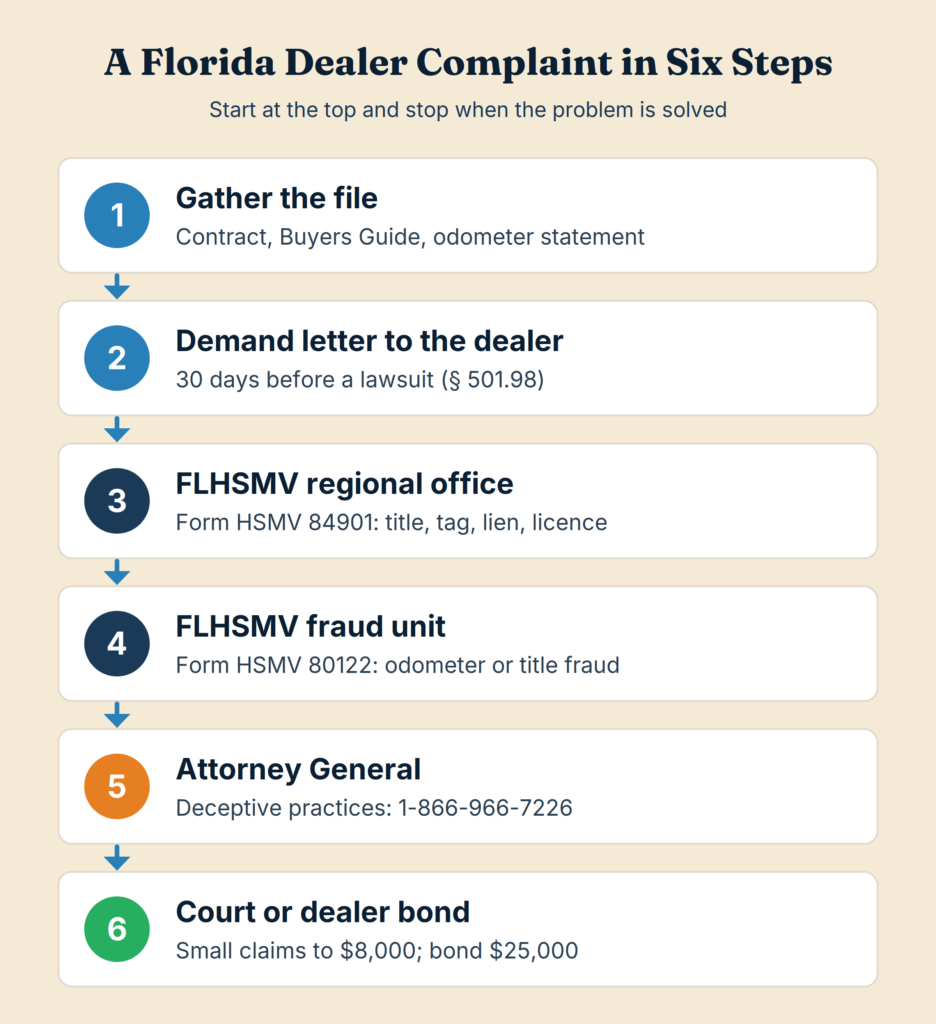
The steps below are the Florida version of how to file a complaint against a car dealer.
- Collect the file: the purchase contract, the Buyers Guide, the odometer statement, the finance agreement, any warranty, repair orders, the advertisement and a printout of the Motor Vehicle Information Check.
- Write to the seller. If the claim is for a deceptive practice, send the demand letter that § 501.98 requires, return receipt requested, and allow 30 days.
- File with FLHSMV. Form HSMV 84901, the Complaint Affidavit, goes by email or mail to the Bureau of Dealer Services regional office for the county where the dealership is located; the form lists all ten. The department deals with a title or tag that was not delivered, a lien that was not released and license violations.
- If the business has closed, ask the same office for an Out-of-Business Affidavit, which may be used to obtain a title, and for the name of the surety behind the bond.
- Report title or odometer fraud on form HSMV 80122 to the Motor Vehicle Fraud Unit, 850-617-2907 or dmv-enforcement@flhsmv.gov, and to local police. For a large scheme add NHTSA’s hotline, 888-327-4236.
- Complain to the Attorney General, whose Consumer Protection Division brings civil cases under the deceptive practices act; complaints go through the File a Complaint page or the fraud hotline, 1-866-9-NO-SCAM (1-866-966-7226).
- Ask for mediation. The Department of Agriculture and Consumer Services takes complaints through its online portal and on 1-800-HELP-FLA (1-800-435-7352). It may mediate but, in its own words, “cannot require businesses to take a particular action such as repairing or replacing a product or refunding money”.
- Take a financing problem to the Office of Financial Regulation, which licenses installment sellers. FLHSMV sends questions about a warranty or GAP product to the Department of Financial Services, 1-877-MY-FL-CFO (1-877-693-5236).
- For a car still inside 24 months of its first delivery, call the Lemon Law Hotline, 1-800-321-5366, before the deadline in § 681.109 passes.
- Claim on the bond or go to court: small claims up to $8,000, the county bench up to $50,000. The state deceptive practices statute, the federal odometer act and Magnuson-Moss all shift attorney’s fees, so a lawyer may take a strong case.
- Tell the federal agencies. ReportFraud.ftc.gov feeds the database quoted above, and the FBI’s Internet Crime Complaint Center, ic3.gov, takes reports of online sales scams.
Official resources
- Florida Statutes, Chapter 319: title certificates, brands, salvage and odometer offenses.
- Florida Statutes, Chapter 320: dealer licensing, the bond and temporary tags.
- Florida Statutes, Chapter 501: the Deceptive and Unfair Trade Practices Act (Part II) and the motor vehicle dealer practices (Part VII).
- Florida Statutes, Chapter 520: retail installment sales, including motor vehicle finance contracts.
- Florida Statutes, Chapter 681: the Motor Vehicle Warranty Enforcement Act, the lemon law.
- Florida Statutes, Chapter 775: the prison terms and fines for each grade of offense, in § 775.082 and § 775.083.
- Florida Statutes, § 817.034: the Florida Communications Fraud Act.
- Florida Statutes, § 860.146: the offenses for fake airbags.
- Florida Administrative Code, rule 69V-50.001: the only charges a retail installment seller may make beyond the cash price.
- Florida Statutes, Title XXIII: the index of the motor vehicle chapters.
- Motor Vehicle Information Check: FLHSMV’s free lookup of a Florida title by VIN or title number.
- Lists of licensed dealers: every licensed franchise, independent, wholesale, auction and salvage dealer.
- Buying from a Licensed Dealer: FLHSMV’s consumer page on warranties, contracts, tag and title.
- Buying from a Private Sale: FLHSMV’s checklist for a sale between individuals.
- Consumer Complaints and Resources: how to complain to FLHSMV and which agency handles what.
- Form HSMV 84901: the Complaint Affidavit, with the ten regional offices.
- Form HSMV 80122: Suspected or Reported Title and Registration Fraud.
- Form HSMV 82042: VIN and odometer verification for a vehicle from another state.
- Form HSMV 90510: request for a title history.
- Flooded vehicles advisory: FLHSMV on flood brands and what to check.
- Flooded vehicles after a disaster: FLHSMV’s instructions to owners.
- Selling a Vehicle: FLHSMV on a private seller’s duties, liens and advertising.
- Motor vehicle fraud: FLHSMV on odometer fraud, title fraud and vehicle cloning.
- FLHSMV, Title Fraud: what title fraud is and how to spot a tampered title.
- FLHSMV, Vehicle Cloning: what cloning is, what a buyer stands to lose and what to check.
- FLHSMV, Electronic Liens and Titles: how an electronic title works and how to convert one to paper.
- Attorney General, File a Complaint: the online form and the postal address.
- Attorney General, Consumer Protection Division: the division that brings civil cases under the deceptive practices act.
- Attorney General, How to Protect Yourself: Buying a Used Car: the state’s own consumer guide.
- Attorney General, How the Florida Lemon Law Works: the arbitration route and its forms.
- Department of Agriculture and Consumer Services, complaint portal: mediation of consumer complaints.
- Office of Financial Regulation, Submit a Complaint or Tip: complaints about motor vehicle finance contracts.
- NMVTIS: the Justice Department’s national title database and its approved providers.
- NHTSA, Odometer Fraud: federal guidance and the Vehicle Safety Hotline.
- FTC, Buying a Used Car From a Dealer: the Buyers Guide explained.
- FTC alert on fake dealership websites: the consumer alert of 1 September 2026.
- ReportFraud.ftc.gov: the Federal Trade Commission’s report form.
- Internet Crime Complaint Center: the FBI’s report form for online scams.
Frequently Asked Questions
Does Florida have a used car lemon law?
No. A Florida used car falls outside Chapter 681, which covers new and demonstrator vehicles; both FLHSMV and the Attorney General say so. The one opening is timing: a car bought for personal use within 24 months of its first delivery carries the remaining rights to the new owner.
Can you return a used car in Florida?
No. State law gives no cooling-off period and no three-day right to cancel; FLHSMV calls the three-day belief a mistake. The one statutory exit is narrow: where the sale is financed through the dealer on a retail installment contract, a buyer who has not yet received the car may rescind until a copy of the signed agreement is delivered or mailed. A defect in a car still inside 24 months of its first delivery is a separate matter, covered by the lemon law.
Does a used car come with a warranty in Florida?
No law requires one; FLHSMV says so in as many words. A dealer’s sale still carries the implied warranty of merchantability unless the car is sold “as is” in a written, conspicuous disclaimer, and the Buyers Guide on the window shows which applies. The Attorney General’s guidance says private sellers do not provide implied warranties under state law.
What title brands does Florida use?
The salvage certificate is marked Rebuildable, Rebuildable Flood or Salvage Theft, and a repaired car comes back as Rebuilt. Others are Flood Damaged, Total Loss Vehicle, Assembled from Parts and Manufacturer’s Buy Back, plus stamps for prior use as a taxicab, police unit or short-term lease.
How can I check if a car was previously titled in Florida?
Run the VIN through the free Motor Vehicle Information Check; a Florida record returns the description, any brand and the last odometer reading. For a car now titled elsewhere, a report from an NMVTIS provider covers the other states.
Why is Florida a high-risk state for flood damage fraud?
Six named storms brought federal disaster declarations between September 2022 and October 2024, and a flood brand depends on the damage being reported, by an insurer or by an owner or dealer. FLHSMV itself warns that vehicles are not inspected before branding and that a water-damaged car from another state can be sold here with a clean title.
Are dealer fees capped in Florida?
No statute we found caps the fee a dealership sets for itself. Government charges must be passed on at cost: FLHSMV says dealers can bill only the actual amount paid for tax, tag and title transfer. Everything else has to be in the advertised price and disclosed in the contract, and a predelivery item must carry a printed statement that it represents costs and profit to the dealer.
How many cars can I sell in Florida without a dealer license?
The statute names no safe number. Buying, selling, offering or displaying three or more in any 12-month period raises the legal presumption of dealing, so two stay under it. Dealing without a license is a second-degree misdemeanor.
How do I file a complaint against a Florida dealer?
Send form HSMV 84901 to the FLHSMV regional office for the dealer’s county for title, tag, lien and license problems. For a deceptive practice, send the 30-day demand letter and complain to the Attorney General on 1-866-966-7226 or online.
Sources and verification
Statutes: the 2026 Florida Statutes as published by the state Senate (flsenate.gov), read on 1 October 2026, with Chapters 2024-218, 2026-39 and 2026-56, Laws of Florida, for recent amendments.
Federal law: the United States Code on govinfo.gov and 16 CFR Part 455 on ecfr.gov, read the same day.
Agency pages, forms and procedures were read on that date too; procedures TL-36 and TL-37 carry revision dates of February 2026 and August 2025. The small claims limit was read on the Miami-Dade and Palm Beach clerks’ pages. The Federal Trade Commission’s alert on fake dealership websites, § 817.034 and rule 69V-50.001 of the Florida Administrative Code were added on 3 October 2026.
Figures: the FTC Consumer Sentinel Network Data Book 2024; FLHSMV’s ten-year title transaction report, its licensed dealer lists (the license counts are our own count of the rows) and its two reports on rebuilt vehicles; FEMA’s disaster declarations database. This page uses the OpenFEMA API but is not endorsed by FEMA.
Cases: taken from the releases linked. Charges are allegations until proven in court.
Next review: October 2027, or sooner if the Legislature amends any section cited here. Changes: 3 October 2026, first version under this standard. How we check facts is set out in our editorial standards.