The Tag Agent Charged With Washing 65 Stolen Luxury Cars
Every fact, figure and legal citation in this article was checked against its original source before publication. Editorial Standards
Picture the deal as the charging documents describe it. A buyer scrolls Facebook Marketplace in 2024 and finds what looks like the deal of the year: a late-model BMW or Cadillac, priced well below comparable cars in the area, with a Pennsylvania title in the seller’s hand. The title is freshly issued. The paperwork is clean. The deal closes. The buyer drives away thinking they have caught a lucky break.
The car was stolen. The title, prosecutors say, came through Adam Richardson, a Philadelphia-area authorized PennDOT tag agent who is charged with using his access to the state’s title system to launder stolen vehicles for the people who brought them in. The Pennsylvania Attorney General’s office named the investigation Operation Hot Wheels. The charges are allegations, Richardson is presumed innocent unless proven guilty, and this account follows the charging documents and the Attorney General’s statements. It is the first entry in our Case Studies section.
How the Deal Went Down
Adam Richardson, 40, operated a business called Richardson Family Enterprises LLC out of the Philadelphia area. The business held an authorization from the Pennsylvania Department of Transportation to act as a tag agent, a private business contracted to process vehicle title transfers, registrations, and related paperwork on behalf of customers as an alternative to a PennDOT office. The authorization gives such a business direct access to the PennDOT title system. Most tag agents handle routine transactions for buyers, sellers, and dealerships across their region.
According to the Pennsylvania State Police and the charging documents, Richardson processed something else through that same system. Stolen luxury vehicles, most of them taken in Pennsylvania and New Jersey and some from as far away as Texas, were brought to him, and for a fee, investigators say, he submitted falsified paperwork to PennDOT through the standard tag-agent channel. The state issued Pennsylvania titles in response. The vehicles, now holding clean state-issued paperwork, moved into the resale market.
Investigators said Richardson was known to people seeking stolen-car titles as “the tag guy”, the operator who could make stolen-vehicle paperwork look legitimate. Some of the buyers, according to investigators, were knowing participants who came to him because they wanted stolen cars with clean paperwork. Others were ordinary used-car buyers who found the vehicles on Facebook Marketplace. The Pennsylvania paperwork looked legitimate to anyone who checked it against the state’s own title records, because the records were real.
In total, Pennsylvania Attorney General Dave Sunday’s office said Richardson moved 65 stolen vehicles through this process and provided fraudulent documentation to 49 different individuals. The estimated total value of the stolen fleet was $3.8 million, an average of about $58,000 per car. The affidavit of probable cause, as reported by Metro Philadelphia, lists a 2021 Ferrari Portofino valued at $260,000, a 2023 Mercedes-AMG S63 at $200,000 and a 2023 Mercedes-Benz G550 at $165,000. Most of the rest were luxury cars from BMW, Mercedes-Benz, and Cadillac, the kind of vehicle that draws thieves because of high resale value and steady demand.
Where It Fell Apart
The investigation began when the Pennsylvania State Police identified stolen vehicles and found they had been titled through Richardson’s company. From there, state police partnered with PennDOT to launch a broader investigation, and later brought in the Attorney General’s Insurance Fraud Section. Each individual case looked routine in isolation. The aggregate told a different story: over the course of about a year, investigators say, state police linked dozens of stolen luxury cars, with victims across multiple jurisdictions, to the same title company, Richardson Family Enterprises LLC. Operation Hot Wheels, as the Attorney General’s office called it, was based in Philadelphia and Bucks County.
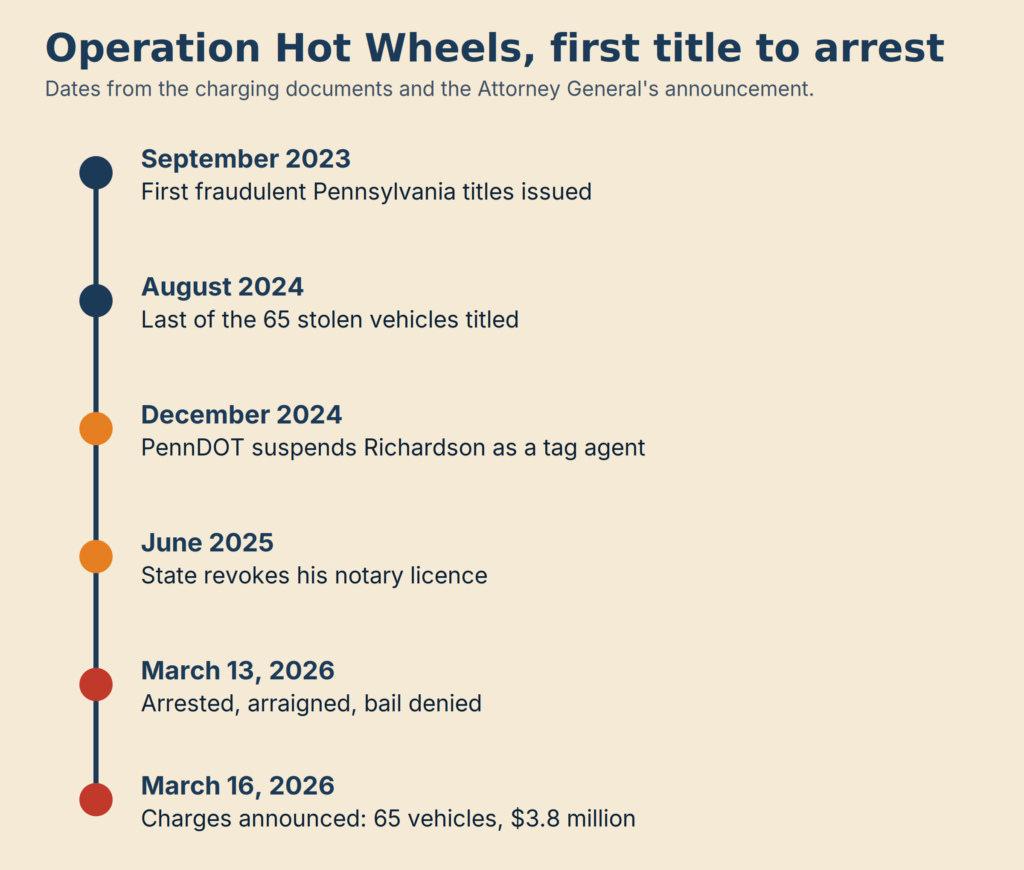
The charging documents describe what investigators found when they worked through the company’s transactions. An informant described Richardson as the “24-hour tag guy,” who could complete an ownership transfer with photographs of an identification card sent by text message. Several people said cars had been transferred into their names without their ever visiting his office near City Avenue; one woman admitted she was paid to have a vehicle placed in her name, and another man’s identity appears to have been stolen for the purpose. Sale prices were often recorded well below market value. PennDOT suspended Richardson’s authorization in December 2024, the state revoked his notary licence the following June, and by March 2026 the case was ready for an arrest.
Pennsylvania Attorney General Dave Sunday announced the charges on March 16, 2026. Richardson had been arrested three days earlier, on Friday, March 13, and arraigned; bail was denied. Sunday said Richardson abused his authority to title 65 stolen vehicles and provided fraudulent documentation to 49 different individuals, and described the alleged scheme as more than paperwork fraud: “washed vehicles provide criminals the means to move around and perpetrate crimes without being detected by law enforcement.”
How the Scam Actually Worked
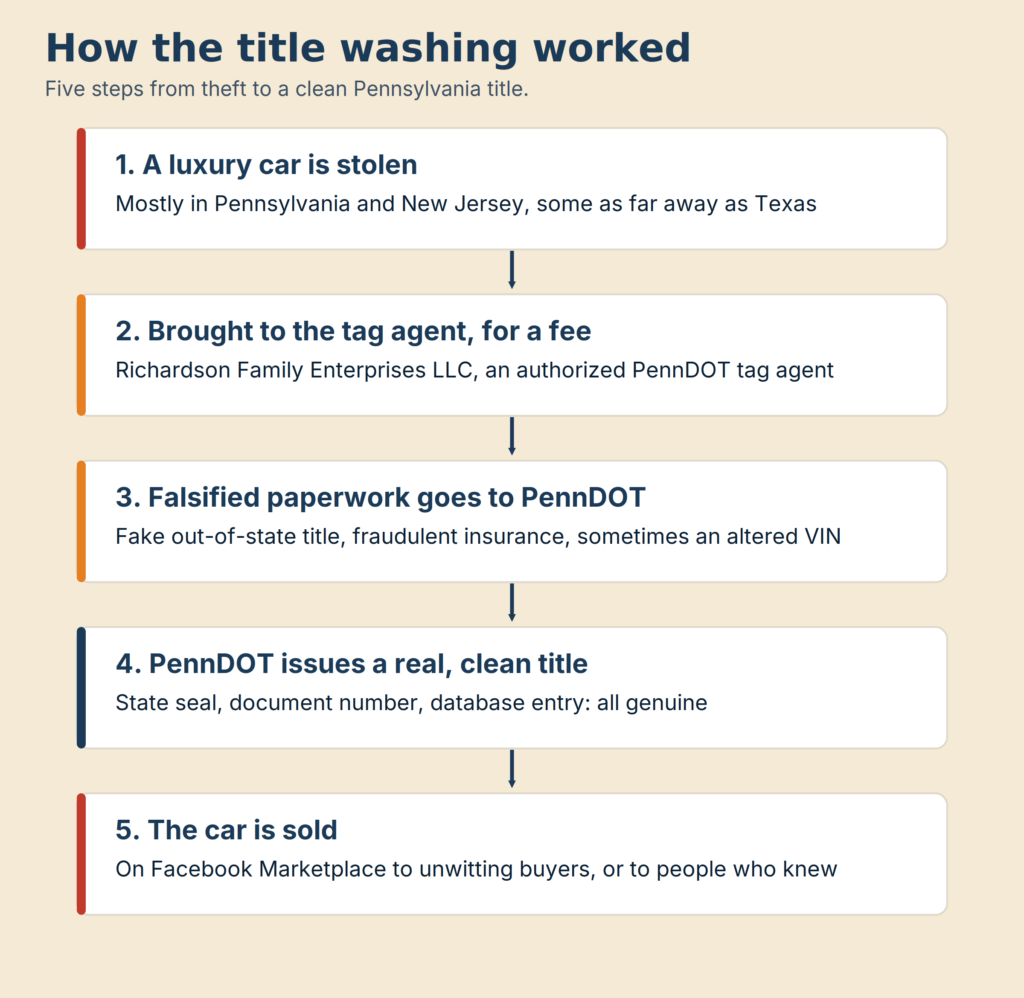
The mechanics turn on what a tag agent’s authorization actually grants. A PennDOT tag agent is a private business, not a state employee, but the business has been vetted and contracted to interact with the PennDOT title system on behalf of the public. The agent submits applications for title and registration. The state processes those applications. From the state’s database perspective, a title issued through a tag agent looks identical to a title issued at any state office.
The alleged scheme exploited that equivalence. Richardson had legitimate access. According to the charging documents, the supporting documents submitted with each title application were forged: fabricated out-of-state titles, fraudulent insurance information and, in some cases, altered vehicle identification numbers. PennDOT processed the applications as it would any other tag agent’s submission, because the state’s system relies on the agent to verify the supporting documentation. The forged documents passed, prosecutors say.
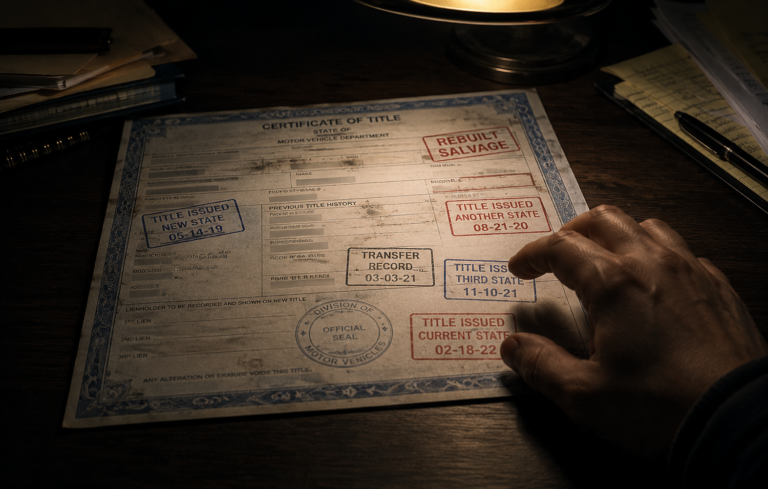
What came out the other end was a real Pennsylvania title with a real state seal, real document number, and a real entry in the PennDOT database. A buyer reading the title and ownership sections of a vehicle history report on such a vehicle would see Pennsylvania ownership consistent with the title in hand. The alleged fraud was not in the title itself but in the supporting documents that justified its issuance, and those documents were not visible to any downstream party. We cover how title washing works and why it persists in our title washing pillar, including the role of authorized intermediaries who can convert stolen-car paperwork into clean state titles in this manner. A step-by-step anatomy of a title washing operation deserves a piece of its own, and it is on our list.
The Red Flags That Were There
For the unwitting buyers, the price was the first signal. Officials said the vehicles were often recorded as sold for well below market value. Luxury cars listed several thousand dollars below comparable market prices, on a platform like Facebook Marketplace, are more likely to be stolen or seriously damaged than to be honest deals. The pattern is not absolute, but it is a strong prior. A 2022 BMW listed at twenty thousand dollars under retail in a private-party sale deserves the question of why.
The transfer itself was a second signal. According to the charging documents, ownership changes were completed with photographs of an ID card sent by text message, at any hour, and several people had cars put in their names without ever visiting the agent’s office. A seller who wants the buyer’s paperwork handled by “their guy” rather than at a PennDOT office or a licensed agent’s counter with both parties present is describing this scheme. The Pennsylvania title, freshly issued shortly before the resale, was a flag in itself for any buyer who knew to read the title’s date of issuance.
The third signal was in the vehicle’s own identity. The charging documents say VINs were altered in some cases and out-of-state titles fabricated, which is why the plain physical checks matter: the VIN plate on the dashboard, the sticker on the door jamb and the number on the title should match exactly, and any sign of tampering on the plate or the sticker ends the conversation. None of the individual buyers had visibility across the full set of 65 vehicles. Investigators did, and that visibility was the case.
The Outcome
Adam Richardson is charged with corrupt organizations, vehicle title washing, forgery, dealing in proceeds of unlawful activity, and related offenses, 16 felony counts and five misdemeanors in all. He was arraigned and denied bail; the case was filed in Dauphin County. As of the announcement his arrest was the only one in the case, but the Operation Hot Wheels investigation is ongoing, and the Attorney General’s office says more charges could be filed in connection with the stolen vehicles. By early October 2026 we had found no report of a plea, a trial date or new charges. The charges remain allegations, and Richardson is presumed innocent unless proven guilty.
Nearly 40 of the 65 vehicles had been recovered by the time of the announcement; the affidavit puts the figure at 37. The rest had not. For buyers who paid for one of the recovered vehicles, the financial outcome is generally bleak: a stolen vehicle returns to its rightful owner regardless of whether the buyer knew it was stolen, and the buyer’s recovery options run through the seller, if the seller can be located and is solvent, and through restitution if the criminal case produces any.
What Buyers Should Take Away
A clean state title is not proof of legitimate ownership. It is proof of paperwork. The Pennsylvania titles issued in this case were real state-issued documents that would pass any check that relies on the issuing state’s database alone. The defense against this category of fraud is to build a verification stack that does not rely on a single document and that cross-checks ownership against independent sources.
For a luxury used-car purchase, the practical sequence is to run a free NICB VINCheck before any other step, because that database flags stolen-vehicle records reported by member insurance carriers regardless of what the title says. Then run a paid vehicle history report, looking specifically for the pattern of brief in-state ownership followed by a private sale. We cover what VIN information reveals about a car’s real identity in our VIN decoding guide, including how to verify the dashboard VIN against the door jamb VIN and the title VIN as a quick consistency check that defeats the most common cloning techniques.
The paperwork is the other half. Do the transfer in person, at a PennDOT office or a licensed tag agent’s counter, with the seller present and the seller’s ID matched to the name on the title. A seller who offers to have the title handled for you, who asks for a photo of your ID by text, or who cannot explain why the car was titled in Pennsylvania only weeks ago, is showing you the mechanics of this case. Walk away, and report the listing.
Discuss this article on r/VINvestigators. Got a listing that looks off, or a report that does not add up? Post it. Over 1,500 members, buyers and trade among them.
New guides and fraud alerts by email, a few times a month, no more. Subscribe on the home page.
Checking a specific car? Get the full vehicle history report from carVertical, an NMVTIS-approved provider, 20% off through our link. The link applies the discount automatically; if you go to carVertical later, the code VINVEST gives the same 20%. We earn a commission from carVertical if you buy; it costs you nothing extra.