How to Read a Vehicle History Report Without Missing the Red Flags
Every fact, figure and legal citation in this article was checked against its original source before publication. Editorial Standards
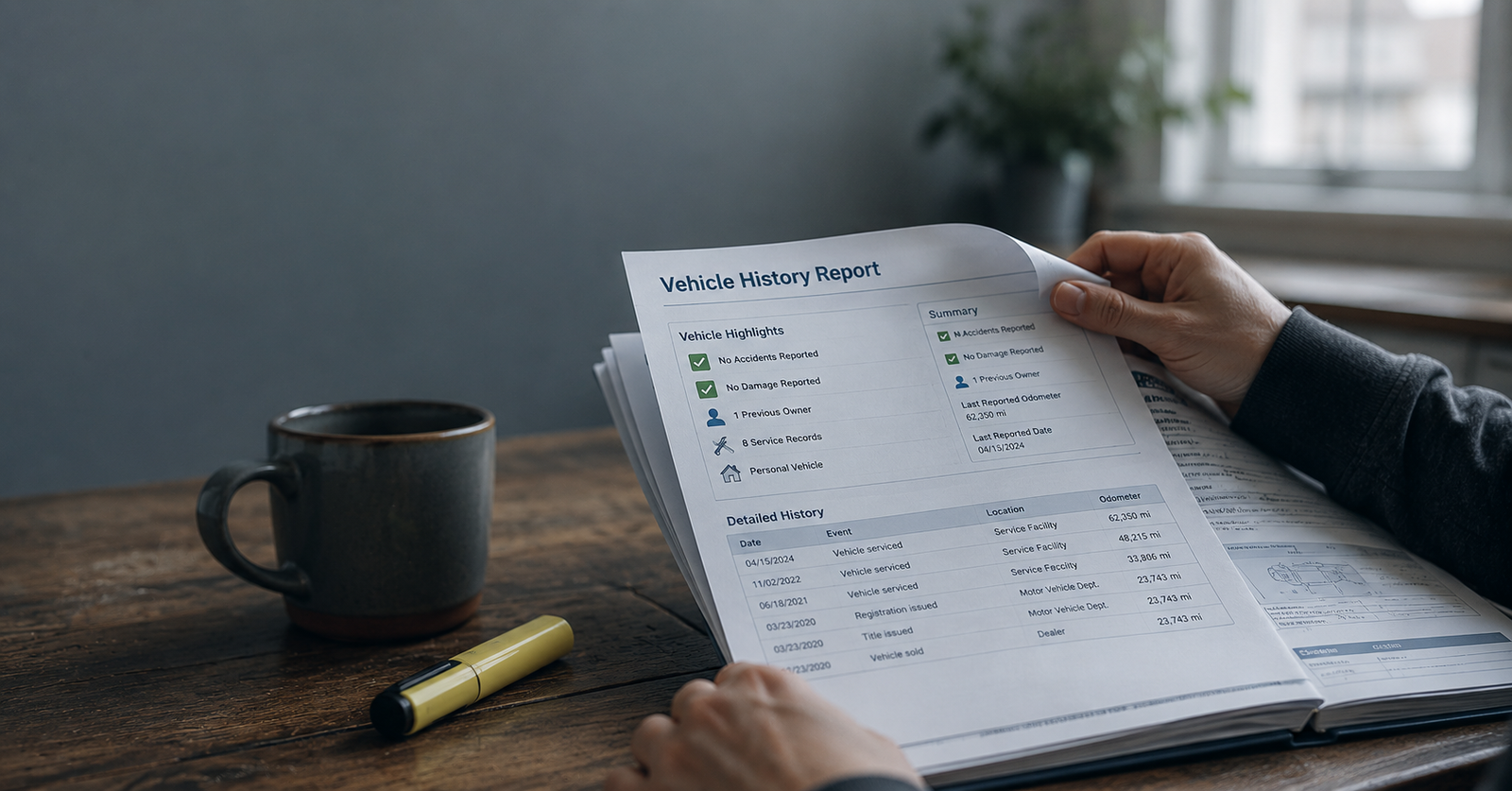
A vehicle history report can run many pages of dense entries: title transfers, registration events, service records, accident notations, mileage readings at every recorded touchpoint. Most buyers scroll through looking for a green checkmark or a red banner and call it done. Knowing how to read a vehicle history report means reading past the summary at the top, because the fraud signals are in the detail below it. They are buried in the chronology, where contradictions between reported events expose the real story of the car.
This guide explains what a typical vehicle history report contains, which sections matter most, and the specific red flags that indicate fraud or hidden damage. It is part of our VIN Guide, alongside the decoding and free-check guides.
What’s Actually in a Vehicle History Report
A commercial vehicle history report is organized into roughly six sections, though the names vary by vendor. An NMVTIS report, from a provider on the Justice Department’s list, holds only the title side of that: the current and earlier states of title, the brands, the latest odometer reading in the title record and the total loss and salvage history, with no accident, service or owner records.
In a commercial report, the title section logs every state where the vehicle has been titled and every brand applied. The accident and damage section reports incidents pulled from police reports, insurance claims, and state DMV records. The odometer section logs every reported mileage reading with date and source. The ownership section counts owners and the duration of each ownership. The service section records dealer and independent shop visits where mileage was logged. The recall section flags open and resolved manufacturer recalls.
Coverage is uneven. Reports show what was reported. Events that never made it into the system do not appear. A vehicle that was repaired by a private mechanic without formal documentation, or that was in an accident the owner paid for out of pocket, will show no record of either event.
Reports also vary by vendor. All 50 states and the District of Columbia now report title data to NMVTIS, but what a report holds beyond the title record depends on which repair shops, insurers, and auctions feed that vendor, so two reports on the same car can differ. The single most useful habit is to start with a free VIN check before paying for a full report, because the National Insurance Crime Bureau’s free VINCheck flags vehicles reported stolen and not recovered, or as salvage or flood damaged, by participating insurers, a separate data source from the paid report.
The Title Section Is Where Most Fraud Hides
The title section deserves the most careful reading because almost every form of used-car fraud leaves a fingerprint there. A title brand is a notation a state DMV applies to a title indicating the vehicle has been damaged, totaled, salvaged, rebuilt, flooded, or otherwise compromised. Common brands include “salvage,” “rebuilt,” “flood,” “junk,” and “manufacturer buyback” (lemon). Each carries a different meaning, but the buyer’s first job is to confirm whether any brand has appeared at any point in the title history.
The most important entry to understand is total loss. An insurance company declares a vehicle a total loss when the cost of repair comes too close to the vehicle’s value; roughly half the states fix a percentage in their title statutes, and the rest leave the call to the insurer. A total loss notation usually means the vehicle was at one point too damaged to repair economically. The vehicle may have since been rebuilt and retitled, sometimes legitimately, sometimes through fraud. Any total loss event warrants additional inspection regardless of what the current title says.
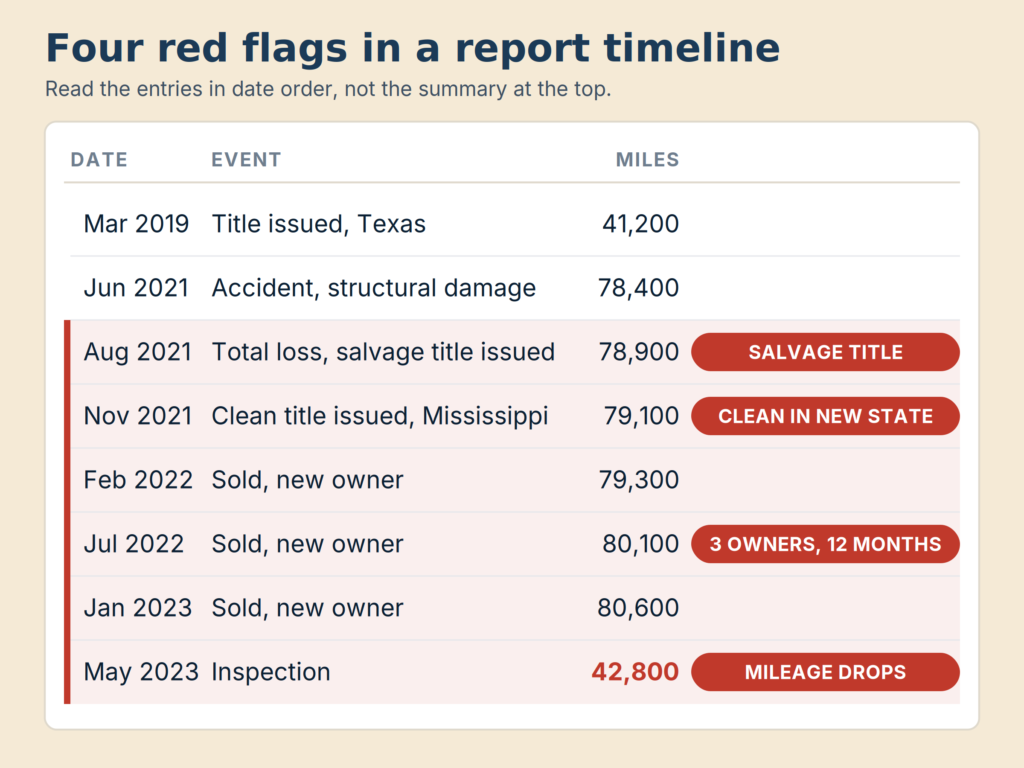
The fraud pattern to watch for is a vehicle showing a damage event or total loss in one state, followed by a clean title in a different state shortly after. That sequence is the signature of title washing, which is the subject of our piece on how title washing hides a car’s real history and the state-by-state weaknesses that allow it. The report can show the chronological breadcrumbs even when the current title is clean, because an NMVTIS report holds the brands every state has applied, not just the current one; a damage event nobody reported leaves none. A clean current title does not erase what came before.
The accident and damage section requires the same chronological scrutiny. Structural damage is the term used when a reported event involved frame or unibody damage, as opposed to cosmetic panel damage. A structural damage entry, even one that the seller insists was professionally repaired, materially reduces the vehicle’s value and warrants an independent frame inspection before purchase.
Reading the Odometer and Ownership Sections
The odometer section is read by looking for arithmetic that does not work. Every reported mileage reading should rise monotonically over time. A vehicle that read 78,000 miles at a 2022 inspection and reads 41,000 miles at a 2024 sale has a problem in the data. The pattern a single rollback leaves is high, then a sudden drop, then readings climbing again from the lower figure, a clear discontinuity in the timeline. The detail on how odometer fraud works and what the numbers really mean is covered in our dedicated odometer fraud piece, including how digital rollbacks now defeat physical inspection of the dashboard itself.
NHTSA’s consumer guidance on odometer fraud recommends requesting a history report to check for discrepancies and comparing the odometer against the title, the maintenance records, and physical wear.
The major reports flag the discontinuity themselves: a reading well below an earlier one is marked as a potential odometer rollback. Any entry carrying that warning should be treated as an unverified discrepancy, and the seller should be asked for documentation.
The ownership history section is shorter but reveals patterns. The number of owners matters less than the duration of each ownership. A vehicle that has had five owners over fifteen years is unremarkable. A vehicle that has had five owners over three years suggests the car has been moving fast through the market, often because each owner discovered a problem and resold rather than fixing it. Short ownership intervals followed by an out-of-state title transfer are also a title-washing signature. The combination of “many short ownerships” plus “title brand on an early title that disappears later” is a strong indicator of a vehicle that has been laundered through the system.
Service gaps are the final signal worth reading. A car with no recorded service for several years, followed by a sudden flurry of activity right before a sale, is a vehicle that may have been sitting on a curbstoner’s lot with cosmetic touch-ups. A personal vehicle serviced at shops that report tends to show steady records year over year.
What a Report’s Score Doesn’t Tell You
Some reports carry a proprietary score, a number on a scale of 1 to 100 displayed alongside a range for vehicles of similar age and class, which the company selling the report says predicts the likelihood that the vehicle will still be on the road in five years. The score is useful as a triage signal: a vehicle scoring well below the range for its peers is worth more careful review, and one scoring within or above the range is a candidate for normal due diligence.
The score’s central limitation is the same as every element of the report: it is calculated from reported events. If incidents were never reported, the score reflects only what was visible to the system, which is to say it can look healthy on a vehicle that has had unreported damage. The score is not a substitute for a pre-purchase inspection and not a guarantee of condition. Edmunds, running the same VIN through two competing reports, found that one had recorded a recent damage event the other had not yet picked up.
For a high-stakes purchase, run a second report from a different provider, or supplement the first with the free NICB VINCheck, which flags unrecovered thefts and salvage from a different data source. We cover what each character in the VIN tells you in our VIN decoding guide, which adds another layer of cross-reference before any report is read.
The Bottom Line
The report is a chronology, not a verdict. Read it in time order, looking for events that contradict each other and for sequences that suggest the vehicle moved through the market faster than a normal personal vehicle would. The title section, the odometer timeline, and the ownership intervals carry more diagnostic weight than the summary score at the top. A clean current title that follows a damage event or total loss in another state is the single most reliable signal that more investigation is needed.
Combine the report with a free NICB check, a frame and ECU inspection from an independent mechanic, and a careful look at the title document itself, and most of the fraud patterns surface before money changes hands.
Discuss this article on r/VINvestigators. Got a listing that looks off, or a report that does not add up? Post it. Over 1,500 members, buyers and trade among them.
New guides and fraud alerts by email, a few times a month, no more. Subscribe on the home page.
Checking a specific car? Get the full vehicle history report from carVertical, an NMVTIS-approved provider, 20% off through our link. The link applies the discount automatically; if you go to carVertical later, the code VINVEST gives the same 20%. We earn a commission from carVertical if you buy; it costs you nothing extra.