
A used car bought from a dealer in this state can be returned: since the Combating Auto Retail Scams Act took effect, the buyer of a used vehicle priced at $50,000 or less has a three-day right to cancel (Civil Code § 1784.43), the only such right in our series so far. The same law gives a secondhand buyer no lemon law refund unless a new car warranty came with the sale, requires no warranty from an ordinary dealer and prints no flood brand on a title. Its strength is the paper it forces on the trade: an NMVTIS history report shown before the sale, a smog certificate, a $50,000 bond and a recovery fund that pays up to $35,000 when a dealership closes.
This guide answers the same questions about California used car laws as every page in our state guides series, so the rules here can be set beside any other. Each statute below links to the official code, directly or through the resources list, and the dates of our checks are at the end.
On this page
- California at a glance
- What a seller must give you
- Warranties and the lemon law
- Title brands and total loss
- Odometer law
- Dealer licensing and the bond
- Used car scams
- Your remedies
- The numbers and the cases
- What sets California apart
- How to file a complaint
- Official resources
- Frequently asked questions
- Sources and verification
California at a glance
| Question | California |
|---|---|
| Used car warranty law | None for an ordinary dealer: an as-is sale with the FTC Buyers Guide is allowed (Civil Code § 1792.4). A buy here pay here dealer must give a written warranty of 30 days or 1,000 miles (Civil Code § 1795.51) |
| Can a dealer sell as-is | Yes, with a conspicuous written notice attached to the car before the sale (Civil Code § 1792.4); never for a car sold as “certified” (Vehicle Code § 11713.18) |
| Lemon law and used cars | Song-Beverly Consumer Warranty Act (Civil Code § 1793.2): the refund or replacement remedy covers a new motor vehicle; a used car qualifies only when a manufacturer’s new car warranty was issued with its sale (Rodriguez v. FCA US, 2024). A used car sold with the dealer’s own written warranty gets the implied warranty for 30 days to three months (Civil Code § 1795.5) |
| Consumer protection law | Consumers Legal Remedies Act, Civil Code § 1780: actual damages, restitution, punitive damages, up to $5,000 more for a buyer aged 65 or older or disabled, attorney’s fees to a winning consumer; written notice 30 days before a damages suit; three years. Unfair Competition Law, Business and Professions Code § 17204: restitution and an injunction, four years |
| Odometer tampering | State offense: a misdemeanor, up to six months in county jail and a $1,000 fine (Vehicle Code § 28051, § 40000.15, § 42002); civil remedy: none in that article, then 49 U.S.C. § 32710, three times the damages or $10,000, whichever is greater, then the Consumers Legal Remedies Act against a dealer |
| Dealer license needed after | No number in the statute: anyone who sells for money or is in the business of selling is a dealer (Vehicle Code § 285); a private person may sell a vehicle acquired and used in good faith for their own use (§ 286) |
| Dealer bond and recovery fund | Bond $50,000 (Vehicle Code § 11710); recovery fund: yes, up to $35,000 per transaction when the dealer has closed or filed for bankruptcy (Vehicle Code § 12208) |
| Salvage threshold | None in percent: a car is a total loss salvage vehicle when the owner or the insurer considers it uneconomical to repair and it is not repaired, or when an insurer pays a total loss claim (Vehicle Code § 544) |
| Title brands issued | Salvaged, Warranty Return (Lemon Law Buyback), Original or Prior Taxi, Original or Prior Police, Grey Market, Remanufactured, Park Trailer (DMV procedures manual, 1.025); no flood and no rebuilt brand; the full list is in the brands table below |
| Return or cooling-off right | Yes, at a dealer: three days to cancel a used vehicle priced at $50,000 or less, driven no more than 400 miles, for a restocking fee of $200 to $600 plus up to $150 for miles over 250 (Civil Code § 1784.43); none in a private sale |
| Small claims limit | $12,500 for a person (Code of Civil Procedure § 116.221) |
| Where to complain | DMV Investigations Division, online complaint portal, 1-800-777-0133; Attorney General, complaint form, 800-952-5225 |
| Official lookups | No free state title or brand check: the dealer must show you the NMVTIS report, and a private buyer orders one from an approved provider; dealer license: Occupational License Lookup |
| Last verified | 15 October 2026, 2026 code; next review October 2027 |
What a California seller must give you before you sign
Every dealer posts the federal Buyers Guide on each used vehicle it offers (16 CFR Part 455). It says whether the car is sold as is or with a warranty. The state adds a document of its own: before a dealer may display or offer a used vehicle for retail sale, it must obtain an NMVTIS history report for that VIN (Vehicle Code § 11713.26). If the report shows a junk or salvage history, a total loss or a title brand, the dealer posts a red “WARNING” sticker next to the Buyers Guide and hands you a copy when you ask.
Disclosures at sale are federal and state at once. The seller writes the odometer reading on the title or on form REG 262, with the buyer’s signature beside it (DMV procedures manual, chapter 5); the federal rule exempts a vehicle once it is 20 years old, and every vehicle of model year 2010 or older (49 CFR § 580.17).
A car that has been a total loss carries a salvage certificate instead of a title, and the certificate tells each later seller to disclose that status before the sale, on pain of a civil penalty of up to $500 (Vehicle Code § 11515(h)). A lemon law buyback carries its own brand, decal and signed disclosure, described in the brands table. An advertisement must disclose that the selling dealer itself used the car as a demonstrator, rental, loaner or lease vehicle (Vehicle Code § 11713(t)); we found no statute that makes a seller volunteer an earlier owner’s rental use or prior accident damage.
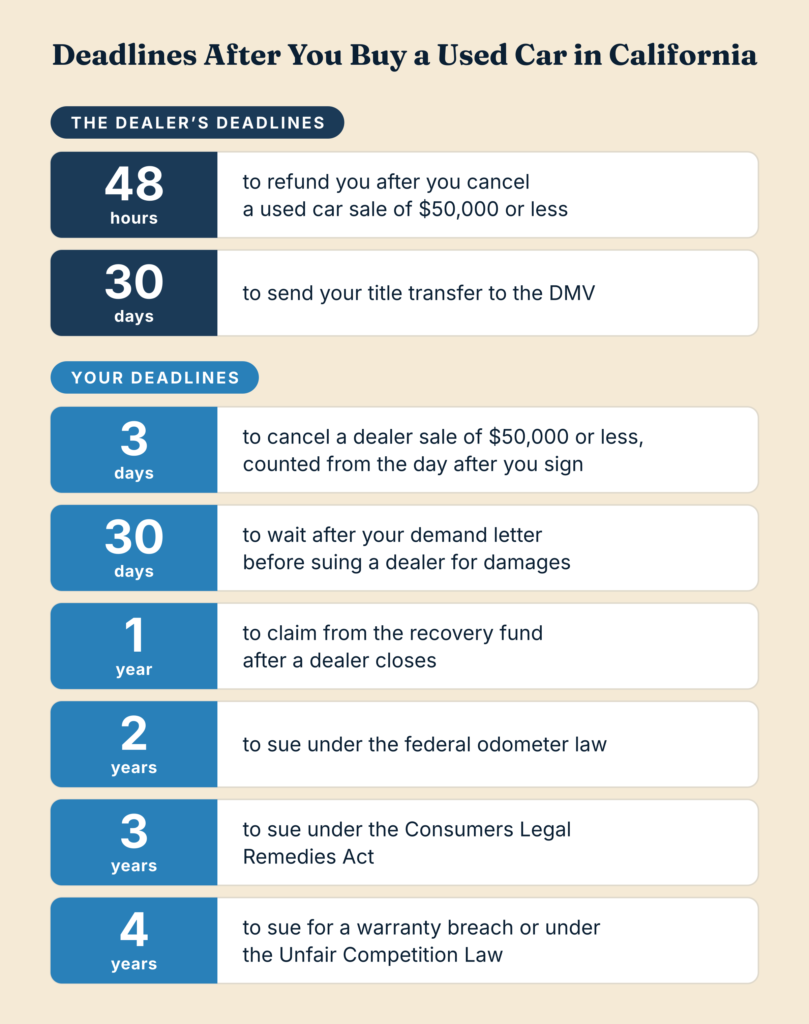
Title delivery has a clock. A dealer sends the registration or transfer application with all fees to the DMV within 30 days of the sale, and the car runs on the report of sale and temporary plates for at most 90 days (Vehicle Code § 4456).
In a private sale the seller reports the transfer within five days (§ 5900) and the buyer forwards the certificate of ownership with the fee within ten (§ 5902). Failing to endorse, date and deliver the certificate to a buyer is unlawful, and a lender that holds it has 15 business days after payoff to release it or owes a $25 daily penalty (§ 5753).
Fees are capped and named. A dealer’s document processing charge is at most $85, or $70 for a dealer without a DMV filing contract, and neither it nor the electronic filing charge may be presented as a government fee (Vehicle Code § 4456.5). An advertised price must include every cost except taxes, registration, the tire fee, finance charges, those two items, the smog certificate fee and an emission test of up to $50 (§ 11713.1).
Since 1 October 2026 the CARS Act goes further. The total price must appear in any advertisement for a specific vehicle and in the dealer’s first written reply about one; an add-on must be disclosed in writing as optional before you sign; and a dealer may not charge for an add-on you cannot benefit from, such as an oil change plan on an electric car or a service contract void because of prior flood damage (Civil Code §§ 1784.41 and 1784.42). Thirteen listed misrepresentations are violations in themselves (§ 1784.40).
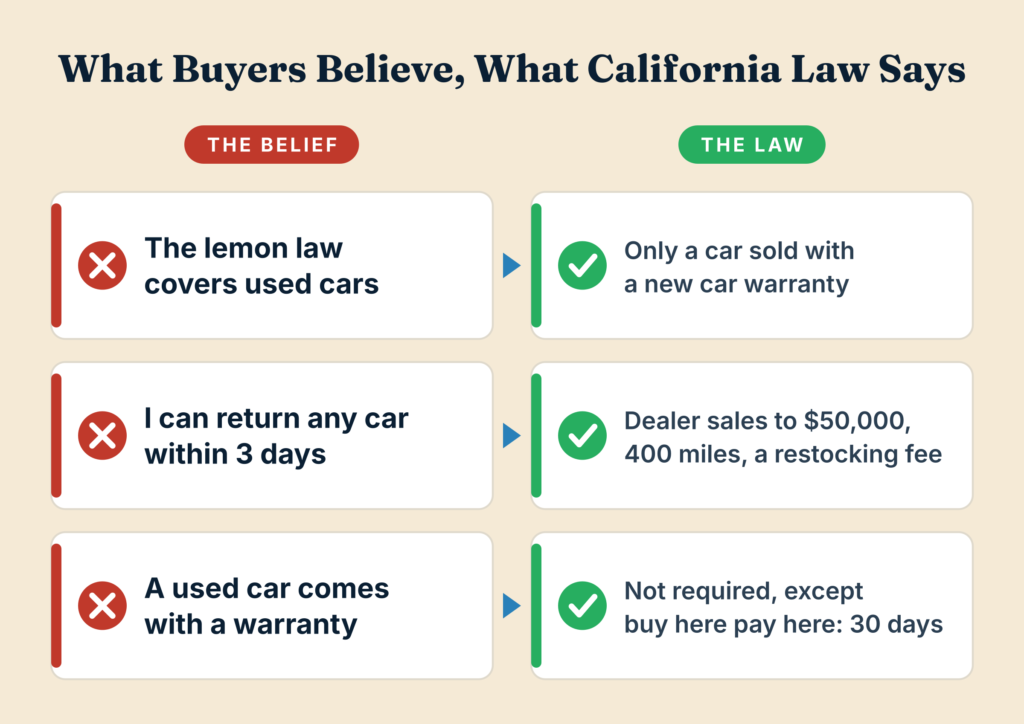
Can you return a used car in California? From a dealer, yes, for three days. The paid two-day cancellation option was repealed on 1 October 2026 and replaced by a right every dealer must give: a used vehicle sold at retail for $50,000 or less may be returned for any reason within three calendar days, counted from the day after you sign and ending at the close of business on the third, or the next time the dealership is open; the statute counts calendar days (Civil Code § 1784.31). The car must come back with no more than 400 miles added, free of new liens and in the condition you took it, less normal wear.
The dealer may keep a restocking fee of 1.5 percent of the price, not less than $200 nor more than $600, plus $1 for each mile over 250 up to $150, and must refund the rest within 48 hours (§ 1784.43). The right does not cover a private sale, a vehicle over $50,000, a motorcycle, a truck rated 10,000 pounds or more, a fleet or business purchase, an auction sale or a lessee buying the car they already drive, and the contract’s first page must say in capitals that new vehicles have no cooling-off period.
Inspection touches every California used car sale. The seller, private or dealer, must give the buyer a valid smog certificate of compliance at or before delivery (Vehicle Code § 24007); it is good for 90 days, and a dealer’s for two years or until the sale. The Bureau of Automotive Repair’s smog check page lists the exemptions: vehicles four model years old or newer pay a transfer fee instead, and gasoline models of 1975 and older, diesels of 1997 and older, electric vehicles, motorcycles and transfers within a family need no test. There is no safety inspection at sale, apart from the revived salvage vehicle covered below.
Warranties, as-is sales and the lemon law
No statute requires a warranty on a used car sold by an ordinary dealer. What the law supplies is the implied warranty of merchantability, which comes with every retail sale by a merchant (Commercial Code § 2314) and may be excluded with the words “as is” or “with all faults” (§ 2316). For consumer goods the exclusion takes a fixed form: a conspicuous writing attached to the car before the sale, saying that it is sold as is, that the risk as to quality is the buyer’s and that the buyer pays for every repair (Civil Code § 1792.4).
Our guide to what “as-is” actually means covers what survives the disclaimer; here that includes every claim for fraud and under the Consumers Legal Remedies Act.
Two kinds of dealer sale carry a warranty by law. When a dealer gives its own written warranty on a used car, the implied warranty runs with it, for not less than 30 days and not more than three months, and the dealer, not the manufacturer, must honor both (Civil Code § 1795.5).
A buy here pay here dealer, one that finances its own sales and assigns fewer than 90 percent of its contracts to outside lenders (Vehicle Code § 241), must warrant every used vehicle it sells or leases for at least 30 days or 1,000 miles, whichever comes first, on the engine, drivetrain, brakes, steering, airbags and the other listed systems, all parts and labor paid (Civil Code § 1795.51). A waiver is void, and a seller that gives no such cover is treated as if it had.
Does California have a used car lemon law? The answer is narrower than the state’s reputation. The Song-Beverly Consumer Warranty Act makes a manufacturer replace a new motor vehicle or refund its price when it cannot fix a defect that substantially impairs use, value or safety after a reasonable number of attempts (Civil Code § 1793.2(d)(2)). The buyer chooses; a refund returns the price with taxes and fees, less an allowance for the miles driven before the first repair visit, computed over 120,000 miles.
The Tanner Act presumes the attempts were reasonable when, within 18 months or 18,000 miles, a safety defect was repaired twice, any defect four times, or the car sat in the shop more than 30 days in all (§ 1793.22).
Where a used car stands was settled by the state Supreme Court on 31 October 2024. In Rodriguez v. FCA US, LLC (S274625) the court held that a vehicle bought secondhand with time left on the factory warranty is not a “motor vehicle sold with a manufacturer’s new car warranty” under the act, so the refund or replacement remedy does not reach it; the phrase covers a dealer’s own stock and demonstrators (the opinion).
What remains is the manufacturer’s duty to repair, the Commercial Code’s remedies within four years of delivery (§ 2725) and the Magnuson-Moss Warranty Act. A private seller owes no implied warranty at all, because the Commercial Code binds merchants. Our pillar on lemon laws and used cars by state sets these rules beside the other states’.
A used car sold with a dealer’s written warranty keeps the act’s remedies against that dealer: damages, attorney’s fees and a civil penalty of up to twice the damages for a willful breach (Civil Code § 1794). A “certified” used car may not be sold as is, carry any state’s salvage, flood or buyback brand or have frame damage (Vehicle Code § 11713.18).
The procedure changed in 2025. For a manufacturer that elects the new track, the buyer sends a written demand for repurchase or replacement at least 30 days before suing for civil penalties, by email or certified mail to the address the maker publishes; an offer within 30 days and a completed deal within 60 ends the penalty (Code of Civil Procedure § 871.24). The election is made for five years at a time, and the Department of Consumer Affairs posts the list (§ 871.29).
Either way, a dispute can go first to a state-certified arbitration program, free to the consumer (Arbitration Certification Program). Under federal law a dealer that gives a written warranty or sells a service contract within 90 days cannot disclaim the implied warranties (15 U.S.C. § 2308).
Title brands, total loss and how to check a California title
The brand this state uses most says less than it should. The DMV’s procedures manual lists what its records and documents carry: Salvaged, for a vehicle that was in an accident or suffered considerable damage from another source, such as flood or vandalism, including one once dismantled; Warranty Return, printed as Lemon Law Buyback; Original or Prior Taxi; Original or Prior Police; Grey Market, for a car built for sale outside the United States and converted; Remanufactured; and Park Trailer (manual section 1.025, under Vehicle Code § 4453).
There is no flood, fire or rebuilt brand: a flooded car an insurer writes off and a wrecked one that is rebuilt get the same word, and one repaired without a claim gets none.
The salvage threshold is not a percentage. A total loss salvage vehicle is one wrecked, destroyed or damaged to the extent that the owner, the leasing company, the lender or the insurer considers it uneconomical to repair, so that it is not repaired, or one for which an insurer has paid a total loss claim after telling the owner that the settlement must be reported to the DMV (Vehicle Code § 544). The report follows that decision.
Within 10 days of a total loss settlement the insurer, or the owner who keeps the car, sends the title, the plates and a $15 fee to the DMV, which issues a salvage certificate in place of the title (Vehicle Code § 11515). A car with no resale value except as parts or scrap, stripped by thieves, burned out or so declared by its owner, gets a nonrepairable vehicle certificate and can never be titled or registered again (§§ 431 and 11515.2); the manual adds that it may change hands only twice on that certificate.
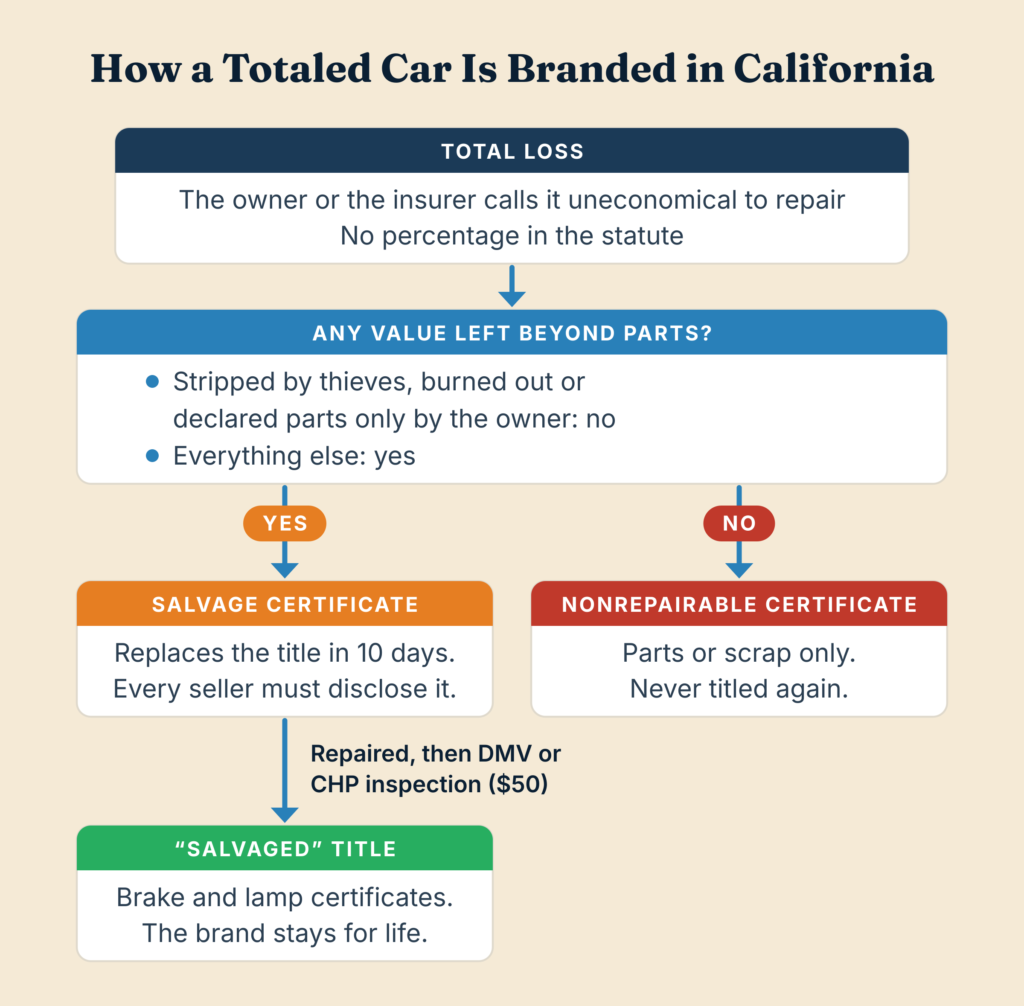
Reviving a salvage car means an inspection, not a new brand: before a vehicle reported as total loss salvage or dismantled is registered again, the DMV inspects it to confirm its identity or refers it to the California Highway Patrol, which may examine the rebuilt car and the papers for its major parts (Vehicle Code § 5505). The applicant brings brake and lamp certificates, or the electronic safety systems certificate that replaced them, a smog certificate where one is due and the $50 inspection fee (manual section 19.065).
The new title reads Salvaged, for life, and the same brand follows a vehicle revived from a junk report. Another state’s brand lives on the NMVTIS record rather than being reprinted, one reason dealers must show that report.
| Brand or document | What it means in California | Can it be removed |
|---|---|---|
| Salvage certificate | The ownership document of a total loss salvage vehicle; a seller must disclose the status at or before sale (§ 11515) | Replaced by a Salvaged title after inspection and registration |
| Salvaged (title brand) | Previously a total loss or a dismantled vehicle, revived after a DMV or CHP inspection and brake and lamp certificates (§ 5505; manual 1.025) | No |
| Nonrepairable Vehicle Certificate | Parts or scrap only: stripped, burned or owner declared (§ 11515.2) | Never titled or registered again |
| Junk (dismantler’s report) | Reported for dismantling (§ 11520) | A revived junk vehicle is inspected and titled Salvaged |
| Lemon Law Buyback (Warranty Return) | Reacquired by the manufacturer after a warranty defect; decal on the left doorframe; written disclosure to every later buyer (Civil Code § 1793.23) | No, the statute calls it permanent |
| Original or Prior Taxi, Original or Prior Police | Formerly used for hire or by law enforcement (manual 1.025) | No |
| Grey Market | Built for sale outside the United States and converted to US standards (manual 1.025) | No |
| Flood, fire, rebuilt | Not a California brand; damage of that kind appears as Salvaged, or not at all | Not applicable |
How to check a California used car title: the state offers no free online title or brand lookup. The DMV releases another person’s vehicle record only on a mailed request form, INF 70, at $5 a record, so the working check is the NMVTIS report, which carries the current title state, brand history and the last odometer reading in the title records. A private buyer orders it from an approved provider for about $10; a dealer’s customer asks for the copy the law requires.
Read the paper too: the owner’s name must match the seller’s identification, and the brand is printed on the face. Our free VIN check pulls the build data, recalls and complaints, and the guide to how to read a vehicle history report explains what the paid report adds.
Odometer law in California
Rolling back an odometer is a small state crime and a large federal one. It is unlawful to disconnect, turn back, advance or reset an odometer with intent to alter the mileage it shows (Vehicle Code § 28051), to sell, install or use a device that makes one read falsely (§ 28050), to drive a car knowing the instrument is disconnected with intent to defraud (§ 28050.5), or to sell a device built for resetting it (§ 28051.5). Each is a misdemeanor, not an infraction (§ 40000.15), punished by up to six months in county jail, a fine of up to $1,000, or both (§ 42002).
The state’s odometer article gives the buyer no civil remedy, so the money comes from elsewhere. Federal law lets a buyer sue anyone who tampered with intent to defraud for three times the actual damages or $10,000, whichever is greater, plus attorney’s fees, within two years (49 U.S.C. § 32710); the federal crime carries up to three years in prison (§ 32709). Against a dealer, a false mileage figure is a misrepresentation under the Consumers Legal Remedies Act, and prosecutors can charge grand theft when the loss exceeds $950 (Penal Code § 487). Our pillar on odometer fraud in America explains why digital odometers did not end it.
Disclosure follows the federal rule, which NHTSA states on its odometer page: exempt once 20 years old or older, or model year 2010 or older. Here the reading goes on the title or on form REG 262 with original ink signatures; when a private seller cannot be found, the buyer records the mileage and explains the gap on a statement of facts (manual section 5.025).
The DMV’s Investigations Division enforces the article and names odometer fraud as one of its complaint categories. Its buyer’s fact sheet lists the signs it looks for: mileage figures that disagree between the title, earlier disclosures and service records, a seller who calls the records unavailable, scratched or misaligned digits, new tires on a car showing 20,000 miles or less, and pedal wear out of step with the reading. Our guide to the five physical signs of a rollback covers the same checks.
The last large federal case here shows the scale: on 7 February 2022 three San Jose men were sentenced to 24, 20 and 20 months for rolling back at least 78 cars, one from 35,000 miles to 35, and selling them on Craigslist with altered titles and registrations (US Attorney, Northern District).
Dealer licensing, curbstoning and the dealer bond
How many cars can you sell in California without a dealer license? The statute names no number. A dealer is a person who, for money or anything of value, sells, buys or offers vehicles, or who is engaged wholly or in part in the business of selling them or taking them in trade for resale (Vehicle Code § 285), and no one may act as one without a license (§ 11700).
The exception for private people is written as a purpose, not a count: a person not in the trade who disposes of a vehicle acquired and used in good faith for personal or business use, and not to get around the code, is not a dealer (§ 286(e)). Selling your own is lawful; buying to resell is dealing from the first one.
Curbstoning, the department’s word for an unlicensed dealer posing as a private seller, is a category on the DMV’s complaint page, which lists “unlicensed vehicle dealers, brokers, and salespeople, also known as ‘curbstoners'” under unlicensed businesses and says the department conducts administrative and criminal investigations. The Occupational License Lookup shows a vehicle dealer’s license status by name, city or number, and a title in a name other than the seller’s is the sign you can read on the spot.
A curbstoned buyer loses the NMVTIS report and warning sticker, the smog certificate, the three-day right to cancel, the bond and the recovery fund. Our guide to how to spot a curbstoner covers the signs that hold in every state.
Every licensed car dealer posts a $50,000 bond (a motorcycle-only dealer $10,000), conditioned on causing no monetary loss to a purchaser, seller, lender or government agency by fraud or fraudulent representation (Vehicle Code § 11710). A person who loses money through a dealer’s or salesperson’s fraud, or by not being paid for a car sold to it, has a right of action against the business, the salesperson and the surety, up to the value of the vehicle (§ 11711).
Beside the bond stands the Consumer Motor Vehicle Recovery Corporation, a fund built from a $1 fee on every dealer sale. When a licensed dealer has stopped selling to the public or filed for bankruptcy, a consumer may claim, without a lawsuit, the fees the dealer failed to send to the DMV, the trade-in loan it left unpaid, the clear title it never delivered, consignment proceeds, or service contracts and insurance it took money for and did not buy, up to $35,000 for one transaction (Vehicle Code § 12204 and § 12208). The claim is due within a year of the closure.
Used car scams in California
The DMV’s Investigations Division sorts what it investigates into named categories on its complaint page: “Document Fraud” (altering, forging or counterfeiting DMV documents, including false vehicle-related advertising), “Licensed Businesses Violations”, “Unlicensed Businesses” (curbstoners and unlicensed dismantlers) and “Odometer Fraud”. The table adds the patterns that county prosecutors, federal prosecutors and the FTC have documented. We found no official ranking by frequency, so the order is ours. Each row rests on a state agency’s own page or on a case brought here, names the statute that covers the conduct, and keeps any federal case apart from the state offense.
| Scam | What the record shows | How to check |
|---|---|---|
| Odometer rollback | The DMV’s Investigations Division lists it as a complaint category and publishes a buyer’s fact sheet on the signs. State offense: a misdemeanor under Vehicle Code § 28051. The federal case of 2022 above, 78 cars, ended in prison terms under federal wire fraud law | Compare the title, the REG 262 disclosure, service records and the NMVTIS report’s last reading; the DMV’s signs: records called unavailable, scratched digits, new tires at 20,000 miles, worn pedals |
| Title not transferred after the sale | County prosecutors sued two national chains over late transfers of used car titles and registrations: AutoNation settled for $650,000 on 26 February 2025 and CarMax for $1.1 million on 25 March 2026; AutoNation settled without admitting the allegations. State rule: the dealer submits the transfer within 30 days (Vehicle Code § 4456) | Ask whether the dealer has the title in hand before you pay; after 30 days with no registration card, a complaint to the DMV portal and, if the dealer has closed, a recovery fund claim |
| Forged titles and consignment fraud | A Fallbrook dealer sold consigned Porsches twice, forged a title signature and kept the money; the owner pleaded guilty to federal wire fraud and was sentenced on 24 July 2026 to 21 months with $9.95 million in restitution, after the DMV suspended the dealer license in 2024. State offense: forging or passing a false title, registration card or transfer endorsement is a felony (Vehicle Code § 4463) | The seller’s name on the title and the identification must match; a consigned car needs the owner’s signature, not the dealer’s; the DMV’s record request confirms the registered owner |
| Cloned or stolen cars | The Department of Justice’s NMVTIS page describes cloned vehicles “sold to unsuspecting consumers” (federal, not specific to California). The CHP counted 133,372 vehicles stolen in the state in 2025 and 111,661 recovered (release of 28 July 2026). State offense: altering or removing a VIN for sale, 16 months to three years and up to $25,000 (Vehicle Code § 10802); dealing in such vehicles, up to six years (§ 10803) | The VIN on the dash, the door label and the title must agree; an NMVTIS report shows the title state and history; a price far below market with no negotiation is the pressure sign |
| Salvage history hidden | The salvage certificate itself orders disclosure at or before sale, with a civil penalty of up to $500 for silence (Vehicle Code § 11515(h)); a dealer must obtain the NMVTIS report and post the warning sticker when it shows a brand (§ 11713.26); a car with any state’s salvage, flood or buyback brand may not be sold as “certified” (§ 11713.18) | Ask for the dealer’s NMVTIS report and read the brand and total loss lines; on the title, look for the word Salvaged; a flood car from another state may show no brand here |
| Curbstoning | Named as a complaint category by the DMV (“unlicensed vehicle dealers, brokers, and salespeople, also known as ‘curbstoners'”). State rule: dealing without a license is unlawful (Vehicle Code § 11700) | The Occupational License Lookup; a title in another name; several cars for sale from one phone number |
| Add-ons and payment packing | The FTC’s alert of 16 August 2024 on add-ons buyers did not want (federal, not specific to California). State rule since 1 October 2026: add-ons disclosed in writing as not required (Civil Code § 1784.41), no charge for one the buyer cannot benefit from (§ 1784.42); the advertised price binds the dealer (Vehicle Code § 11713.1) | Compare the total price in the first written quote with the contract line by line; strike any add-on you did not choose; the document fee may not exceed $85 |
| Lookalike “DMV” websites | The DMV told its licensees in January 2026 that a domain name containing “DMV” or “Department of Motor Vehicles” is prohibited for its licensees from 1 January 2026 (Vehicle Code § 25); the bulletin calls a violation a misdemeanor | Transfer a title at dmv.ca.gov or a field office; a registration service is a private business and must say so |
| Fake online listings and deposits | The FTC’s alert on phony online car sales (federal, not specific to California): a demand for a wire transfer or gift cards is the scam, every time. State offense: obtaining money by false pretense is punished as theft (Penal Code § 532) | See the car and the title in person before any money moves; complete the transfer at a DMV field office |
When a row above describes your purchase, the remedies section says what you can recover and the complaint section says whom to tell.
Your remedies under California law
The statute most car buyers sue under is the Consumers Legal Remedies Act. Its list of forbidden practices (Civil Code § 1770) reaches a used car sale at several points: misrepresenting a vehicle’s characteristics or history, passing a reconditioned one off as original, claiming a certification it lacks, bait advertising, misstating the buyer’s rights, inserting an unconscionable term and, since July 2024, advertising a price that leaves out a mandatory fee.
A consumer who suffers loss may recover actual damages, restitution, an injunction, punitive damages and, for a buyer aged 65 or older or disabled, up to $5,000 more; a winning consumer gets costs and attorney’s fees, a winning dealer only if the suit was in bad faith (§ 1780). The trap is notice: at least 30 days before a damages suit, the buyer sends a written demand by certified or registered mail, return receipt requested, naming the violations and asking for a correction, and a seller that cures within 30 days defeats that claim (§ 1782). An injunction suit needs no notice. The limitation period is three years from the act (§ 1783).
The Unfair Competition Law runs beside it. Any person who has suffered injury in fact and lost money or property to an unlawful, unfair or fraudulent business practice may sue for restitution and an injunction (Business and Professions Code § 17204), within four years (§ 17208); it pays no damages and no fees of its own.
The civil penalties belong to the public side: the Attorney General, district attorneys and the city attorneys of the largest cities may recover up to $2,500 for each violation, and up to $2,500 more for each one against a senior or a disabled person (§§ 17206 and 17206.1). The CARS Act adds no penalty schedule; it is enforced through these laws and the DMV’s power over a dealer’s license, and its remedies are cumulative (Civil Code § 1784.22).
Warranty claims have their own clock and their own penalty. A breach of a written or implied warranty is sued on within four years of delivery under the Commercial Code (§ 2725), and under the Song-Beverly Act a buyer who proves a willful failure to honor a warranty or service contract may add a civil penalty of up to twice the actual damages, with attorney’s fees (Civil Code § 1794). Common-law fraud is pleaded beside these claims, with three years from discovery of the fraud (Code of Civil Procedure § 338(d)).
Where the money is small the forum is small claims court: a person may sue for up to $12,500 (Code of Civil Procedure § 116.221), a business for $6,250 (§ 116.220), and no attorney may take part (§ 116.530). Larger claims go to the superior court, and a dealer’s contract may send them to arbitration.
Two federal remedies apply in every state and sit beside these: the odometer act’s three times damages or $10,000 (49 U.S.C. § 32710) and the Magnuson-Moss Warranty Act’s suit for breach of a written warranty with attorney’s fees (15 U.S.C. § 2310). Our page on the federal laws that protect buyers covers both in full, and the complete buyer’s fraud prevention playbook says what evidence to keep from the first visit so that any of these claims can be proved.
The numbers and the cases in California
The FTC’s Consumer Sentinel Network Data Book 2024 ranks California 17th among the states for fraud and other reports, 1,291 per 100,000 residents, 506,727 in all, with $1,678.7 million reported lost and a median loss of $542 (data book, March 2025, state page 27). “Auto Related” was the seventh-largest category, at 3 percent of all reports from the state; the book gives a share, not a count.
The fleet is the country’s largest: the DMV counted 36,190,654 registered vehicles in 2025, 25,742,093 of them automobiles (DMV statistics for 2025). We found no state count of licensed dealers, dealer complaints, branded titles or rolled-back and flood-damaged cars on the road.
The California Highway Patrol reported 133,372 vehicles stolen in 2025, down from 176,230 in 2024, with 111,661 recovered, an 84 percent recovery rate (release of 28 July 2026, linked in the scams table). The unrecovered sixth is the pool from which cloned cars can be sold.
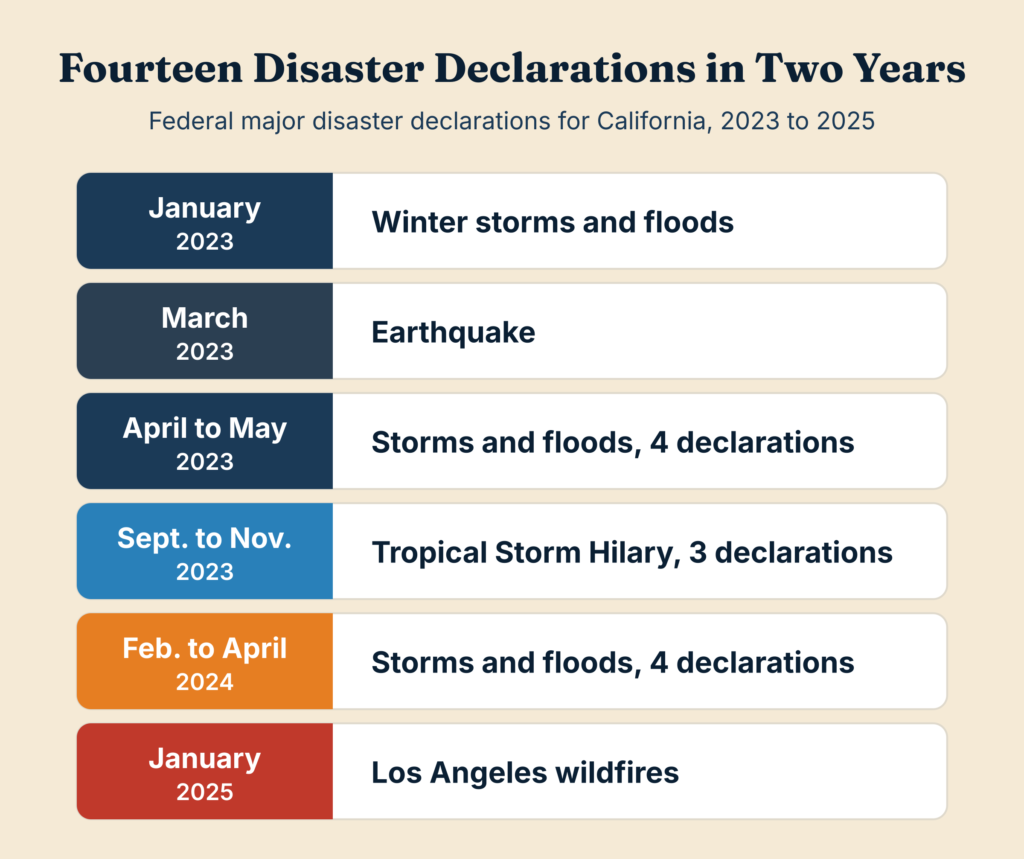
Exposure comes from water and fire. FEMA’s database listed 14 major disaster declarations for the state since January 2023 when we queried it on 15 October 2026: five for the winter storms and floods of January to May 2023, three for Tropical Storm Hilary between September and November 2023, four for the storms and floods of February to April 2024, the Los Angeles wildfires declared in January 2025, and the earthquake of March 2023 (Disaster Declarations Summaries; the count is ours and includes those covering tribal areas; this page uses the OpenFEMA API but is not endorsed by FEMA).
A car flooded or burned in any of them and written off by an insurer carries a salvage certificate and later the Salvaged brand; one repaired without a claim carries nothing, which is why the NMVTIS report and a mechanic’s inspection matter more here.
The enforcement log, newest first, from the offices’ own releases:
24 July 2026. The owner of a Fallbrook Porsche consignment dealership, whose dealer license the DMV had suspended in September 2024, was sentenced to 21 months in federal prison and ordered to pay $9,951,763 in restitution to 66 people after pleading guilty to wire fraud; she had sold consigned cars without paying their owners and forged a signature on a title transfer (US Attorney, Southern District).
25 March 2026. CarMax agreed to pay $1.1 million, $900,000 of it in civil penalties, to settle a suit by five county district attorneys over a five-year pattern of late ownership transfers on used cars; it must now hold any sale of a vehicle whose title is not in hand or reachable within 30 days (Santa Clara County District Attorney).
26 February 2025. AutoNation’s California dealerships agreed to pay $650,000, $450,000 of it in civil penalties, to settle a suit by six district attorneys’ offices over thousands of used car sales since 2019 in which buyers waited past the 30-day deadline for title and registration, without admitting the allegations (Los Angeles County District Attorney).
Older but on the record: on 7 November 2022 the Attorney General announced a $20 million judgment and a permanent ban against Paul Blanco’s Good Car Company, a seven-location used car group that accepted liability for 670,000 violations of the Unfair Competition Law and the False Advertising Law; the complaint had alleged add-ons sold as required (Attorney General’s release); the insolvent corporations were not expected to pay.
What sets California apart
The three-day right to cancel is the newest feature. The Combating Auto Retail Scams Act (Senate Bill 766) was signed on 6 October 2025 and became operative on 1 October 2026 (Civil Code § 1784.28); it wrote the pricing and add-on rules of the federal CARS Rule, vacated by an appeals court in January 2025, into state law and added the cancellation right the federal version never had. Our page on the federal CARS Rule that was vacated and what California did instead covers the comparison.
The DMV’s September 2026 bulletin tells dealers that the act replaces the paid two-day option and that compliance records are kept for two years. A buyer’s waiver of any of it is void (§ 1784.21).
The dealer’s NMVTIS duty is the second. Since 1 July 2012 no dealer may display a used car without first pulling the federal title record, and a branded one wears a red warning next to its Buyers Guide (Vehicle Code § 11713.26). It compensates for a title system with no flood or rebuilt brand and no public lookup: the state checks the car for the buyer at the point of sale. Our pillar explains how title washing works nationwide; here the wash is a change of state rather than of brand, since Salvaged is never removed and a flood brand never applied.
The third is the lemon law’s reach and its limits. The Song-Beverly Act is the model other states copied, with its refund formula, its two-times civil penalty and its buyback brand and decal. For a used car it gives less than most buyers expect and more than most states give through two dealer rules: the implied warranty that runs with a dealer’s written warranty, and the 30-day, 1,000-mile cover from every buy here pay here dealer.
The last is the safety net for a dealership that fails. The $50,000 bond is common; a recovery fund that pays up to $35,000 on an application, with no judgment required, is not (Vehicle Code § 12204). The fund stood at $5 million in June 2025, when the DMV paused the $1 fee (DMV bulletin of 6 June 2025).
How to file a complaint in California
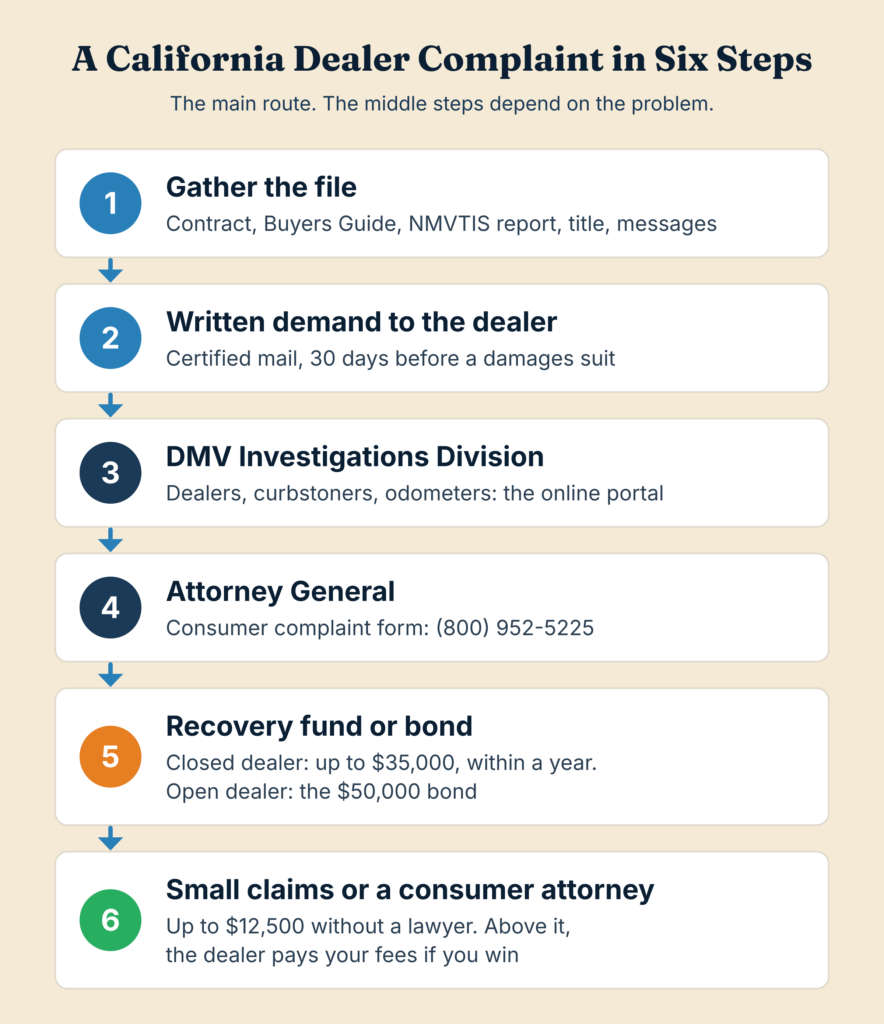
- Document everything: the advertisement, the first written quote, the contract and add-on forms, the Buyers Guide, the NMVTIS report, the odometer disclosure, the smog certificate and the dates of every call.
- Send the dealer a written demand by certified mail, return receipt requested, naming what went wrong and what you want; it starts the 30-day clock of the Consumers Legal Remedies Act (Civil Code § 1782) and is the notice a lemon law manufacturer that opted in requires.
- File with the DMV Investigations Division through its online complaint portal, linked in the key facts table, or on the Record of Complaint form INV 172A at a local Investigations office, 1-800-777-0133. The division can discipline or prosecute a dealer, an odometer tamperer or a document forger; it cannot give legal advice, make a dealer take a car back, referee a spoken promise or award you money.
- File with the Attorney General’s Public Inquiry Unit through its complaint form, linked in the key facts table, or at 800-952-5225. The office refers single disputes and does not represent individuals. The New Motor Vehicle Board mediates disputes with new car dealers and manufacturers at (916) 445-1888, and the Arbitration Certification Program, (916) 574-7350, lists the certified arbitration programs for warranty defects, free to the consumer.
- If the dealership has closed or is in bankruptcy, apply to the Consumer Motor Vehicle Recovery Corporation, 800-961-6175, within one year, for the losses listed in the dealer section, up to $35,000 (Vehicle Code § 12204); for fraud by a dealer still in business, a claim against the $50,000 bond names the dealer, the salesperson and the surety (§ 11711).
- Sue: small claims up to $12,500 for a person, or a consumer attorney for a larger claim, since the Consumers Legal Remedies Act and the Song-Beverly Act make a losing dealer pay the fees. For an odometer scheme, also call NHTSA’s Vehicle Safety Hotline, 888-327-4236; report a seller you never met to ReportFraud.ftc.gov and, for an online scam, to the FBI’s Internet Crime Complaint Center.
Official resources
- Civil Code § 1784.31, § 1784.40, § 1784.41 and § 1784.43: the Combating Auto Retail Scams Act, its definitions and restocking fee, the misrepresentations, the price and add-on disclosures, the three-day right to cancel; §§ 1784.20 to 1784.44 in all, operative 1 October 2026 (§ 1784.28).
- Civil Code §§ 1790 to 1795.8, the Song-Beverly Consumer Warranty Act: implied warranties, as-is sales, the lemon law and its presumption, the buyback brand, the buy here pay here warranty, damages and the civil penalty.
- Code of Civil Procedure § 871.20 and § 871.29: the 2025 lemon law procedures and the manufacturer’s election.
- Civil Code § 1770, § 1780, § 1782 and § 1783: the Consumers Legal Remedies Act’s practices, remedies, notice rule and limitation period.
- Business and Professions Code § 17204, § 17206, § 17206.1 and § 17208: the Unfair Competition Law’s standing, penalties and limitation period.
- Commercial Code § 2314, § 2316 and § 2725: the implied warranty, its exclusion and the four-year period.
- Code of Civil Procedure § 116.220, § 116.221, § 116.530 and § 338: the small claims limits, the rule on attorneys there, and the limitation period for fraud.
- Vehicle Code § 285, § 286, § 241 and § 11700: who is a dealer, who is not, the buy here pay here dealer, the license requirement.
- Vehicle Code § 11710, § 11711, § 11713, § 11713.1, § 11713.18 and § 11713.26: the bond and claims on it, dealer conduct and advertising, certified used cars, the NMVTIS report.
- Vehicle Code § 544, § 11515, § 11515.2, § 11520 and § 5505: total loss, the salvage and nonrepairable certificates, junk reports, the inspection of a revived vehicle.
- Vehicle Code § 28050, § 28050.5, § 28051, § 28051.5, § 28053, § 40000.15 and § 42002: the odometer article and its penalty.
- Vehicle Code § 12200, § 12204 and § 12208: the consumer recovery fund, its eligible claims and its cap.
- Vehicle Code § 4456, § 4456.5, § 5753, § 5900 and § 5902: the report of sale and temporary plates, the document fee, title delivery, the seller’s notice and the buyer’s transfer.
- Vehicle Code § 4000.1, § 24007 and Health and Safety Code § 44015: the smog certificate on transfer and its exemptions.
- Vehicle Code § 25, § 4453, § 4463, § 10802 and § 10803: the “DMV” name, the title’s contents, forged titles, VIN tampering.
- Penal Code § 487 and § 532: grand theft and false pretenses.
- DMV, complaints against dealers and unlicensed sellers: the Investigations Division’s categories and its portal.
- DMV, the CARS Act: the department’s plain-language page.
- DMV, registration for a vehicle purchased from a private party and from a dealer: the deadlines, the forms, the NMVTIS report rule.
- DMV, Vehicle Industry Registration Procedures Manual: section 1.025 on branded titles, chapter 5 on odometer disclosure, chapter 19 on salvage, nonrepairable and junk vehicles.
- DMV, Occupational License Lookup: the dealer license check.
- DMV, vehicle record request: form INF 70 for another person’s vehicle record, $5.
- DMV, odometer fraud fact sheet and DMV complaints fact sheet: the division’s warning signs, form INV 172A, what it can and cannot do.
- DMV industry bulletins 2026-10, 2026-03 and 2025-06: the CARS Act for dealers, the “DMV” domain name rule, the recovery fund’s balance.
- Attorney General, buying a car: the Car Buyer’s Bill of Rights, the lemon law in brief, every complaint channel (written before the CARS Act: it still describes the old two-day option).
- Attorney General, consumer complaint: the Public Inquiry Unit’s form.
- Department of Consumer Affairs, Arbitration Certification Program: the certified arbitration programs, and its page on the 2025 lemon law changes with the manufacturers that opted in.
- Bureau of Automotive Repair, smog check: when a smog check is due and who is exempt.
- California Highway Patrol, vehicle theft in 2025: the theft and recovery counts.
- NMVTIS, for consumers and approved providers: the federal title system and where to buy a report.
- NHTSA, odometer fraud: the disclosure exemption and the hotline.
- FTC, buying a used car from a dealer and the Used Car Rule, 16 CFR Part 455: the Buyers Guide.
- FTC, Consumer Sentinel Network Data Book 2024: the state’s fraud report figures.
- FEMA, Disaster Declarations Summaries: the declarations behind the exposure count.
- 49 U.S.C. § 32709, § 32710, 49 CFR Part 580, 15 U.S.C. § 2308 and § 2310: the federal odometer penalties, remedy and disclosure rule, and the Magnuson-Moss Warranty Act.
Frequently Asked Questions
Does California have a used car lemon law?
Not in the sense most people mean. The Song-Beverly Act’s refund or replacement remedy covers a new motor vehicle, and the state Supreme Court held in 2024 that a used car with time left on the factory warranty does not qualify unless the new car warranty was issued with that sale. One sold with the dealer’s own written warranty is covered against that dealer, and a buy here pay here seller must warrant it for 30 days or 1,000 miles.
Can you return a used car in California?
From a dealer, yes, since 1 October 2026: a used vehicle priced at $50,000 or less can be returned for any reason within three calendar days after the day you sign, if it has not been driven more than 400 miles and comes back as you took it. The dealer keeps a restocking fee of 1.5 percent of the price, between $200 and $600, plus $1 a mile over 250, and refunds the rest within 48 hours. A private sale and a new car cannot be undone this way.
Does a used car come with a warranty in California?
Only if the paperwork says so. A dealer may sell as is, with the Buyers Guide’s as-is box checked and a conspicuous notice on the car, which cancels the implied warranty. Where the dealer gives a written warranty, the implied one runs with it for at least 30 days, and a buy here pay here dealer must provide 30 days or 1,000 miles. A private seller owes none.
Are dealer fees capped in California?
The document processing charge is: $85 at a dealer with a DMV filing contract, $70 at any other, and it may not be called a government fee. The advertised price must include every other dealer charge, and since October 2026 the total price must appear in the first written quote, with add-ons disclosed as optional.
How many cars can I sell in California without a dealer license?
The Vehicle Code gives no number. You may sell a vehicle you acquired and used in good faith for your own purposes; anyone who buys vehicles to resell them, or sells them for a commission, is a dealer from the first sale. The DMV calls unlicensed sellers curbstoners and investigates them.
How do I file a complaint against a California dealer?
Start with a certified letter to the dealer, which the Consumers Legal Remedies Act requires 30 days before a damages suit. Then file with the DMV Investigations Division’s online portal, which disciplines dealers but awards no money, and with the Attorney General. If the dealership has closed, apply to the recovery fund within a year; otherwise a bond claim, small claims court up to $12,500, or a consumer attorney paid by the dealer under the fee-shifting statutes.
What title brands does California use?
Salvaged, which covers a total loss from a crash, flood or vandalism and a revived junk vehicle; Lemon Law Buyback; Original or Prior Taxi; Original or Prior Police; Grey Market; Remanufactured; and Park Trailer. There is no flood, fire or rebuilt brand, and Salvaged is never removed. A nonrepairable vehicle gets a certificate instead of a title and is never registered again.
What is the California CARS Act?
The Combating Auto Retail Scams Act, Civil Code §§ 1784.20 to 1784.44, in force since 1 October 2026: the total price in advertisements and first written quotes, thirteen forbidden misrepresentations, add-ons disclosed as optional and never charged where they bring no benefit, and a three-day right to cancel for a used vehicle priced at $50,000 or less.
How do I check a California used car title?
There is no free state lookup. A dealer must pull the NMVTIS report before offering the car and show it to you on request; in a private sale, buy it from an approved provider for about $10, then compare the owner’s name on the title with the seller’s identification, look for the word Salvaged, and check the VIN on the dash and the door label against both.
Sources and verification
Everything on this page was checked on 15 October 2026. Statutes: the 2026 California codes, in a published copy of the code, linked to the official site, leginfo.legislature.ca.gov, the Combating Auto Retail Scams Act among them; federal law on govinfo.gov and ecfr.gov. Court decision: Rodriguez v. FCA US, LLC (Cal. Supreme Court, S274625, 31 October 2024), read in a published copy and linked to the court’s site.
Agencies: the DMV’s web pages, procedures manual (chapters 1, 5 and 19), industry bulletins and Investigations fact sheets named in the resources list; the Attorney General, the Arbitration Certification Program, the Bureau of Automotive Repair, NHTSA and NMVTIS, also named there. Figures: the FTC’s Consumer Sentinel Network Data Book 2024 (March 2025), California’s entry and the ranking table; the DMV’s Statistics for Publication for 2025; the CHP’s release of 28 July 2026; FEMA’s Disaster Declarations Summaries, distinct declaration numbers since 1 January 2023. Cases: from the releases linked; a settlement is not a finding, and AutoNation settled without admitting the allegations. Next review: October 2027, or sooner if a statute here is amended. Changes: 15 October 2026, first version under this standard. How we verify: every fact is traced to its source before it goes live, as our Editorial Standards describe.