
Before money changes hands, four things about a seller can be checked against the state’s own records: whether a dealer holds a license, what the state’s title record says about the car, whether the seller can hand you a paper title at all, and where the two of you have to be when the title is signed. The table on this page gives the answer for every state and the District of Columbia, with a link to the official page or tool. Every entry was read on the state’s own site on 22 October 2026.
The checks matter because the newest scams copy what a real seller looks like. A seller who meets you in a parking lot and sells several cars a year may be a curbstoner, and the dealer license lookup is the one test that settles whether the seller holds a license. A copied dealer website borrows a real dealer’s name, so the state’s record gives you the address and phone number to call instead of the number on the site. A title can be forged on paper; the state’s record cannot. The scams behind each check are in our overview of car scams to look out for.
The whole table, with the full wording of each entry and every address, is in the CSV download at the end of the page, with a note on how we built it and how to cite it.
How to read the table
Dealer license lookup. The column names the lookup of the agency that licenses used car dealers. “Search” opens a search tool: eight say they search by business name, twelve do not say what they search by, and Indiana, New York and North Dakota search by license type, number or location. “List” opens the agency’s list of licensed dealers, a PDF, a spreadsheet, a text file or a list inside the state’s portal, to search for the name. In 23 of the 51 the agency has a search tool, in 19 a list.
“Not found” means no official page we read offers either; the licensing agency is the place to ask, as Montana says on its own page. In Massachusetts the license comes from the city or town, not the state.
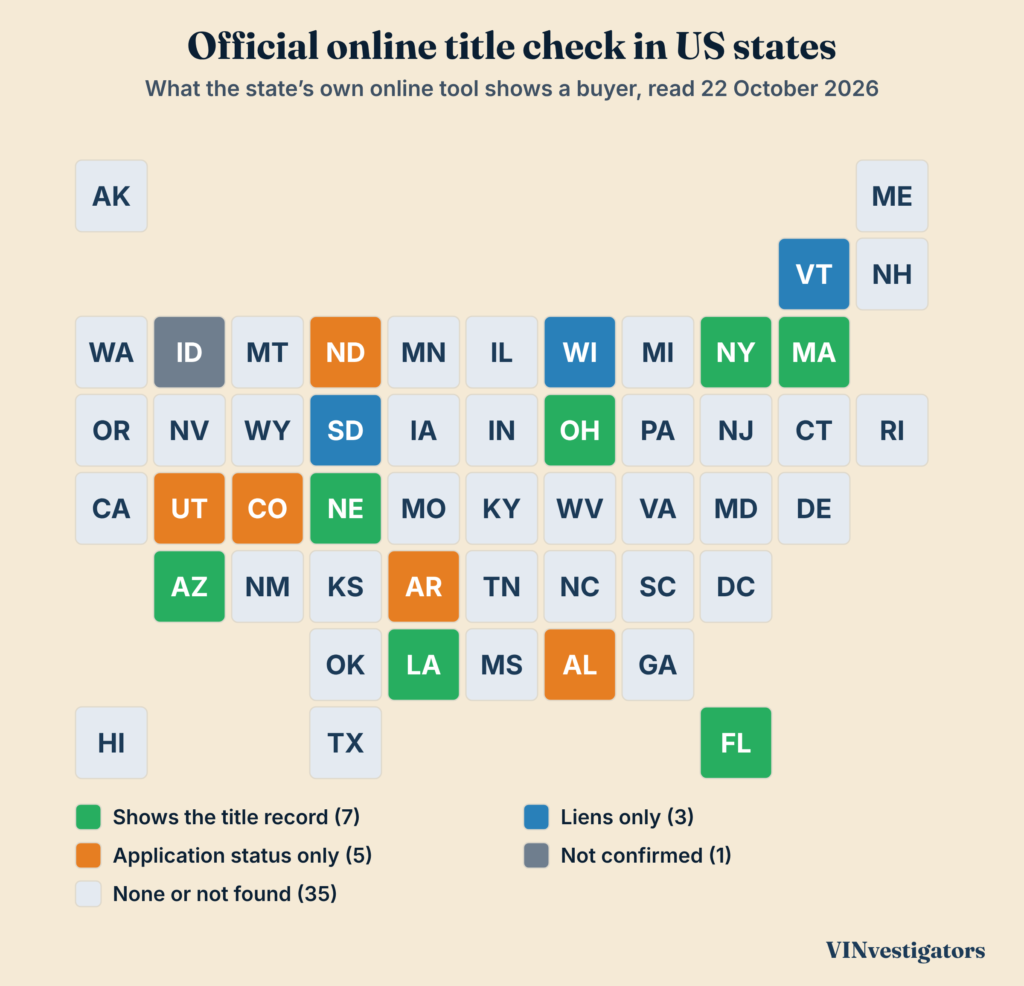
Official title check. The column names an official online check of the state’s own title record that a buyer can run without paying. Seven states show something about the title itself: Arizona (brands and liens), Florida (the last recorded odometer reading and any brand), Louisiana (whether a title is valid), Massachusetts and New York (the issue date and the lienholders), Nebraska (the status of a title or lien) and Ohio (the title number and whether a lien was released). Arizona, Florida, Massachusetts and Nebraska say the check is free; Louisiana, New York and Ohio show no fee. South Dakota, Vermont and Wisconsin check liens only.
Five states show only whether a title application has been processed, which tells a buyer nothing about the car. “None” means the state offers a buyer no free check of its record: the record is sold, usually only to the owner or to listed requesters, or, in Washington, the agency takes the question by phone. For any state, the national title record, an NMVTIS report, covers the title, the brands any state has applied, the odometer reading and the total loss and salvage history, from a provider on the Justice Department’s list.
Electronic title with a loan, and with no loan. In most states a lender holds the title as an electronic record while the loan is open; “lender must” and “lender may” say whether the state requires that. At payoff the owner gets a paper title in most states, by mail or on request; in a few, Arizona, Florida and Oklahoma among them, the title stays electronic unless the owner asks for paper. The second column says whether an owner with no loan can hold an electronic title with no paper at all. Both answers tell you what a seller can show you.
“The bank has it” is normal where the first column says the lender holds it, and the sale then closes at the lender or through escrow, never on a promise that the title will follow. In Arizona, Florida and Oklahoma, among others, a seller with no loan may have no paper title either, and the transfer runs through the state’s own process.
Private sale: where it is signed. The column says where the seller and the buyer are when the title changes hands, not the buyer’s later trip to register the car. “No set place” means the law sets none: the seller signs the assignment on the title and hands it over when the car is delivered.
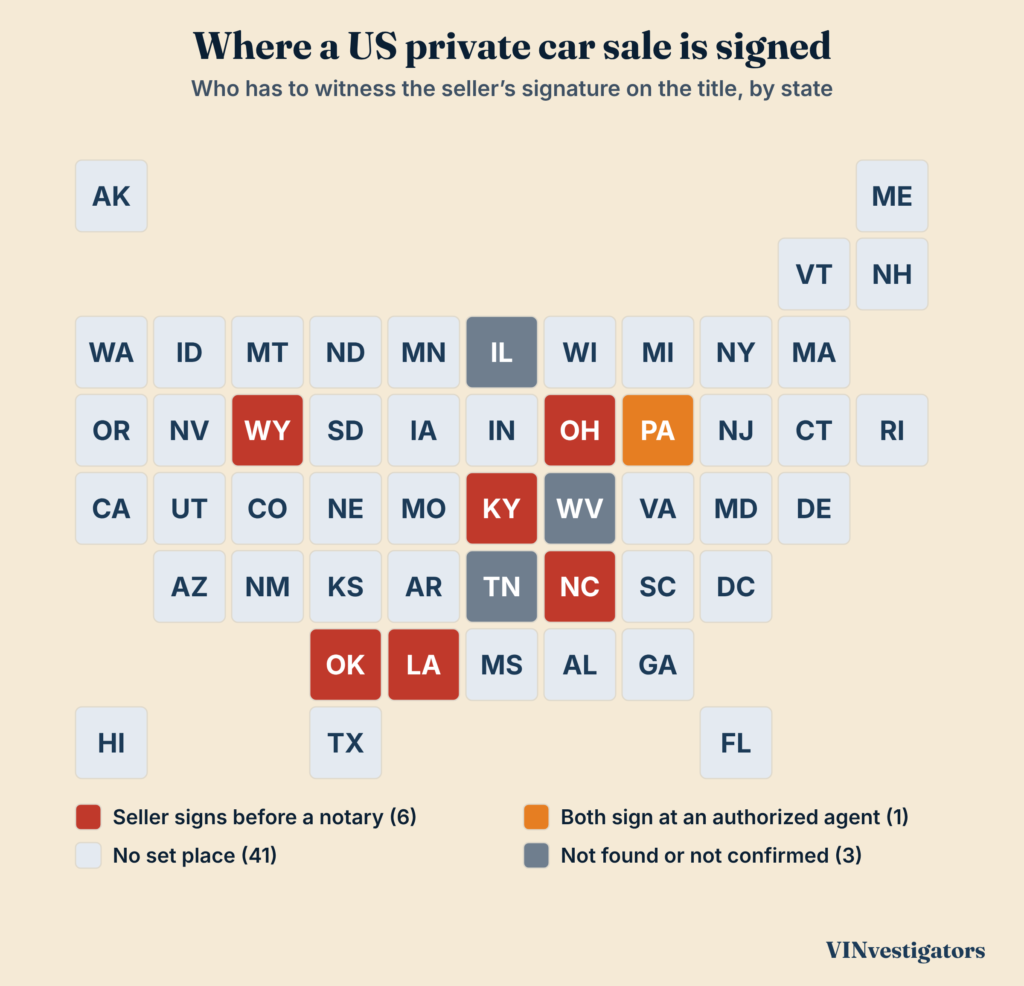
“Before a notary” means the state’s law has the seller sign the title before a notary; six states require it, Louisiana also allows two witnesses or an officer of the buyer’s financing bank, North Carolina an electronic signing under its electronic transactions law, and Pennsylvania has both parties sign at an authorized agent, where the seller’s signature is notarized or verified. Where an agency recommends meeting at its office, the cell says so.
Our fraud prevention playbook covers the rest of the handover, from the payment to the plates.
What these checks do not tell you
A dealer license shows that the business holds the license the state, or in Massachusetts the city or town, requires, not that its deals are fair. The complaint record is a separate check: the state attorney general’s office, and in South Carolina the lookup itself, which shows a dealer’s sanction history for the last ten years. A dealer who is licensed and still charges for add-ons you never asked for is a dealer to report, not a dealer to trust.
A state title check reads that state’s record. A car titled in another state last year carries its history in the other state’s record and in NMVTIS, which every state queries before it issues a title. Our guide to title washing explains how a brand can go missing between two states and what the national record still shows.
None of these checks looks at the car. Before the state’s record, run the free checks: NICB VINCheck for theft and salvage records from member insurers, then our free VIN check for the build data, recalls, complaints and crash ratings NHTSA holds.
A paid vehicle history report covers what a title record does not, such as reported accidents. Our guide explains how to read a vehicle history report without missing the red flags, and the state’s own record is the check to run beside it.
How we built this page
One row for each state and the District of Columbia. Each fact was read on an official page, the agency’s or the state code’s, on 22 October 2026, and every row was then read against its sources by a second reader who had not seen the research. Where no official page states a fact, the cell says “Not found” rather than a guess. “Not confirmed” marks a tool or a rule we could not settle from an official page: Delaware’s dealer lookup, what Idaho’s title check shows, West Virginia’s notary rule and whether Massachusetts has switched on its E-Title. Several state tools open only inside the state’s own portal, which asks you to accept cookies first.
State rules change. Kentucky moves to electronic titles on 1 January 2027, Wyoming’s electronic title law applies from 1 July 2027, and Massachusetts has announced electronic titles for private sales. The next full check of every row is October 2027. A reader who finds a change before then can tell us through the Contact page.
Last checked: 22 October 2026.
Download: the full table as a CSV, with the full wording of each entry, the tool and source addresses and the date each was read: dealer-license-lookup-by-state.csv.
Cite it as: VINvestigators, Dealer License Lookup and Car Title Check by State, checked 22 October 2026, https://vinvestigators.com/dealer-license-lookup-by-state/.
Questions readers ask
How do I check if a car dealer is licensed?
Find your state in the table and open the dealer license lookup. Search for the dealer, by business name where the tool takes one, or open the state’s list and search it. Compare the address in the record with the lot you visited and the phone number on the listing: a record that names a different address is a question to settle before you pay. If the state has no public lookup, call the licensing agency named on its page. Start from the map on the State Guides page for the state’s own rules on dealers, warranties and complaints.
Can I check a car title status for free?
In seven states, yes: Arizona, Florida, Louisiana, Massachusetts, Nebraska, New York and Ohio each have an official online check of the title record; four say it is free and three show no fee. Three more states check liens only. In the other states we found no free check of the record itself: five show only whether a title application has been processed, a few list a tool without saying what it shows, and the rest have none; where a state sells its record, it is to the owner or to listed requesters. The national record, an NMVTIS report, covers every state and is sold by the providers on the Justice Department’s list; each provider’s site gives its price.
The seller says the title is electronic. What do I do?
In states where lenders hold titles electronically, the seller’s loan has to be paid off before the title can be signed over, and the sale closes at the lender or through an escrow service. In Arizona, Florida, Indiana, Ohio, Oklahoma and Virginia an owner with no loan can hold an electronic title too, and the transfer then runs through the state’s own process: Florida at a service center, Arizona and Virginia online for an eligible sale, Ohio and Oklahoma with a notarized form; for Indiana we found no page on it. Never pay on a promise that the title will follow.
Does the seller’s signature need a notary?
In Kentucky, Louisiana, North Carolina, Ohio, Oklahoma and Wyoming the seller signs the title before a notary (Louisiana and North Carolina each allow one alternative, noted above), and in Pennsylvania both parties sign at an authorized PennDOT agent, which can be an agent, a tag service or a dealer, and the seller’s signature is notarized or verified. West Virginia has the seller’s statement of liens verified under oath, and no official page says whether that needs a notary.
Elsewhere we found no set place: the seller signs the title’s assignment and hands it over, Honolulu calls a notary optional and Hawaii County recommends one, and for Illinois and Tennessee we found no rule. Several agencies recommend meeting at a licensing office, where the transfer is recorded while you are both there.