How to Check If a Car Dealership Is Legit Before You Pay
Every fact, figure and legal citation in this article was checked against its original source before publication by Artūras Andriušaitis, founder and editor. Editorial Standards
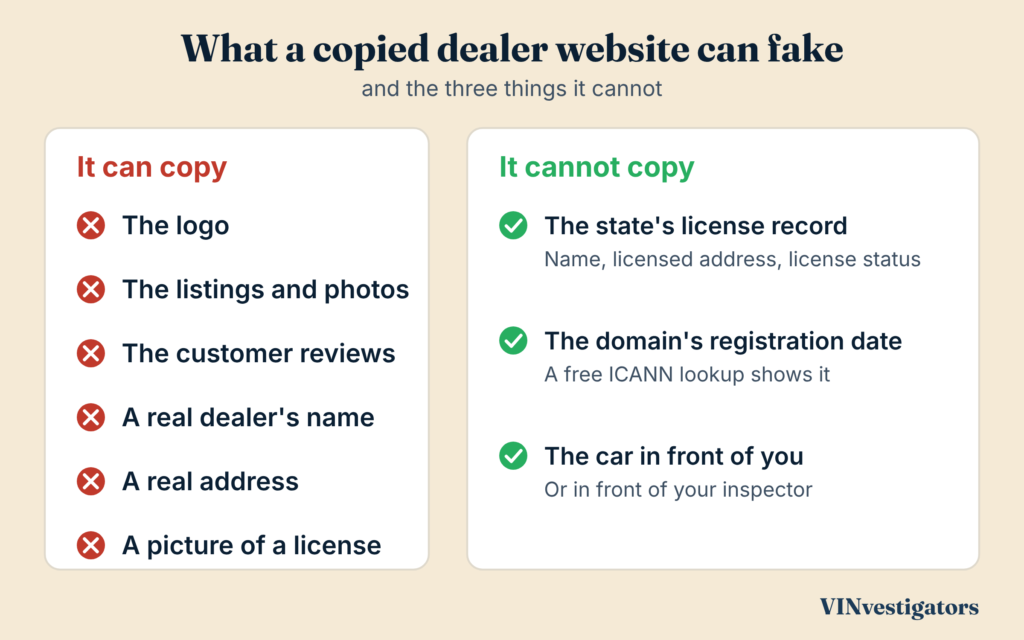
A dealership website can now be copied in an afternoon. The logo, the listings, the photos and the customer reviews all look right, and the car you want is a few thousand dollars under market. This guide is how to check if a car dealership is legit using two records the scammer cannot copy: the state’s dealer license record and the website’s own registration date. Both take minutes and, in nearly every state, cost nothing.
What the scam looks like
On 1 September 2026 the Federal Trade Commission warned that scammers clone real dealers’ websites, often with AI, copying the brand logos, the vehicle listings and the photos, and sometimes adding fake customer testimonials. The bait may be a rare muscle car or a classic that is hard to find, with a flexible return policy to put you at ease. You pay up front, and the car never arrives. Show up at the real dealership and nobody has a record of your order or your payment, because the real dealer never sold you anything. The FTC alert and the year’s cases are in our guide to the car scams to look out for.
The site does not always clone a working dealer. Tennessee’s Attorney General warned in March that the fake dealers may answer the phone, send videos and hand over fake business licenses, and that some borrow the name or the address of a business that has closed. In Maize, Kansas, police warned in February 2025 about a site selling restored classics under the name and the address of a used car lot that had gone out of business, with photos taken from other legitimate websites (KSN).
Our used car scam log, the count we keep of official warnings and cases, holds four warnings about fake dealer websites between January and September 2026, from Texas, Maine, Tennessee and the FTC. The rest of the year’s scams are in our Scams & Fraud section.
Check the state’s dealer record, not the website
In every state but Massachusetts a state agency licenses car dealers (there the city or town does), and whoever issues the license keeps the record. A copied site can carry a real dealer’s name and a real address, so the website is not the thing to check. The state’s record is, and the first half of how to check if a car dealership is legit is reading it. Our dealer license lookup for every state links each state’s official search tool or list, which 41 states and the District of Columbia publish, and says where we found none.
- Open your state’s dealer lookup from our table and search the business name on the website, then any trading name it uses. A few states search by license type or location instead, and our table says which.
- Read the licensed address against the address on the site. A site using the address of a closed dealership, or a warehouse, is the pattern behind the Texas and Maine warnings in the scam log.
- Call the dealer at the phone number in the state’s record, where it gives one, never at the number the listing gives you. If the real dealer has never heard of the car, you have your answer.
- If the business name is not in the record at all, the seller is not a licensed dealer, whatever the certificate in your inbox says. A private owner selling one car needs no license, but then there is no dealership to clone, and the title guide’s checks apply instead.
A seller who sells cars without a license is a curbstoner, and our guide to spotting one covers what you go without in such a sale. The state’s business entity search, which the Tennessee Attorney General points to, answers a different question, whether the company exists, and is worth a look too. The dealer licensing agency’s record is the one that says whether this business may sell you a car.
Check how old the website is
A real dealership’s website has usually existed for years. A fake one was registered recently, because the scammer only needs it to last until the first few buyers have paid. ICANN, the body that coordinates domain names, runs a free lookup tool that returns the date a domain name was registered. Type the site’s address and read the registration date in the result. That date is the second half of how to check if a car dealership is legit.
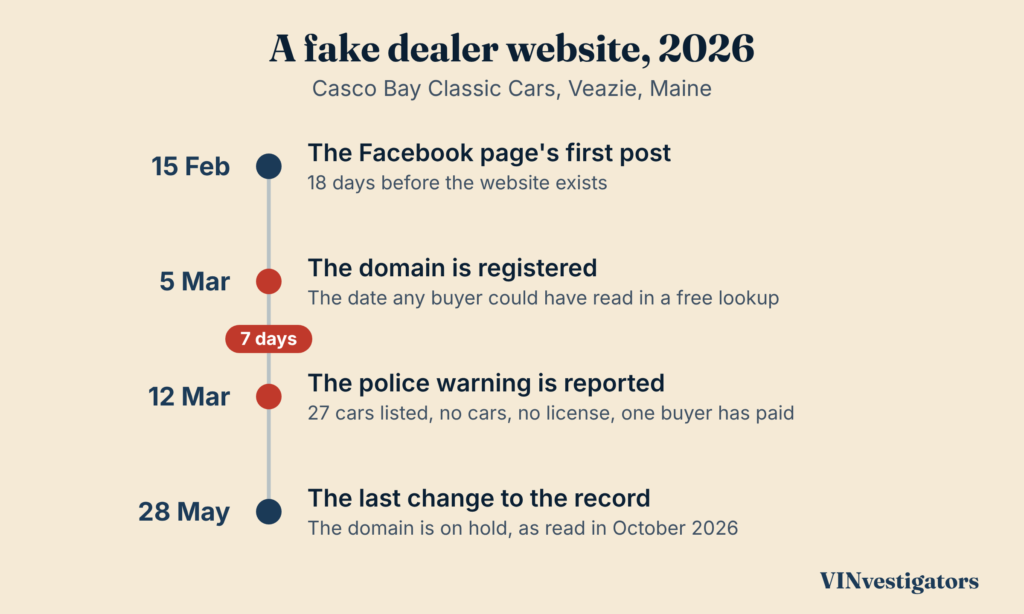
One example from the scam log. On 12 March 2026 the Bangor Daily News reported that police in Veazie, Maine, had warned that “Casco Bay Classic Cars”, a website listing 27 classic cars with a 1969 Camaro at $37,900, had no cars and no dealer license, and that at least one buyer had already paid (Bangor Daily News). The public registration record for that site’s domain shows it was registered on 5 March 2026, one week before the report. A website seven days old with 27 classic cars on it says enough.
When the site clones a dealer that really exists, the date check still works: a search for the dealer’s name may turn up two websites with one name, and the younger one is the clone, its registration date the day it was built. The date is a sign, not proof. A real dealer launches a new site now and then, and a scammer can buy an old domain, so the date is read beside the state record and the visit, never alone. The FTC’s advice to search the dealer’s name with “scam”, “review” or “complaint” catches the cases other buyers have already reported; the domain date flags the ones nobody has reported yet.
See the car before any money moves
The FTC’s advice is the simplest: ask to see the car and the dealership in person, and walk away if they refuse. For a car too far to visit, tell the dealer you are hiring a mobile inspection service to look at it, and take a refusal as the answer. A real dealer loses nothing by letting an independent mechanic walk around a car. A fake one has no car to show.
Before the inspection, run the VIN in the listing through a free VIN check. A VIN that decodes to a different year, make or model than the listing, or a listing with no VIN at all, means you cannot check the car, and that is reason enough to stop. A reverse image search on the listing photos shows where they came from; the Maize site’s photos had been taken from other legitimate websites.
Then the payment. The FTC has said since 2019 that a seller who asks for a wire transfer or gift cards is running a scam, every time (FTC), and its September alert says to walk away from any dealer that will take only an upfront wire. The Tennessee Attorney General’s advice is a check or a credit card, and no wire or bank transfer to a seller you have not verified. No deposit, no “shipping fee” and no “holding payment” goes out before the state record, the domain date and the inspection all come back clean.
Before any transfer, confirm the account with the dealer at the phone number in the state’s record, never from the invoice or the email that supplied it: a cloned site’s invoice carries the scammer’s account under the real dealer’s name. If you have already paid, report it at ReportFraud.ftc.gov and to the FBI’s Internet Crime Complaint Center at ic3.gov, and tell your bank the same day. The checks that come before any purchase, from the history report to the test drive, are in our fraud prevention playbook.
The Bottom Line
How to check if a car dealership is legit comes down to two records the scammer cannot fake and one visit. Look the business up in the state’s dealer license record, compare the address, and call the number the state has, not the number on the site. Look up the website’s registration date at ICANN’s free lookup, and read a dealer with twenty cars and a site two weeks old as a warning to check harder, not as a verdict. Then see the car, or send an inspector, and pay nothing by wire before you do.