
In Texas, damage makes a car salvage only when the repair bill exceeds everything it was worth before the loss, and the state’s own title fee report works out to about 174,700 rebuilt salvage title applications in one fiscal year. No statute requires a dealer warranty on a secondhand vehicle, none gives a general three-day return right, and the dealer regulator grants lemon law refunds for new cars only. The strength lies in the remedies: the Deceptive Trade Practices Act allows up to three times the economic damages for knowing conduct plus attorney’s fees, an as-is clause alone does not waive it, and the same regulator publishes a penalty range for each common violation.
This guide answers the same questions about Texas used car laws as every page in our state guides series, so the rules here can be set beside any other. Each statute below links to the official code, directly or through its chapter in the resources list, and the dates of our checks are at the end.
On this page
- Texas at a glance
- What a seller must give you before you sign
- Warranties, as-is sales and the lemon law
- Title brands and how to check a title
- Odometer law
- Dealer licensing, curbstoning and the dealer bond
- Used car scams in Texas
- Your remedies
- The numbers and the cases
- What sets Texas apart
- How to file a complaint
- Official resources
- Frequently asked questions
- Sources and verification
Texas at a glance
| Question | Texas |
|---|---|
| Used car warranty law | None. Dealers may sell as-is with the Federal Trade Commission’s (FTC) Buyers Guide; the implied warranty of merchantability applies to a dealer’s sale unless disclaimed (Business and Commerce Code § 2.314). |
| Can a dealer sell as-is | Yes. “As is” excludes implied warranties (Business and Commerce Code § 2.316(c)(1)); it does not by itself waive a claim under the Deceptive Trade Practices Act (§ 17.42). |
| Lemon law and used cars | Occupations Code Chapter 2301, Subchapter M. The Texas Department of Motor Vehicles (TxDMV), which decides the cases, says only new vehicles qualify for a refund or replacement. A used car still under the manufacturer’s original warranty, or with a defect reported while that warranty ran, may get repairs through a warranty performance complaint (§ 2301.204; TxDMV). |
| Consumer protection law | Deceptive Trade Practices Act, Business and Commerce Code § 17.50: economic damages; for knowing conduct also mental anguish damages and up to three times the economic damages; for intentional conduct up to three times both; attorney’s fees to a consumer who prevails. Written notice at least 60 days before a suit for damages, not required where the limitation period is about to run out or the claim is a counterclaim (§ 17.505); two years to sue (§ 17.565). |
| Odometer tampering | State offense, with no class named: up to two years in county jail, a fine of up to $1,000, or both; on a repeat conviction 30 days to two years and up to $2,000 (Transportation Code § 727.002). Knowingly giving false information on a title assignment is a third-degree felony (§ 501.155). Civil remedy: none in Chapter 727, so 49 U.S.C. § 32710, three times actual damages or $10,000, whichever is greater; the Deceptive Trade Practices Act also lists odometer tampering (§ 17.46(b)(16)). |
| Dealer license needed after | Four vehicles of one type sold or offered in a calendar year. The exemption covers a person who “sells or offers to sell during a calendar year fewer than five vehicles of the same type” that are owned and registered in that person’s name, so the fifth needs a license (Transportation Code § 503.024(a)(1)). |
| Dealer bond and recovery fund | Bond $50,000 for dealers other than franchised new car dealers (Transportation Code § 503.033). A claim needs a court judgment. Recovery fund: none that we found. |
| Salvage threshold | Repair cost above the vehicle’s actual cash value (market value) before the damage, with repainting and sales tax left out; this decides the brand, not the insurer’s payout (Transportation Code § 501.091(15)). A vehicle that arrives on another state’s salvage title is salvage here too. An insurer or other owner may take out a salvage title by choice for a car that does not meet the definition, and the owner of a “self-insured” vehicle, one not insured by an insurance company (§ 501.091(18)), must report damage that does meet it and apply for the title before the 31st business day after the damage (§ 501.1001). |
| Title brands issued | Documents: Salvage Vehicle Title (with a flood notation where flood alone caused the damage) and Nonrepairable Vehicle Title. Remarks on a regular title: Rebuilt Salvage, Flood Damaged, Manufacturer Buyback, Reconstructed, Replica, Not for Dealer Resale, Bonded Title, Actual Mileage, Not Actual Mileage, Mileage Exceeds Mechanical Limits (Transportation Code §§ 501.091 to 501.100; Texas Administrative Code, Title 43 (43 TAC), §§ 217.84 and 217.89; TxDMV Title Manual, Table 4-1). The full list of these is in the brands table below. |
| Return or cooling-off right | None for a change of mind, and no three-day right to cancel a purchase made at a dealership. Attorney General: “Under Texas Law, you do not have 3 days to cancel the purchase” (Buying a New or Used Car). Two narrow exceptions need no reason: a sale solicited and signed away from the seller’s premises (Business and Commerce Code Chapter 601), and a retail installment contract with the seller, until the seller delivers the car or delivers or mails a copy of the contract (Finance Code § 348.111). A separate matter: a car that does not conform to the contract, which the buyer may reject within a reasonable time or, after accepting it, give back by revoking acceptance where a defect that substantially impairs its value was hard to discover, was accepted on the seller’s assurances or was not cured as assumed (Business and Commerce Code §§ 2.601, 2.602 and 2.608). |
| Small claims limit | $20,000, not counting interest, in justice court (Government Code § 27.031); a statutory county court generally takes cases up to $325,000, a limit in force since 4 December 2025 (§ 25.0003). |
| Where to complain | TxDMV Enforcement Division, Motor Vehicle Dealer Online Complaint System, help line (888) 368-4689; Attorney General, File a Consumer Complaint, hotline (800) 621-0508; for financing, the Office of Consumer Credit Commissioner, (800) 538-1579. |
| Official lookups | No free state title lookup that we found: TxDMV Title Check sends buyers to the approved providers of NMVTIS, the National Motor Vehicle Title Information System. Other official checks: the county tax office in a private sale, the Department of Public Safety’s Vehicle Inspection Report for mileage at past inspections, and the Dealer License Lookup on txdmv.gov/dealers. A title history from TxDMV costs $5.75 on Form VTR-275 and needs written authorization from a recorded owner, lienholder or previous owner, or one of the form’s permitted uses. |
| Last verified | 6 October 2026, against the Texas codes as amended through the 89th Legislature (2025); next review October 2027. |
What a Texas seller must give you before you sign
Federal law supplies the first document. The Used Car Rule, 16 CFR Part 455, makes any dealer that has sold or offered five or more secondhand vehicles in the previous twelve months display a Buyers Guide on each one, stating whether it comes with a warranty or as-is. We found no state window form that replaces it.
The state’s own disclosure rule, 43 TAC § 215.160 in the Texas Administrative Code, concerns rebuilt cars: a dealer that knows a car was once salvage must post a notice, visible from outside, that it has been repaired, rebuilt or reconstructed “after formerly being titled as a salvage motor vehicle”, and the purchaser signs an acknowledgment at the sale.
No repair-cost threshold excuses silence about an earlier wreck. The Dealer Manual of the regulator, the Texas Department of Motor Vehicles (TxDMV), calls the belief in a dollar limit a common misconception: “No law or court decision in Texas supports this dollar limit exemption.” Nor did we find a provision that makes a seller declare former use as a rental, taxi, police or fleet vehicle. What covers both is § 17.46(b)(24) of the Deceptive Trade Practices Act (the DTPA), which lists failing to disclose known information to induce a sale.
A lemon law buyback does carry a disclosure statement through the first retail purchase, with a new 12-month, 12,000-mile warranty (Occupations Code § 2301.610) and the title remark “Manufacturer Buyback”. No rule we found lets a later owner have that remark removed.
Mileage is disclosed on the title itself: Transportation Code § 501.072 requires the seller to state the odometer reading in compliance with 49 U.S.C. § 32705. Exempt, by TxDMV’s Title Manual, are vehicles of model year 2010 or older, newer ones once they turn 20, and anything rated above 16,000 pounds; on those the seller need not disclose the mileage. We found no airbag or frame disclosure form; knowingly installing a counterfeit airbag is a felony (Transportation Code § 547.614).
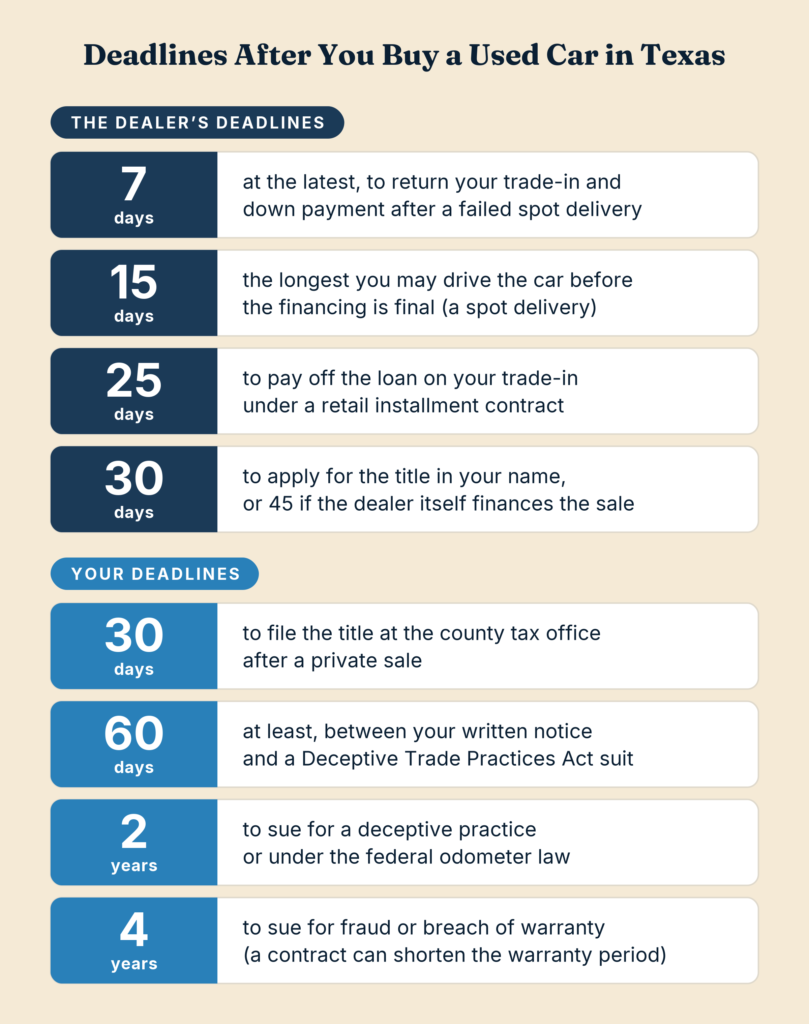
A dealer must apply for the title and registration in the buyer’s name and remit the sales tax (§ 501.0234). The department’s rule, 43 TAC § 215.144, counts 30 days from the sale as a reasonable time, 45 when the dealership finances the purchase itself, and obliges the seller to hand over the application receipt. Late transfer is, in the Dealer Manual’s words, the “most common complaint received from consumers”; TxDMV’s Disciplinary Matrix, its published penalty schedule, prices it from a warning letter to $10,000 per vehicle.
Paper buyer’s tags ended on 1 July 2025: under House Bill 718 a buyer leaves the lot with metal license plates. The charge is $10 (43 TAC § 215.155), and the Dealer Manual says sellers “may not charge any other amount for the plates”; the statute separately allows up to $20 for the database entry it requires (Transportation Code § 503.0631).
In a private sale the seller must hand over a properly assigned certificate of title when the vehicle is delivered (§ 501.0721), and the purchaser has 30 days to file it at the county tax office (§ 501.145). TxDMV’s buying tips add a signed Form 130-U, the title application, showing the price; the seller keeps the plates, and a Vehicle Transit Permit, good for five calendar days, covers the drive to that office.
The Texas used car sales tax of 6.25 percent is paid at titling (Tax Code §§ 152.021 and 152.041).
Open titles, those with the buyer’s name left blank, are barred: handing over or accepting an incomplete transfer document is fined $50 to $200 (Transportation Code § 501.161). A vehicle may not be sold again unless the owner named on the certificate signs it over (§ 501.071), the rule against what the trade calls title jumping. A sale made in violation of Chapter 501 is void, and ownership does not pass until its requirements are met (§ 501.073).
No statute we found caps the documentary fee, the “doc fee”, at a fixed sum. Finance Code § 348.006 allows one in a financed sale only if cash and credit buyers are charged alike, the amount is reasonable and the contract says conspicuously that it is not an official charge or required by law. A rule, 7 TAC § 84.205, presumes $225 or less reasonable; a seller that wants more must first file a cost analysis with the Office of Consumer Credit Commissioner, which can order the excess refunded.
What else a financed contract may itemize outside the cash price is listed in § 348.005: taxes, government fees, and the insurance, service contracts and other products the chapter allows. Some add-ons cannot be forced: a seller may not make a deal, cash or financed, conditional on buying a vehicle protection product that is not already installed (§ 348.014), and may not require a debt cancellation agreement such as guaranteed asset protection (§ 348.124).
A dealer’s advertised price must already include destination, dealer preparation and any markup, and may leave out only taxes, registration, title and license fees and other charges the law expressly allows; no savings claim may be advertised on a used vehicle (43 TAC § 215.250).
Driving home before the financing is final is a conditional delivery, known on the lot as a spot delivery. Finance Code § 348.013 limits such an arrangement to 15 days. If no installment contract follows, the seller must hand back the trade-in and the down payment by the seventh day after the arrangement ends, or at the moment the buyer returns the car at the seller’s request, and must pay the agreed value of a trade-in it cannot return as it was.
Under a retail installment contract, the seller must pay off the loan on a trade-in by the 25th day after the contract is signed and both cars, with the old one’s title documents, have changed hands (§ 348.408).
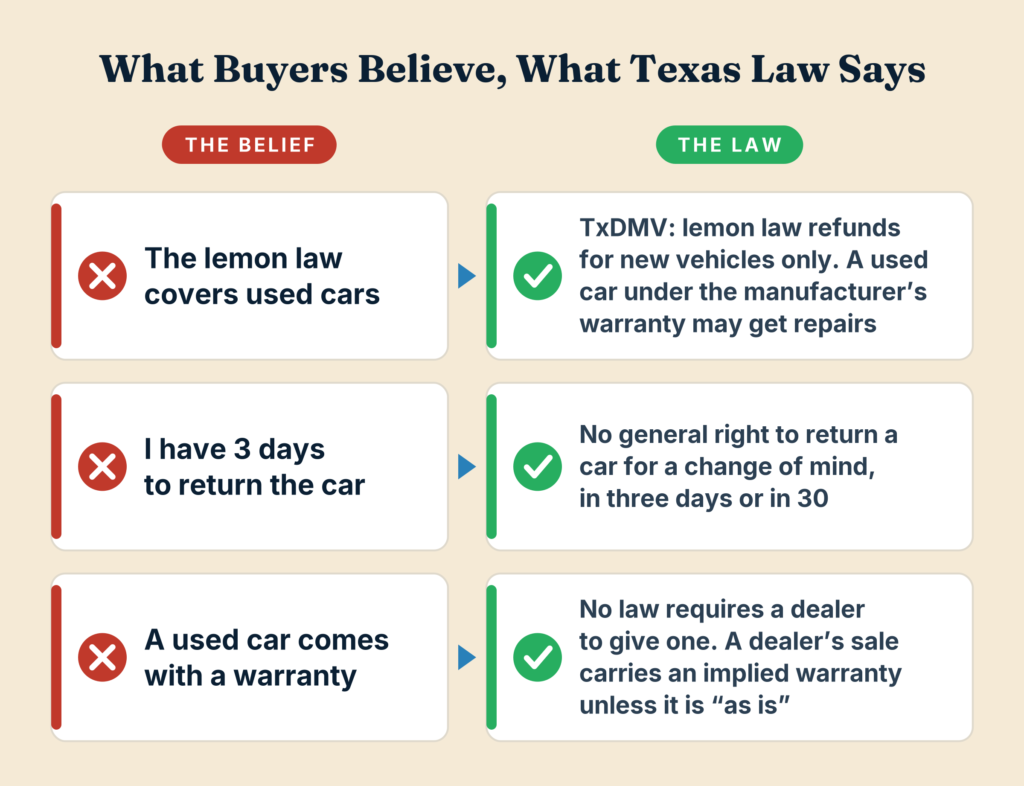
No statute we found lets a buyer return a used car for a change of mind, the so-called buyer’s remorse, in three days or in 30. The State Law Library says of the three-day belief: “there is no state law that explicitly grants this right.” The same page advises checking the contract itself for a return policy.
The three-day rule that does exist, Business and Commerce Code Chapter 601, lets a consumer cancel within three business days only where the merchant solicited the sale and took the order outside its own premises.
The other statutory right we found to cancel a signed deal without a reason belongs to a purchase financed through the seller on a retail installment contract. Until the seller delivers or mails a copy of it, a buyer who has not yet received the vehicle may cancel (rescind) and recover payments and trade-in (Finance Code § 348.111).
No safety inspection is tied to a sale any longer: House Bill 3297 ended the annual check for noncommercial vehicles on 1 January 2025. An emissions test is still required for registration in 17 counties, and Bexar County will become the 18th on 1 November 2026.
Warranties, as-is sales and the lemon law
No statute requires a dealer warranty on a secondhand car; TxDMV’s title check page says the state “does not provide any warranty or consumer protection on the reliability of that vehicle”. What a buyer has by default is the implied promise of merchantability in Business and Commerce Code § 2.314: goods sold by a merchant must be fit for their ordinary purposes.
That promise binds merchants only: it attaches to a dealer’s sale, not to a private seller’s. It can also be excluded: a disclaimer must mention merchantability and, if written, be conspicuous, but under § 2.316(c)(1) expressions like “as is” or “with all faults” exclude all implied warranties unless the circumstances indicate otherwise.
An as-is buyer still has rights, and the main one comes from the Deceptive Trade Practices Act. § 17.42 voids any waiver of that law unless it follows the section’s form, is signed, and is made by a consumer who is not in a significantly disparate bargaining position and has a lawyer of his or her own.
Under the federal Magnuson-Moss Warranty Act (15 U.S.C. § 2308), a seller that gives a written warranty, or enters into a service contract within 90 days of the sale, cannot disclaim the implied terms, only limit how long they last.
The lemon law, Occupations Code Chapter 2301, Subchapter M, is written for new vehicles: § 2301.603 obliges a manufacturer to make the repairs needed to conform one to its express warranty, and § 2301.604 requires a replacement or a refund, less an allowance for use, when a reasonable number of repair attempts fail. TxDMV, which decides the cases, splits the used car question in two on its lemon law page. A refund or replacement is out: “only new vehicles can qualify”.
Repair help may be available when a used one “is still covered by the manufacturer’s original warranty (not an extended service contract)”, or when the defect was reported while that coverage ran. The route is a warranty performance complaint under § 2301.204, which has no filing fee (43 TAC § 224.232). The statute’s definition of owner does reach a later purchaser who lives in Texas and registered the vehicle here (§ 2301.601), but the department’s page reserves repurchase for cars bought new, so a later owner should plan on the repair route. That is the Texas answer on lemon laws and used cars by state.
A reasonable number of attempts is presumed (§ 2301.605) after four for the same defect, two for a serious safety hazard, or 30 days out of service, all before the earliest of the warranty’s end, 24 months from the original delivery or 24,000 miles. The manufacturer must have had written notice and a chance to cure, and a proceeding has to start within six months after that earliest point (§ 2301.606).
The statute sets up no arbitration board. A complaint goes to TxDMV through its online complaint system; a request for repurchase or replacement costs $35 (§ 2301.712), repaid by the losing side if the owner wins. A case advisor first tries mediation, and unresolved cases go to a hearings examiner, a licensed attorney, who must rule within 60 days after the hearing closes (43 TAC § 224.264).
We found no Texas standard for “certified pre-owned”; a dealer’s written warranty is a contract, and its breach is a ground for suit under Business and Commerce Code § 17.50.
Title brands, total loss and how to check a Texas title
Texas sets its branding line at everything the car was worth, not at a share of it. Under Transportation Code § 501.091(15), a salvage motor vehicle is one with damage to, or missing, a major component part such that the cost of repairs exceeds its actual cash value, meaning market value, immediately before the loss. Repainting and the sales tax on the work are left out of the sum, and the same label attaches to anything that arrives on another state’s salvage title.
Several kinds of loss do not count at all: hail, harm to the exterior paint only, gradual damage, and a theft unless the vehicle was damaged before recovery. The definition makes no exception for age or price. A nonrepairable motor vehicle is chiefly one whose only residual value is as a source of parts or scrap metal.
A total loss payment is a separate matter from the brand, and the title chapter sets no percentage for it. An insurance company that takes ownership or possession of a salvage or nonrepairable vehicle through a claim must apply for the matching document (§ 501.1001). One that pays the claim but leaves the car with its owner reports the payment before the 31st day after paying, and no sale may follow until a salvage or nonrepairable title has been issued in the owner’s name (§ 501.1002). An insurer that owns a car meeting neither definition may still take one out by choice (§ 501.1001).
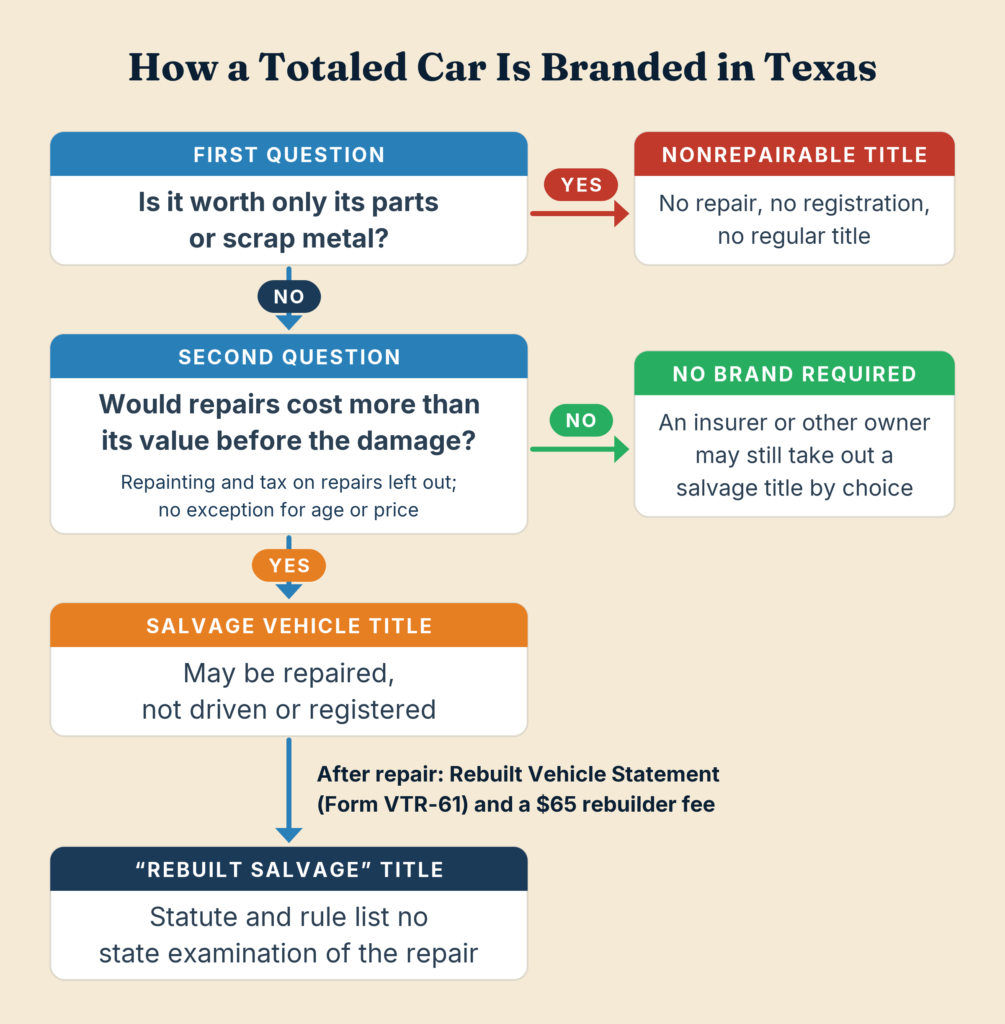
A salvage vehicle may be repaired but not driven or registered; a nonrepairable one may not be repaired or registered (§ 501.09111), and no regular certificate can issue on a nonrepairable title issued since 1 September 2003 or on its out-of-state equivalent.
After repair, the owner of a salvage vehicle applies for a rebuilt salvage title under § 501.100 and pays a $65 rebuilder fee. The application carries the Rebuilt Vehicle Statement, Form VTR-61, signed by owner and rebuilder, which names each major component part used, who supplied it and its identification number.
Neither that section nor the rule, 43 TAC § 217.89, lists an examination of the repair. The checks named are documents, plus a VIN (vehicle identification number) inspection where the car was last titled or registered in another country (§ 501.0321). TxDMV’s consumer pages and its Salvage and Nonrepairable Manual say a rebuilt vehicle must be “inspected” or “must pass safety and anti-theft inspections”; we found no such step in the Texas statute or rule.
The remark printed on the face of a Texas rebuilt title is “Rebuilt Salvage”. The certificate is a regular blue one: a TxDMV licensing page says the remark is stated on its front, while salvage and nonrepairable vehicles get special ones “distinguishable from the blue title”.
A salvage title issued for damage caused exclusively by flood must carry a notation (§ 501.09112), which 43 TAC § 217.84 words as “Flood Damage” and carries forward to every later certificate.
Brands from other states follow the car in. Under § 501.09113 the Texas certificate carries any notation needed where another state’s title, or its record in the federal database NMVTIS, shows rebuilt, flood damage, salvage, nonrepairable, junked or similar marks. On a letterhead statement from an official of the reporting jurisdiction that a brand was applied in error, TxDMV will consider removing it.
What the system cannot see is a car nobody branded. TxDMV’s Smart Buyer flood guide of September 2019 warns that an owner without comprehensive insurance “may try to dispose of a flood-damaged vehicle without disclosing that the vehicle was submerged”.
Our pillar on how title washing works nationwide follows a brand lost between jurisdictions, and a flooded car that leaves the state unbranded enters the interstate flood car pipeline.
These are the documents and remarks a buyer can meet.
| Brand or document | What it means | Source |
|---|---|---|
| Salvage Vehicle Title | Repair cost exceeded the vehicle’s value before the damage, the car arrived on another state’s salvage title, or an insurer or other owner took the title out by choice; may be rebuilt, may not be driven or registered | Transportation Code § 501.091(15); § 501.09111(c); § 501.1001(c) |
| Nonrepairable Vehicle Title | Parts or scrap metal only; may not be repaired, registered or given a regular title. A nonrepairable certificate issued before 1 September 2003 is the exception: its holder may rebuild the vehicle | § 501.091(9); § 501.09111(a), (b); § 501.100(f) |
| “Rebuilt Salvage”, printed with “Damaged” | A former Texas salvage vehicle retitled after repair on the Rebuilt Vehicle Statement, which the owner and the rebuilder sign and where, by the form, they “may be the same”; the title must disclose the former condition “in a manner reasonably understandable to a potential purchaser” | § 501.100(c); 43 TAC § 217.89(f); Form VTR-61; Title Manual, Table 4-1 |
| “Rebuilt Salvage”, printed with “Issued by” and a state code | Rebuilt from another state’s or country’s salvage document | 43 TAC § 217.89(g); Title Manual, Table 4-1 |
| “Flood Damaged” (the rule writes “Flood Damage”) | Damaged exclusively by flood water to the salvage level; carried forward on later titles; freshwater and salt water are branded alike | § 501.09112(d); 43 TAC § 217.84(f)(1); Title Manual, Table 4-1; TxDMV water damage page |
| “Manufacturer Buyback” | Returned to the manufacturer for unresolved warranty defects, or a lemon law brand carried from another state’s title | Title Manual, Table 4-1; Occupations Code § 2301.610 |
| “Reconstructed” | Converted so that it no longer resembles the vehicle as originally manufactured | Title Manual, Table 4-1 |
| “Replica” and “Not for Dealer Resale” | Replica: an established make of an earlier model year assembled as a new vehicle. Not for Dealer Resale: an assembled vehicle that a licensed dealer may not buy or sell | Title Manual, Table 4-1 |
| “Bonded Title” | Issued on a surety bond of one and a half times the vehicle’s value because the ownership evidence was incomplete; the bond expires after three years, and the remark can then be removed on request | § 501.053; Title Manual, Table 4-1 and Chapter 8 |
| “Actual Mileage”, “Not Actual Mileage” and “Mileage Exceeds Mechanical Limits” | The mileage statement at transfer: the reading was the true distance driven; it was not; or the odometer had passed its highest figure, 99,999 on a five-digit unit. The last two stay on the title after the vehicle becomes exempt from disclosure | § 501.072; Title Manual, Table 4-1 and Chapter 15 |
| Older remarks: “Rebuilt Salvage” with “Loss Unknown” or “95% Plus Loss”; “Reconditioned” | Marked obsolete in the Title Manual but still shown on old records; “Reconditioned” gave way to “Rebuilt Salvage” for titles issued from 1 August 1997. The Salvage and Nonrepairable Manual still lists the first two for a car rebuilt on a Texas salvage or nonrepairable certificate issued before 1 September 2003 | Title Manual, Table 4-1; Salvage and Nonrepairable Manual, Table 6-1 |
We found no free title lookup run by the state. TxDMV’s Title Check, linked in the table at the top, sends buyers to the approved NMVTIS providers. The Justice Department’s NMVTIS site says a provider’s report shows the brand history, the latest reported odometer readings, any insurer’s total loss decision and any transfer to a junk or salvage yard.
One title check is at the counter: in a private sale TxDMV advises taking the seller along to the county tax office, where staff can say whether the title “is correct and if it has any salvage or legal issues”.
An NMVTIS report with no brands is marked “Clear”, and the department’s buying tips speak of “a clean title”; both mean only that no brand had been reported when the search was run. Our guides to the free VIN check and to reading a vehicle history report show what each source can and cannot see.
Odometer law in Texas
The state offense is Transportation Code § 727.002. A person who, with intent to defraud, disconnects or resets an odometer to reduce the miles shown faces up to two years in the county jail, a fine of up to $1,000, or both. A repeat conviction brings 30 days to two years and a fine of up to $2,000. The section names no offense class.
It covers only the act of tampering, not the sale of a car someone else rolled back. Knowingly writing a false figure on a title assignment is a third-degree felony under § 501.155, which Penal Code § 12.34 punishes with two to 10 years and a fine of up to $10,000. Odometer disclosure and its exemptions are covered under the seller’s duties.
Chapter 727 gives no civil remedy. 49 U.S.C. § 32710 makes anyone who violates the federal odometer chapter with intent to defraud liable for three times the actual damages or $10,000, whichever is greater, plus costs and a reasonable attorney’s fee; the action must be brought within two years. In Texas the same facts are a listed deceptive practice, § 17.46(b)(16), which opens the remedies below.
TxDMV’s Smart Buyer odometer guide sends anyone who bought from a dealer to the department, at (888) 368-4689, and everyone to local law enforcement.
The mechanics are in our pillar on why odometer fraud still works, and the inspection routine is in five physical signs of an odometer rollback. We found no amendment to § 727.002 or to § 501.072 by the 88th or 89th Legislature.
Dealer licensing, curbstoning and the dealer bond
Nobody may do business as a dealer without a general distinguishing number, the Texas dealer license, for each location (Transportation Code § 503.021). The threshold sits in the exemption: no number is needed by a person who “sells or offers to sell during a calendar year fewer than five vehicles of the same type that are owned and registered in that person’s name” (§ 503.024(a)(1)). Read literally, that covers four vehicles sold or offered in a year; the fifth needs a license. A car not owned and registered in the seller’s name is outside the exemption from the first sale.
Dealing without a license is a misdemeanor under § 503.094, fined $50 to $5,000. A civil penalty of $50 to $1,000 applies to each violation and each day it continues (§ 503.095).
TxDMV uses the word curbstoning for more than the unlicensed seller. Its Dealer Manual defines it as the unlawful act of “selling vehicles somewhere other than licensed premises”, which takes in a licensed lot that sells from a parking area as well. For the unlicensed kind the Disciplinary Matrix sets $1,000 per vehicle, a referral to law enforcement, or both, rising to $4,000 each. The warning signs are in our guide on how to spot a curbstoner before you hand over cash.
A license can be checked on TxDMV’s Dealer License Lookup, linked in the table at the top.
A dealer other than a franchised one files a $50,000 surety bond (§ 503.033), so a used car bought at a franchised dealership has no bond behind it. The security backs two things: the bank drafts and checks the business writes to buy vehicles, and good title to each one it offers for sale. A defect or a misrepresentation is not covered.
To recover, a person needs a court judgment against the dealer on one of those grounds. The company behind the bond then owes the amount paid for the vehicle that came without good title, plus reasonable attorney’s fees, up to the $50,000 for all claims together. TxDMV’s Notice of Surety Bond, which each bonded dealer must post, names that company and tells consumers to contact it directly.
We found no recovery fund for car buyers in the code. Complaints do return money: more than $2 million in refunds to consumers in fiscal 2025, by TxDMV’s Enforcement Division report. It counts 20,149 general dealer licenses and 3,097 franchise ones issued that year; 91 percent of complaints were against independent dealers and 7 percent against unlicensed sellers.
Used car scams in Texas
We found no TxDMV list of the main vehicle scams. Its Dealer Manual gives examples of “forgery and fraud”, the first three being rollbacks, title fraud and “fraudulent sales of reconditioned vehicles”, which we read as rebuilt ones. The table starts with those three and adds five that the department, the Attorney General or the Federal Trade Commission has documented. We found no official ranking by frequency, so the order is ours.
| Scam | What the record shows | How to check |
|---|---|---|
| Odometer rollback | TxDMV’s Smart Buyer guide (July 2017) says rolling back an odometer “has become a more frequent problem for consumers”. The manager of a San Antonio used car dealership was sentenced in federal court, in a case announced on 3 April 2025, for disconnecting, resetting or altering the odometers of vehicles the lot advertised. Under state law, tampering with intent to defraud carries up to two years in county jail (Transportation Code § 727.002); for a dealer TxDMV’s Disciplinary Matrix, its published penalty schedule, sets misrepresenting mileage at $2,000 up to revocation. | Download the Vehicle Inspection Report from the Department of Public Safety: TxDMV’s guide calls it free and says the mileage should rise steadily from one inspection to the next. Outside the emissions counties, noncommercial cars have had no annual inspection since 1 January 2025. Compare the title, the service records and the oil change stickers; look at pedal wear. TxDMV’s guide also says to ask for the title and compare the mileage disclosed on its back with the figure printed on its face; on older, exempt vehicles the mileage does not have to be reported. |
| Title fraud and open titles | Title-related violations were 24 percent of the 8,087 violations cited in the motor vehicle cases TxDMV closed in fiscal 2025, by its Enforcement Division report. The Disciplinary Matrix prices forging a title document and filing a false lien at $1,000 up to revocation, and selling without a title at $1,000 to $10,000 per vehicle. Under state law, knowingly giving false information, or signing another person’s name without legal authority, on a title application or assignment is a third-degree felony (Transportation Code § 501.155); handing over or accepting incomplete transfer documents is fined $50 to $200 (§ 501.161), and selling or offering a registered vehicle without possessing its title or title receipt is a misdemeanor fined $1 to $100 on a first conviction (§§ 501.152 and 501.157). | TxDMV’s buying tips: “Never, ever walk away from a private sale without the title.” Its buying page tells the seller to sign the title with the date of sale and the odometer reading, and advises going to the county tax office together. The buyer also needs a signed Form 130-U showing the price; the pages name no bill of sale. File within 30 days “or you will be charged financial penalties”. At that office the 6.25 percent sales tax is charged on the price or, when the price is below 80 percent of the state’s standard presumptive value for the vehicle (a guidebook figure TxDMV maintains), on that 80 percent unless a certified appraisal gives another value (Tax Code § 152.0412). |
| Rebuilt or flooded cars sold without disclosure | The Attorney General’s flood warning: some sellers “may be looking to take advantage of consumers by selling them flood-damaged vehicles in the months following a hurricane or major storm”; the words “Flood Damage” must be on the title. A dealer must post the rebuilt notice and obtain the buyer’s signed acknowledgment (43 TAC § 215.160), and the Disciplinary Matrix prices a failure at $1,000 up to revocation. Under state law, failing to disclose known information to induce a sale is a deceptive practice (Business and Commerce Code § 17.46(b)(24)), and knowingly selling a salvage vehicle in violation of the salvage subchapter is a Class C misdemeanor, a fine of up to $500, rising to Class B on a second conviction and a state jail felony, 180 days to two years, on a third (Transportation Code § 501.109; Penal Code § 12.35). | Run an NMVTIS report and read it beside the title. A total loss or salvage yard entry in the report, unlike another state’s brand, does not by itself put a brand on a Texas title, so a title with no brand can sit beside a report that shows a total loss; the Title Manual tells staff handling bonded titles to give such entries “no consideration”. TxDMV’s water damage signs: recently shampooed carpet, rust on screws in the console, dried mud under the dashboard, a musty odor. Pay an independent mechanic. |
| Cloned or stolen cars | TxDMV’s buying page: “Many stolen vehicles are sold to unsuspecting buyers”, and “If you buy a stolen car unknowingly, you could lose the car and your money.” Three men were sentenced in federal court on 29 August 2025 for a Dallas-Fort Worth scheme that put the VINs of salvaged vehicles on stolen ones and sold them “as purportedly rebuilt vehicles”. Under state law, placing a serial number on a vehicle to change its identity is a third-degree felony (Transportation Code § 501.151). | TxDMV: the title and registration should match the seller’s name and address; the dash VIN plate should be “present, secure and unaltered”; be suspicious of a deal that seems too good to be true. |
| Curbstoning | TxDMV’s Dealer Manual: “Unlicensed persons commonly use vacant store parking lots and other curbsides to place vehicles for sale.” The Disciplinary Matrix sets $1,000 per vehicle, a referral to law enforcement, or both, rising to $4,000 per vehicle. Unlicensed dealing is a misdemeanor fined $50 to $5,000 (Transportation Code § 503.094). | The name on the title must be the seller’s own: a car not owned and registered in that name is outside the private sale exemption (§ 503.024(a)(1)). Check a business on the Dealer License Lookup. |
| Yo-yo financing | TxDMV’s Dealer Manual: a spot delivery “is also known as yo-yo financing”. The Attorney General describes the pattern: the buyer drives away on a verbal agreement, the credit is not approved, and “the trade-in has already been sold”. Under state law a conditional delivery may not run past 15 days; if no contract follows, the seller must hand back the trade-in, or pay its agreed value where it cannot be returned as it was, and refund the down payment by the seventh day after the arrangement ends, or at the moment the buyer returns the car at the seller’s request (Finance Code § 348.013). | The Attorney General: “DO NOT leave with your new car before the contract has been finalized completely and signed by both parties.” We would add: keep the trade-in until then. |
| Forced add-ons and padded fees | The Federal Trade Commission warned 97 dealership groups in March 2026, not specific to Texas, about fees missing from advertised prices and required extras. Its 2024 complaint over add-on charges at three Texas dealerships was dismissed on 5 October 2026 with no ruling on the allegations. Under state law, conditioning a sale on a protection product that is not installed is a deceptive practice (Finance Code § 348.014). | Read the itemized charges before signing: the sales tax is 6.25 percent of the price less the value of any trade-in (Tax Code §§ 152.002 and 152.021). The Attorney General on extras such as “extended warranties, nitrogen filled tires, window tinting, interior or exterior protection packages”: “just decline to purchase the vehicle or negotiate the price of the products.” In a financed sale a documentary fee above $225 needs a cost analysis on file with the Office of Consumer Credit Commissioner, (800) 538-1579. |
| Fake dealership websites | A Federal Trade Commission alert of 1 September 2026, not specific to Texas: scammers clone a real dealer’s website, “often using AI to do so”, and take payment up front for a car the buyer never receives. Under state law, creating a website in another’s name without consent and with intent to defraud is online impersonation, a third-degree felony (Penal Code § 33.07). | The alert’s advice: see the car and the dealership in person, walk away if the seller insists on an upfront payment by wire transfer only, and report the site at ReportFraud.ftc.gov. Also check the license on the Dealer License Lookup. |
If one of these has happened, the remedies and the complaint steps follow.
Your remedies under Texas law
The Texas used car buyer’s statute is the Deceptive Trade Practices Act, Business and Commerce Code Chapter 17, Subchapter E. A consumer includes any individual who seeks or acquires goods by purchase or lease (§ 17.45), and the statute speaks of conduct by “any person”, not only by a licensed dealer. § 17.50 gives three grounds that fit a car sale: a listed practice the consumer relied on, breach of an express or implied warranty, and an unconscionable action, one that takes grossly unfair advantage of a buyer’s lack of knowledge or experience.
Of the practices listed in § 17.46(b), those that fit a car sale include misstating characteristics, quality or grade, misrepresenting what a warranty covers, turning back an odometer, and failing to disclose known information to induce the purchase.
The base award is economic damages, the money lost, repair and replacement costs included. If the conduct was committed knowingly, the consumer may also recover for mental anguish and the judge or jury may award up to three times the economic damages; if intentionally, up to three times both. Every consumer who prevails is awarded court costs and reasonable and necessary attorney’s fees. A suit found groundless or brought in bad faith puts the seller’s fees on the buyer.
A demand comes before a suit for damages. § 17.505 requires a written notice at least 60 days before filing, giving the specific complaint and the amounts claimed for economic damages, mental anguish and expenses; no delivery method is prescribed. A seller that offers to pay (tenders) the sums claimed within 30 days of receiving the notice has a defense (§ 17.506), and a case filed without one can be put on hold (abated) at the seller’s request.
The limitation period is two years from the deceptive act, or from when the consumer discovered it or should have with reasonable diligence (§ 17.565). Common-law fraud has four years (Civil Practice and Remedies Code § 16.004), and so does a breach of warranty claim, counted from delivery unless the contract shortens the period (Business and Commerce Code § 2.725).
Public enforcement of the Act belongs mainly to the Texas Attorney General, whose consumer protection division sues in the state’s name. Under § 17.47 a court may grant an injunction, a civil penalty of up to $10,000 per violation, and up to $250,000 more where the practice was aimed at a consumer aged 65 or older, as well as restitution. The division does not act as a private citizen’s lawyer.
Occupations Code § 2301.807 lets TxDMV order a person found in violation to pay a refund to the buyer after a proceeding, along with a civil penalty of up to $10,000 per violation (§ 2301.801). What it cannot do, in its own words, is “pursue a private claim for damages on your behalf”.
For financing, the Office of Consumer Credit Commissioner licenses dealers that sell on installment contracts and the companies that buy them (Finance Code § 348.501), enforces the documentary fee and conditional delivery rules, and may order money returned. Neither rule creates a right to sue (§§ 348.006 and 348.013).
Texas small claims go to the justice courts, which take civil cases of up to $20,000, not counting interest (Government Code § 27.031). A statutory county court generally takes cases up to $325,000 (§ 25.0003). An arbitration clause does not change the deadlines: a claim that is too late for a lawsuit is too late for an arbitrator as well (Civil Practice and Remedies Code § 16.073).
Two federal remedies apply everywhere: the odometer act’s triple damages, and the Magnuson-Moss Warranty Act, 15 U.S.C. § 2310(d), which lets a consumer sue for breach of a written or implied warranty and lets the court award attorney’s fees. The checks to run before paying are in the complete buyer’s fraud prevention playbook.
The numbers and the cases in Texas
The Federal Trade Commission’s Consumer Sentinel Network Data Book 2024, published in March 2025, ranks Texas sixth among the states for fraud and other reports: 1,561 per 100,000 residents, 462,667 in all, with $897.9 million reported lost and a median loss of $500. “Auto Related” was the seventh-largest category, at 3 percent of all reports from the state, identity theft included; the book gives a share, not a count. The 2025 edition had not been published when we checked.
TxDMV’s title fee report by county for the fiscal year that ended on 31 August 2025 shows $8,735,100 in rebuilt fees paid to the state highway fund; since § 501.100 sends $50 of each $65 there, that is 174,702 rebuilt salvage applications. The same report counts 6,893,552 titles issued.
The Chairman’s Annual Report for fiscal 2025 shows 16,342 motor vehicle enforcement cases opened and 12,977 closed, and 844 lemon law and warranty complaints closed. We found no published count of odometer cases, of flood-branded titles or of licenses revoked.
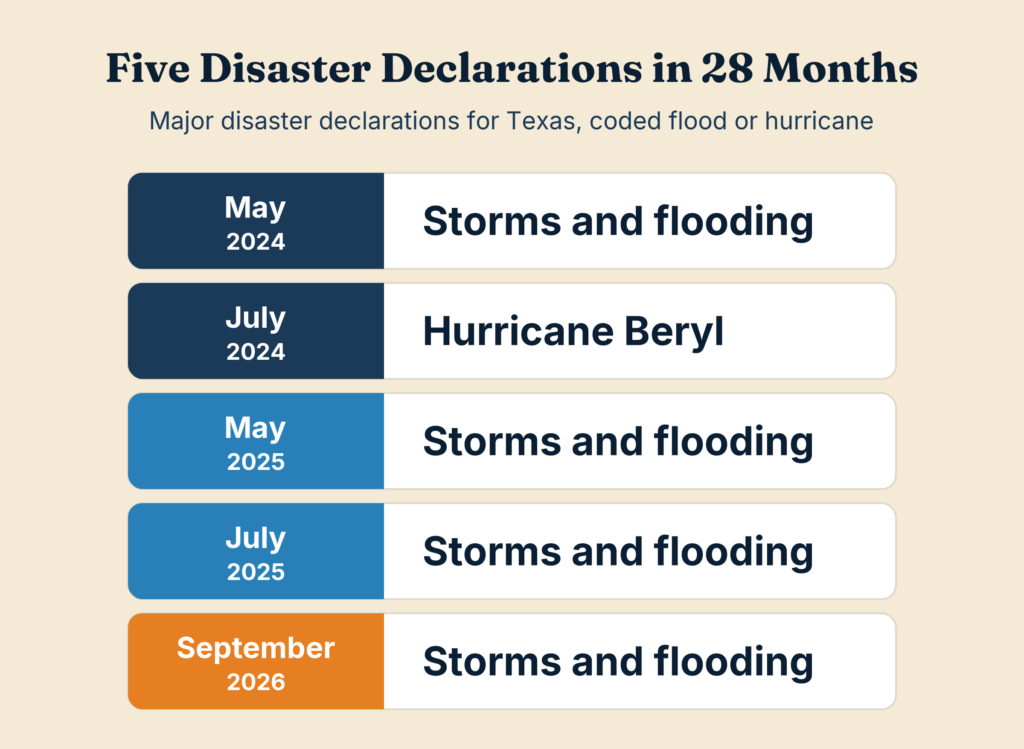
The database of the Federal Emergency Management Agency (FEMA), queried on 6 October 2026, lists 108 major disaster declarations for Texas since 1953, none of them tribal, 44 coded as floods and 17 as hurricanes. Five of those 61 were declared within 28 months: for Hurricane Beryl on 9 July 2024, and for severe storms and flooding on 17 May 2024, 21 May 2025, 6 July 2025 and 1 September 2026. We found no government count of the vehicles those events flooded.
The enforcement log is a selection from the last three years, newest first.
29 August 2025, US Attorney, Eastern District of Texas. Three men were sentenced that day to 78, 21 and 18 months for a VIN flipping scheme in the Dallas-Fort Worth area: they conspired to steal vehicles, replace the identification numbers with ones from salvaged cars, and sell the results “as purportedly rebuilt vehicles”.
23 July 2025, US Attorney, Southern District of Texas. The final defendant in a conspiracy to sell fake Texas paper tags was ordered to serve 60 months and to pay $22 million in restitution to TxDMV. According to the release, the group sold more than 550,000 tags online without selling any vehicles; the defendant had two fictitious dealerships licensed under fake identities.
3 April 2025, US Attorney, Western District of Texas. The manager of a San Antonio used car dealership was sentenced to six months and ordered to pay $264,747.05 in restitution for disconnecting, resetting or altering odometers on vehicles the business advertised.
We found no release in that period from TxDMV or the state’s four US Attorneys on a prosecution for selling undisclosed flood vehicles or for unlicensed dealing. Nor did we find a case against a car dealer or a complaint ranking among the Attorney General’s releases of those years.
What sets Texas apart
Paper tags come first. Dealers here printed them from a state database until 1 July 2025, and the conspiracy case in the log above shows what that became; the FBI’s Houston office said in that release that the case “led to changes in the way temporary tags are issued in Texas”.
The rebuilt volume is the second: 174,702 applications in fiscal 2025. A car repaired for 80 or 90 percent of its worth need not be branded here; our Florida guide describes a rule that brands an uninsured vehicle at 80 percent of its replacement cost. Once branded, a Texas car returns to the road on the statements of owner and rebuilder: the statute and the rule list no state examination of the repair, where Florida examines identity and parts.
Water is the standing risk, and the code ties the flood notation to federal aid records: § 501.09112 has TxDMV and the state’s emergency management division coordinate with FEMA to get the identification numbers of flood vehicles repaired or salvaged with its aid.
How to file a complaint in Texas
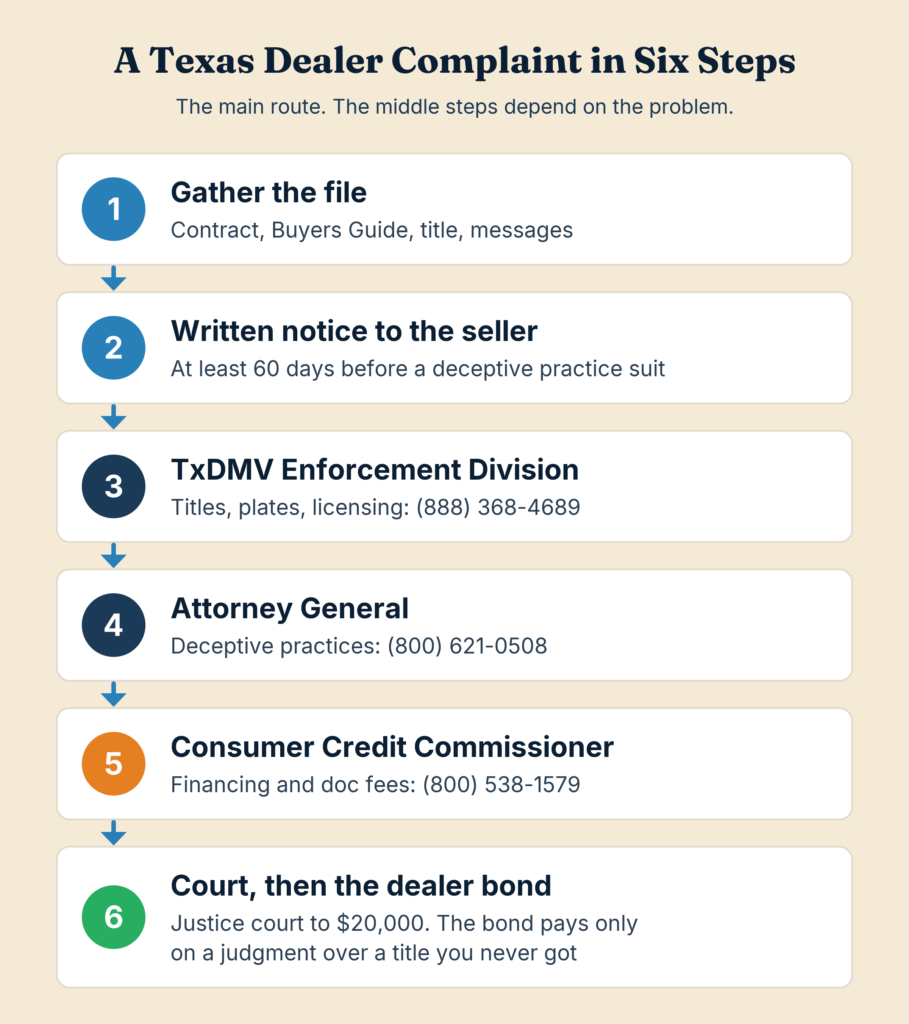
The steps below are the Texas version of how to file a complaint against a car dealer. The first two fit every case; steps 3 to 8 depend on the problem.
- Collect the file: the Buyers Guide, the contract, the title or the receipt for the title application, the odometer statement, the advertisement and every message with the seller.
- Write to the seller. For a deceptive practice send the notice that § 17.505 requires at least 60 days before a suit, with the complaint and the amounts claimed, and keep proof of delivery.
- File with TxDMV if the seller is a dealer, licensed or not, through the Motor Vehicle Dealer Online Complaint System (help line (888) 368-4689), and attach the sales contract and any advertisement at issue. The department handles titles and plates not delivered, advertising, fraud and license violations, and may order a refund.
- If the dealership has closed, ask a TxDMV Regional Service Center for a letter stating that it has gone out of business, then take it with the sales contract, photo ID and Form 130-U to the county tax office. Fees you can show were paid to the dealer may be waived (Dealer Closures).
- Report a rolled-back odometer to TxDMV when a dealer sold the car, and to local law enforcement in every case. For a large scheme add the National Highway Traffic Safety Administration’s Vehicle Safety Hotline, (888) 327-4236.
- Go to the Attorney General through the File a Consumer Complaint page or the hotline, (800) 621-0508. Complaints are reviewed “for informational purposes” and are open to the public; the office “cannot give you legal advice”.
- Take a financing problem to the Office of Consumer Credit Commissioner, (800) 538-1579: a documentary fee above $225 with no cost analysis on file, a conditional delivery that ran past 15 days, a trade-in or down payment not returned. The agency says it will, “when warranted, mediate solutions”.
- For a new car, file the lemon law complaint with TxDMV before the six-month deadline in § 2301.606 passes. For a used one, a warranty performance complaint is open if the defect was reported before the manufacturer’s warranty ran out (43 TAC § 224.232).
- Go to court. A justice court takes claims up to $20,000. The Deceptive Trade Practices Act and the federal odometer act award attorney’s fees to a buyer who wins, and Magnuson-Moss lets the judge do so, so a lawyer may take a strong case.
- Claim on the bond, where the dealer has one, if you paid and never received good title: present the judgment to the bond company named on the posted notice.
- Tell the federal agencies. ReportFraud.ftc.gov feeds the Consumer Sentinel database cited above, and the FBI’s Internet Crime Complaint Center, ic3.gov, takes reports of online sales scams.
Official resources
- Transportation Code, Chapter 501: titles, transfer duties, odometer disclosure, salvage, nonrepairable and rebuilt vehicles, and the title offenses.
- Transportation Code, Chapter 503: dealer licensing, the exemption for private sellers, the bond, plates and penalties.
- Transportation Code, Chapter 727: the odometer tampering offense.
- Transportation Code, Chapter 547: vehicle equipment, with the counterfeit airbag offense in § 547.614.
- Transportation Code, Chapter 548: vehicle inspection and emissions testing.
- Tax Code, Chapter 152: the motor vehicle sales tax, with the rate in § 152.021 and the standard presumptive value in § 152.0412.
- Business and Commerce Code, Chapter 2: sales, with the implied warranty, its exclusion, rejection and revocation of acceptance, and the four-year limit.
- Business and Commerce Code, Chapter 17: the Deceptive Trade Practices Act in Subchapter E.
- Business and Commerce Code, Chapter 601: the three-day right to cancel a sale solicited away from the merchant’s place of business.
- Occupations Code, Chapter 2301: the lemon law in Subchapter M, warranty performance complaints, the filing fee, refunds and civil penalties.
- Finance Code, Chapter 348: motor vehicle installment sales, with the documentary fee, itemized charges, conditional delivery, add-on and trade-in rules.
- Government Code, Chapter 27: justice courts, with the small claims limit in § 27.031.
- Government Code, Chapter 25: statutory county courts, with the general limit in § 25.0003.
- Civil Practice and Remedies Code, Chapter 16: limitation periods, with fraud in § 16.004 and arbitration in § 16.073.
- Penal Code, Chapter 12: the punishment for each grade of offense.
- Penal Code, Chapter 33: online impersonation in § 33.07.
- Texas Administrative Code, Title 43, Chapter 215: dealer rules, with title deadlines, the plate fee, the rebuilt notice and advertising.
- Texas Administrative Code, Title 43, Chapter 217: salvage titles, the flood notation and rebuilt salvage titles.
- Texas Administrative Code, Title 43, Chapter 224: lemon law and warranty performance procedure in Subchapter G.
- Texas Administrative Code, Title 7, Chapter 84: motor vehicle installment sales, with the $225 documentary fee rule in § 84.205.
- TxDMV Complaints: the Motor Vehicle Dealer Online Complaint System and what the department can do.
- TxDMV Lemon Law: coverage, the presumption, the deadline and the answer on used vehicles.
- TxDMV Office of Administrative Hearings: how a lemon law hearing runs.
- TxDMV Dealer Closures: getting a title when the dealership has gone out of business.
- TxDMV Title Check: the NMVTIS providers, brand descriptions, the removal of a brand applied in error and used vehicle buying tips.
- TxDMV Salvage Brands: the salvage brands and what the department says about rebuilding.
- TxDMV Water-Damaged Vehicles: the flood brand and the inspection signs.
- TxDMV Rebuilt Vehicles: the rebuilt brand and what to ask before buying one.
- TxDMV Notice of Rebuilt Motor Vehicle: the sign a dealer posts on a rebuilt vehicle.
- TxDMV Buying or Selling a Vehicle: private sales, the county tax office, the transit permit, the emissions counties and stolen vehicle tips.
- TxDMV Dealers: the Dealer License Lookup and the lists of licensed dealers.
- TxDMV Salvage Dealer: salvage and nonrepairable vehicles and the blue title.
- TxDMV House Bill 718 Implementation: metal plates in place of paper tags since 1 July 2025.
- TxDMV notice on Bexar County: emissions testing from 1 November 2026 and the end of the safety inspection.
- TxDMV Form 130-U: the application for a Texas title and registration.
- TxDMV Form VTR-61: the Rebuilt Vehicle Statement.
- TxDMV Form VTR-275: request for a title history.
- TxDMV Notice of Surety Bond: the notice each bonded dealer posts.
- TxDMV Motor Vehicle Title Manual: Table 4-1 of remarks and brands, the bonded title section of Chapter 8 and Chapter 15 on odometers.
- TxDMV Salvage and Nonrepairable Motor Vehicle Manual: the salvage and rebuilt title procedures.
- TxDMV Motor Vehicle Dealer Manual: what the regulator tells dealers about disclosure, titles, plates and fraud.
- TxDMV Disciplinary Matrix: the penalty range for each common dealer violation.
- TxDMV Smart Buyer, Checking for Flood Damage: the department’s flood guide of September 2019.
- TxDMV Smart Buyer, Odometer Fraud: checking mileage and where to report, July 2017.
- TxDMV Chairman’s Annual Report, fiscal 2025: enforcement cases opened and closed and lemon law complaints closed.
- TxDMV Enforcement Division Annual Report, fiscal 2025: complaint shares, violations cited, licenses issued and refunds to consumers.
- TxDMV title fee reports by county: titles issued and rebuilt fees by fiscal year.
- Department of Public Safety, Vehicle Inspection: the Vehicle Inspection Report download.
- Attorney General, Buying a New or Used Car: the state’s own consumer guide.
- Attorney General, File a Consumer Complaint: the complaint portal.
- Attorney General, Contact Us: the Consumer Protection Hotline.
- Attorney General, Warning: Flood Damaged Cars: the flood car warning.
- Office of Consumer Credit Commissioner, File a Complaint: complaints about motor vehicle financing and what the office does with them.
- Texas State Law Library, returning a car: the three-day belief answered.
- NMVTIS: the Justice Department’s national title database and its approved providers.
- National Highway Traffic Safety Administration (NHTSA), Odometer Fraud: federal guidance and the Vehicle Safety Hotline.
- FTC, Buying a Used Car From a Dealer: the Buyers Guide explained.
- FTC release on 97 dealership groups: the warning letters of March 2026 on pricing and required extras.
- FTC order of 5 October 2026: the dismissal of the 2024 complaint over add-on charges at three Texas dealerships.
- FTC alert on fake dealership websites: the consumer alert of 1 September 2026.
- ReportFraud.ftc.gov: the Federal Trade Commission’s report form.
- Internet Crime Complaint Center: the FBI’s report form for online scams.
Frequently Asked Questions
Does Texas have a used car lemon law?
Not for refunds. TxDMV, which decides the cases, says only new vehicles qualify for repurchase or replacement. A Texas used car still under the manufacturer’s original warranty, or with a defect reported while it was, may get repairs through a warranty performance complaint.
Can you return a used car in Texas?
No. We found no buyer’s remorse law for cars in Texas: no statute gives a general cooling-off period or right to cancel, in three days or in 30. One of two narrow exits: under a retail installment contract with the seller, a buyer who has not yet received the vehicle may cancel until a copy of that agreement is delivered or mailed. A car that does not conform to the contract may be rejected within a reasonable time.
Does a used car come with a warranty in Texas?
No statute requires a dealer to give one. A dealer’s sale carries the implied warranty of merchantability unless the car is sold “as is”, and the Buyers Guide on the window shows which applies. An as-is sale does not by itself waive a claim under the Deceptive Trade Practices Act.
What title brands does Texas use?
Two documents take the place of a regular one: the Salvage and the Nonrepairable Vehicle Title. A regular certificate can carry the remarks Rebuilt Salvage, Flood Damaged, Manufacturer Buyback, Reconstructed, Replica, Not for Dealer Resale and Bonded Title, and two odometer warnings, Not Actual Mileage and Mileage Exceeds Mechanical Limits.
Why is Texas a high-risk state for used car fraud?
We found no government ranking of the states for used car fraud. The record shows three sources of exposure: 61 major disaster declarations for floods and hurricanes since 1953, a salvage line set at the car’s whole value, and a rebuilt title issued on the statements of owner and rebuilder.
Can I sue a Texas dealer under the DTPA?
Yes, for a listed deceptive practice you relied on, a breach of warranty or an unconscionable action. Send written notice at least 60 days before filing and sue within two years. A consumer who prevails recovers economic damages and attorney’s fees, and up to three times those damages if the conduct was knowing.
Are dealer fees capped in Texas?
Not at a fixed amount. In a financed sale the documentary fee must be reasonable; $225 or less is presumed to be, and more needs a cost analysis filed with the Office of Consumer Credit Commissioner. The plate charge is $10, plus up to $20 for the database entry.
How many cars can I sell in Texas without a dealer license?
Four in a calendar year. The exemption covers fewer than five vehicles of the same type sold or offered, each owned and registered in your name; the fifth needs a license. Unlicensed dealing is a misdemeanor fined $50 to $5,000.
How do I file a complaint against a Texas dealer?
File with the TxDMV Enforcement Division through the Motor Vehicle Dealer Online Complaint System; the help line is (888) 368-4689. For a deceptive practice also send the written notice at least 60 days before a suit and report to the Attorney General at (800) 621-0508.
Sources and verification
Statutes: the Texas codes as published by the Legislature (statutes.capitol.texas.gov), amended through the 89th Legislature and its 2025 called sessions, read on 6 October 2026. Administrative Code rules were read the same day in a published copy and are linked to the Secretary of State’s portal.
Federal law: the United States Code on govinfo.gov and 16 CFR Part 455 on ecfr.gov, read the same day.
Agency pages and forms: read on 6 October 2026. TxDMV’s publications carry these dates: the three manuals (Title, August 2026; Salvage and Nonrepairable, January 2026; Dealer, 2026 edition); Disciplinary Matrix, 17 November 2025; Chairman’s Annual Report, 9 December 2025; Enforcement Division Annual Report, September 2026; Smart Buyer guides, July 2017 and September 2019.
Figures: the FTC Consumer Sentinel Network Data Book 2024; TxDMV’s title fee report for fiscal 2025 (the rebuilt count is our own division of the fee total by $50); FEMA’s disaster declarations database. This page uses the OpenFEMA API but is not endorsed by FEMA.
Cases: taken from the releases and orders linked; allegations are not findings.
Next review: October 2027, or sooner if the Legislature amends any section cited here. Changes: 6 October 2026, rewritten to our current state guide standard, replacing the version of 23 September 2026. How we check facts is set out in our editorial standards.