
What “As-Is” Actually Means and When You Still Have Rights
Every fact, figure and legal citation in this article was checked against its original source before publication. Editorial Standards
A used car sold as is comes with no dealer warranty, and when it breaks the usual answer is that you signed for it. That is not always the end of the matter. The as-is box removes one protection, the warranties the law would otherwise imply. It does not cancel a repair promise the dealer put in writing, a factory warranty that is still running or a state law that restricts as-is sales, and it does not protect a seller who lied about the car. The fact to hold on to is that fraud overrides as-is, when it can be proven.
What “As Is, No Dealer Warranty” Means
Every dealer has to display a Buyers Guide on each used car it offers for sale. The FTC Buyers Guide comes from the Used Car Rule, in effect since 1985, and it has two versions. One has a box marked “As Is” and “No Dealer Warranty”. The other, for states that limit or prohibit as-is sales, says “Implied Warranties Only”. Dealers in Maine and Wisconsin use their own state form.
When the as-is box is checked, the Guide says: “THE DEALER DOES NOT PROVIDE A WARRANTY FOR ANY REPAIRS AFTER SALE.” In the rule’s own words, the car is sold “without any implied warranty”. That is all the box does. When the FTC rewrote that sentence in 2016, it said that the absence of a dealer warranty “does not foreclose the possibility that a dealer could have post-sale repair obligations in some circumstances”. It had proposed to add that buyers “may have other legal rights and remedies for dealer misconduct”. Dealer groups objected, and the line was dropped.
Two more points matter. The Guide is part of the sales contract and overrides anything in the contract that contradicts it. And it warns that spoken promises are difficult to enforce, so a promise to repair belongs in writing, ideally on the Guide itself. In a 2021 Ohio appeal, a dealer sold a 2005 Nissan Murano as is and agreed, on a separate “we owe” form, to repair the exhaust, the air conditioning, the brake pads and two smaller items. It did not do the work. The court held that the as-is sale “does not cancel or negate” the written promise, and the buyer was awarded $2,937.71.
When Fraud Overrides As-Is
An as-is clause is a warranty disclaimer. It is not permission to lie. An Ohio appeals court put the line this way in 2023: the clause relieves a seller of a duty to disclose, but it “does not bar a claim for ‘positive’ fraud, a fraud of commission rather than omission”. A seller who says nothing about a defect is usually protected by the clause. A seller who makes a false statement, or works to hide the defect, is not. The Used Car Rule also makes it a deceptive practice for a dealer to misrepresent the mechanical condition of a used vehicle.
Minnesota’s Supreme Court went a step further in 2018. A dealer bought a pickup from a salvage yard for $6,770, knowing it needed engine repairs, repaired it just enough to look appealing and drive short distances, and sold it as is for $12,950.68. The contract disclosed the salvage title and the lit check-engine light, which the salesman blamed on a faulty oxygen sensor. The truck would not go faster than 40 miles an hour, and a second dealer recommended a new engine at about $20,000. The court ruled that the fraudulent statements made the as-is disclaimers themselves ineffective, and the buyer was awarded $14,366.03 in damages and $21,949.35 in attorney fees and costs.
Fraud has to be proven, and the same court noted that not every wrong statement is fraud. A statement of fact about the car, such as “never in an accident”, can also be an express warranty, which an as-is clause does not remove. Opinion and sales talk create no warranty, and a statement that was only spoken is hard to prove against a written contract.
Some lies have a law of their own. Anyone who tampers with an odometer or misstates the mileage with intent to defraud is liable for three times the actual damages or $10,000, whichever is greater, however the car was sold. We cover odometer fraud in a guide of its own.
Proof decides these cases. Keep the Buyers Guide, the contract, the listing and every message, and have an independent mechanic put in writing what is wrong. A vehicle history report that shows an accident or a brand the dealer denied is evidence, and a brand that disappeared between states points to title washing. Then take the file to your state attorney general or a consumer-protection attorney.
For the checks to run before you sign, from the VIN check to the paperwork, see our complete fraud prevention playbook and the rest of our Buyer’s Guide.
Warranties That Survive an As-Is Sale
The main warranty an as-is sale removes is the implied warranty of merchantability: the promise, implied when the seller deals in goods of that kind, that the goods are fit for their ordinary purpose. For a car, the FTC puts it simply: it will run. As is also removes the narrower implied warranty of fitness for a particular purpose. Three things can keep a warranty alive when the as-is box is checked.
The first is the manufacturer’s warranty. A factory warranty that still applies to the car is not affected by the dealer’s as-is box, and the Buyers Guide has a separate box for it.
The second is the dealer’s own paperwork. Under the federal Magnuson-Moss Warranty Act, a dealer that gives a written warranty, or enters into a service contract with the buyer within 90 days of the sale, cannot disclaim the implied warranties. That is the Magnuson-Moss Warranty Act explained as far as a used car buyer needs it, and it is one of the federal laws that protect used car buyers in every state.
In May 2025 Indiana’s Supreme Court ruled for the estate of a buyer whose 2007 Dodge Caliber was sold with the as-is box checked and a service contract the same day. The court decided the case on the paperwork and left the federal question open: the Guide’s own line about service contracts and a handwritten note of the purchase made the disclaimer ambiguous, so the implied warranty stood. The case went back to decide whether the dealer had been given a reasonable opportunity to cure the problem, which the Act requires before a buyer can sue.
The third is state law.
State Rules on As-Is Sales
At least 23 states and the District of Columbia limit when a dealer may sell as is, require a minimum warranty, or attach duties that the sticker cannot waive. We read each rule in the state’s code, session law or attorney general’s guidance in October 2026. Two changed on October 1, 2026: Connecticut dropped its price test and moved its age line from seven years to ten, and California’s three-day right to cancel took effect, as we reported.
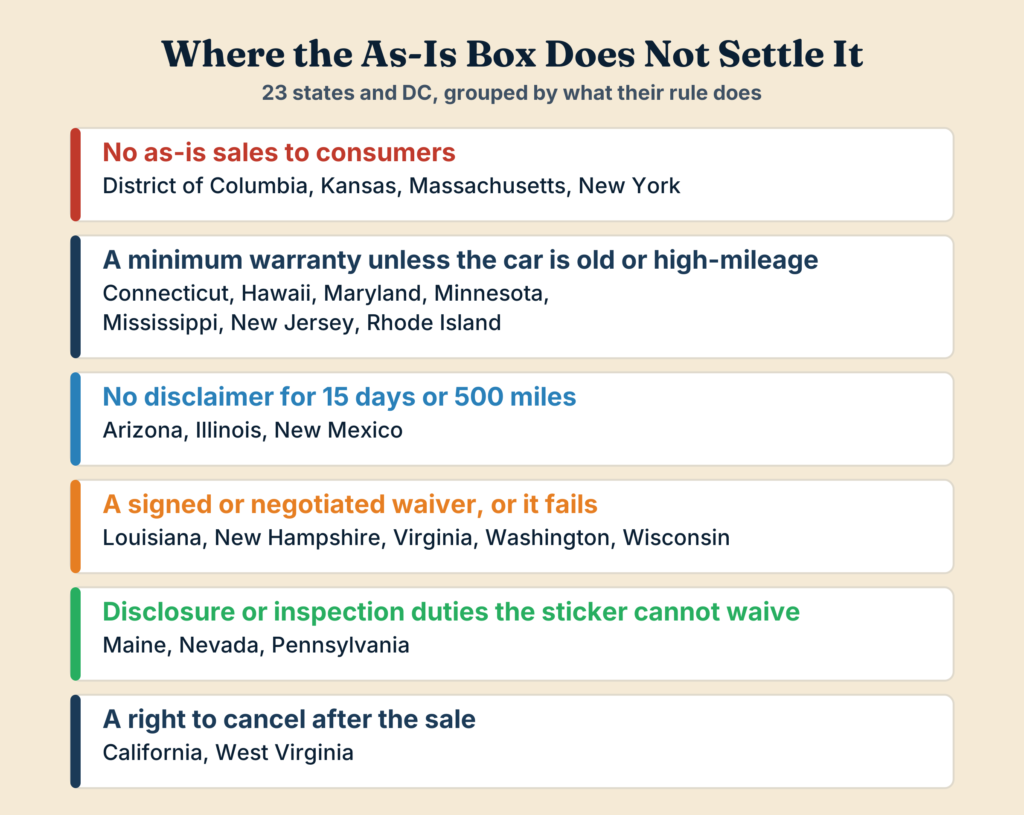
| State (most names link to the main source) | As-is restriction | What protection applies |
|---|---|---|
| Arizona | No waiver of the implied warranty of merchantability for 15 days or 500 miles, whichever comes first. | The dealer must get a chance to repair before a refund can be sought. A defect spelled out in writing is not covered. |
| California | As is allowed at most dealers. | Three days to cancel a dealer purchase priced at $50,000 or less and driven no more than 400 miles, for a restocking fee. |
| Connecticut | As is only on cars ten years old or older, counted from January 1 of the model year (Public Act 26-100). | Younger cars get 60 days or 3,000 miles on parts and labor. |
| District of Columbia | No as-is sales to consumers. | Only defects noted conspicuously in writing at the sale are excluded. |
| Hawaii | As is allowed if the car is sold for less than $1,500, has over 75,000 miles or is five years old or older. | Other cars get 30 to 90 days by mileage. |
| Illinois | No disclaimer of the power train warranty for 15 days or 500 miles, whichever is earlier. | Excluded are cars with more than 150,000 miles, rebuilt or flood titles and a few other classes. |
| Kansas | No as-is sales to consumers. | The only exception is a defect the dealer can show the buyer knew about. |
| Louisiana | A waiver of the warranty against hidden defects must be clear, unambiguous and brought to the buyer’s attention. | It fails if the seller claimed a quality he knew the car did not have. |
| Maine | Implied warranties can be disclaimed on the posted window form. | The warranty that the car meets state inspection standards cannot be waived. |
| Maryland | As is only if the car is over 6 model years old and has more than 60,000 miles. | On other cars implied warranties cannot be excluded. |
| Massachusetts | No as-is sales to consumers. | Dealers also owe 30 to 90 days by mileage on cars under 125,000 miles sold for $700 or more. |
| Minnesota | As is only for cars the warranty law excludes, such as those with 200,000 miles or more. | Other cars get 15 to 60 days by mileage. |
| Mississippi | As is only if the car is over six model years old or has more than 75,000 miles. | On other cars implied warranties cannot be excluded. |
| Nevada | As is allowed. | At 75,000 miles or more the dealer must inspect the engine and drivetrain and disclose defects in writing. |
| New Hampshire | As is only with a conspicuous statement signed by the buyer. | Without it the implied warranties stay in force. |
| New Jersey | As is if the car is sold for less than $3,000, is more than seven model years old or has more than 100,000 miles, or by signed waiver over 60,000 miles. | Other cars get 30 to 90 days by mileage. |
| New Mexico | No disclaimer of the implied warranty of merchantability for 15 days or 500 miles, whichever is earlier. | A disclosed defect the buyer signs for is not covered. |
| New York | The Attorney General’s guide says no dealer can sell a car “as is”. | Cars sold for $1,500 or more with up to 100,000 miles get 30 to 90 days by mileage, and the warranty cannot be waived. |
| Pennsylvania | As is allowed, with a notice in the car. | The dealer must disclose known defects in the frame, block, transmission or differential, flood damage and inability to pass state inspection. |
| Rhode Island | As is if the car is sold for less than $1,500, or with a windshield notice and an initialed waiver. | Other cars up to 100,000 miles get 30 or 60 days by mileage. |
| Virginia | As is only with a signed disclosure on the front of the buyer’s order. | Without it the buyer may cancel within 30 days. |
| Washington | A disclaimer must list what is not warranted and, the Attorney General says, be explicitly negotiated. | Otherwise the implied warranty of merchantability applies. |
| West Virginia | As is allowed if the car is sold for less than $4,000, has more than 100,000 miles or is seven years old or older. | Those buyers have until the end of the dealer’s third business day to cancel for a significant mechanical problem. |
| Wisconsin | As is must be explicitly negotiated and marked on the Wisconsin Buyers Guide. | The dealer must still inspect the car and disclose existing problems. |
The rows give the main test in each law, not every exemption. If a dealer skipped a step its state requires, the as-is clause can fail on that ground alone. The rules on lemon laws and used cars by state differ more than most buyers expect, and a state that is not listed may still have rules of its own, which its attorney general’s office can confirm.
Vermont is unsettled. One sentence of its code makes any attempt to exclude implied warranties in a sale of consumer goods unenforceable, but the same subsection opens with a rule for new goods only, and the Attorney General warns buyers that an as-is sale may leave them without legal recourse against the dealer.
For one state’s used car rules in full, see our state guides.
As Is in a Private Sale
None of the sticker rules reach a private seller. The Used Car Rule covers dealers, which it defines by volume: five or more used vehicles sold or offered in the previous twelve months. The implied warranty of merchantability arises only when the seller is a merchant in goods of that kind. A private sale is generally as is without anyone saying so.
Fraud law still applies, and so does the federal odometer law. Some states go further. Massachusetts, in the law linked in the table, makes a private seller disclose every known defect that impairs the car’s safety or substantially impairs its use, and gives the buyer 30 days to undo the sale otherwise. Louisiana’s warranty against hidden defects applies to every seller, dealer or not, unless it is properly waived. And a “private seller” with several cars for sale may be a dealer in law: see how to spot a curbstoner.
The Bottom Line
As is means the dealer gives no implied warranty. It does not protect a seller who lied, cancel a written promise, end a factory warranty or override a state law that restricts as-is sales. Before you sign, get every promise in writing and check whether your state is in the table. If the car fails afterwards, keep the paperwork, get the defect diagnosed in writing, give the dealer a chance to put it right, and take the file to your state attorney general or a consumer-protection attorney.
Discuss this article on r/VINvestigators. Got a listing that looks off, or a report that does not add up? Post it. Over 1,500 members, buyers and trade among them.
New guides and fraud alerts by email, a few times a month, no more. Subscribe on the home page.
Checking a specific car? Get the full vehicle history report from carVertical, an NMVTIS-approved provider, 20% off through our link. The link applies the discount automatically; if you go to carVertical later, the code VINVEST gives the same 20%. We earn a commission from carVertical if you buy; it costs you nothing extra.