
Lemon Laws and Used Cars, What Is Actually Covered in Each State
Every fact, figure and legal citation in this article was checked against its original source before publication. Editorial Standards
A used car that will not stay fixed is the most common reason buyers go looking for a lemon law, and the first thing most of them learn is that the law they heard about was written for new cars. Every state and the District of Columbia has a lemon law, and nearly every one of them puts the duty to repair, refund or replace on the manufacturer, under the written warranty that came with the car when it was new. A dealer selling a six-year-old sedan made no such promise, so the statute that rescues a new car buyer after four failed repairs usually has nothing to say about a used one.
That is the rule, and the exceptions are what this guide is about. Six states have a used car lemon law of their own, which forces the dealer to give a written warranty and take the car back when it cannot be repaired. A handful more make the dealer stand behind the car for a short period or keep the implied warranty alive. In most of the rest, the new car lemon law follows a car to its second owner for as long as the original rights period runs, and federal warranty law backs up a buyer everywhere.
We read every state’s statute at its legislature’s own site, or an official state page where the code is not published there, and the table below says what we found. It opens our Laws & Regulations section, which will grow around it.
What a lemon law does and why most of them stop at the showroom
A state lemon law is a warranty enforcement statute. It takes the manufacturer’s written warranty on a new vehicle, gives the manufacturer a set number of chances to fix a defect that substantially impairs the car’s use, value or safety, and then forces a choice: replace the car or refund the price. The number of chances is written into the statute as a presumption. In Texas, for example, the presumption arises after four repair attempts for the same defect within 24 months or 24,000 miles, or 30 days out of service. Other states use three attempts, or 15 days, or 18 months, but the shape is the same everywhere.
Two features of that shape leave used car buyers outside. The first is the warrantor. The lemon law’s duties run from the manufacturer, and a used car dealer is not the manufacturer. Florida’s statute says so in terms: nothing in the chapter “imposes any liability on a dealer,” apart from a written warranty the dealer gave itself and two narrow exceptions. The second is the clock. The rights period runs from the date of original delivery to the first buyer, not from the day a second buyer takes the keys, and it is typically one or two years. A three-year-old car was outside that window before it reached the used lot, whoever owns it now.
The phrase “lemon law” also gets stretched, which is why the question “does lemon law cover used cars” has no single answer. New York calls its used car warranty statute a lemon law. Arizona has a dealer warranty rule that its Attorney General calls a used car lemon law, although the statute never uses the phrase. And the federal Magnuson-Moss Warranty Act is not a lemon law at all, but a rule about how written warranties and service contracts work. This guide takes them in turn.
The six states with a used car lemon law
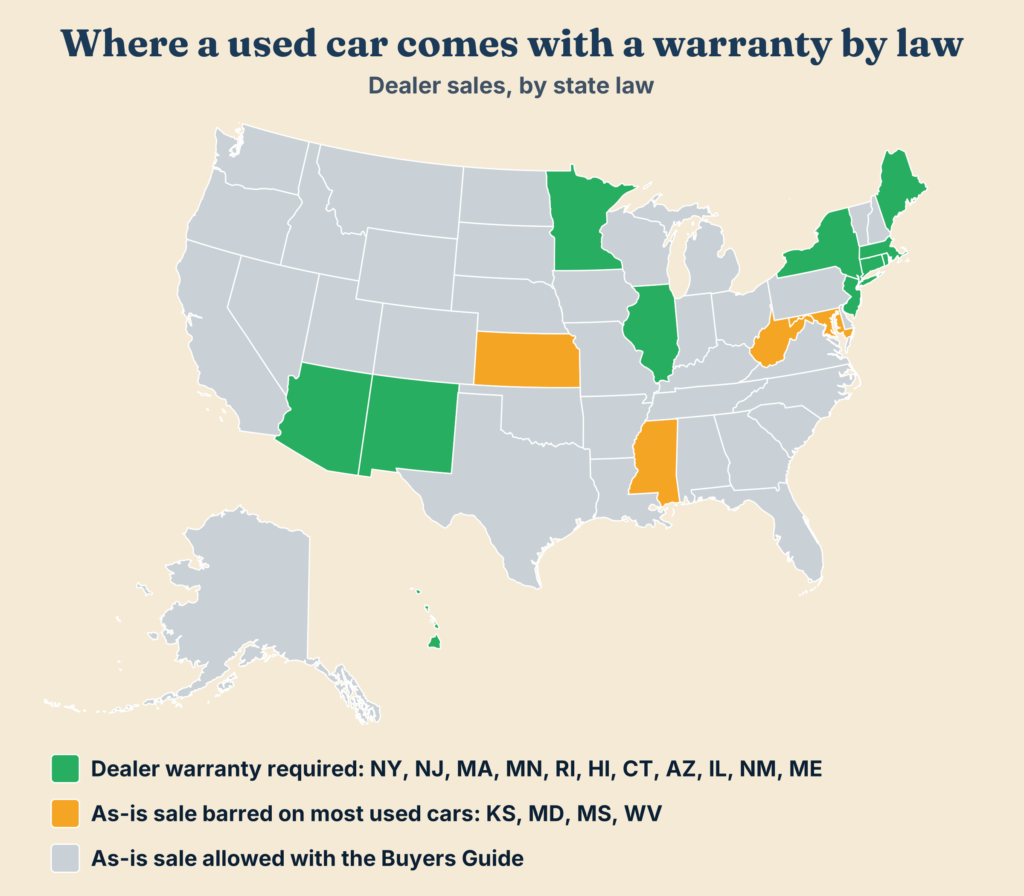
Only 6 states require a dealer to give a written warranty on most used cars it sells: New York, New Jersey, Massachusetts, Minnesota, Rhode Island and Hawaii, and five of them make the dealer take the car back when it cannot be fixed. The warranties are short, measured in days and miles from the sale, and they shrink as the odometer reading rises. None of the six covers a private sale. New York, New Jersey and Rhode Island define a dealer as anyone who sold three or more used cars in the previous twelve months, Massachusetts as anyone who sold more than three, and Minnesota and Hawaii use their dealer licensing definitions.
What the warranty must cover is written into each statute. New York, Rhode Island, Hawaii and Minnesota list the engine, the transmission, the drive axle, the brakes and the steering, and most add the radiator, the alternator and the starter. New Jersey’s list stops at the engine, the transmission and the drive train. Massachusetts lists no parts at all and instead covers any defect that impairs safety or use, which is the widest of the six.
| State | Warranty the dealer must give | Cars left out | Refund trigger |
|---|---|---|---|
| New York | 90 days or 4,000 miles up to 36,000 miles; 60 days or 3,000 miles to 79,999; 30 days or 1,000 miles from 80,000 to 100,000 | Under $1,500; over 100,000 miles | 3 repair attempts or 15 days out of service |
| New Jersey | 90 days or 3,000 miles up to 24,000 miles; 60 days or 2,000 miles under 60,000; 30 days or 1,000 miles from 60,000 | Under $3,000; seven or more model years old; more than 100,000 miles; a disclosed total loss | 3 attempts or 20 days waiting for repair |
| Massachusetts | 90 days or 3,750 miles under 40,000 miles; 60 days or 2,500 miles under 80,000; 30 days or 1,250 miles under 125,000 | Under $700; 125,000 miles and over; business use | 3 attempts or 10 business days out of service |
| Minnesota | 60 days or 2,500 miles under 36,000 miles; 30 days or 1,000 miles under 75,000; 15 days or 500 miles under 200,000 (not at a new car dealer) | Under $3,000 or eight years and older (first two tiers); 200,000 miles and over; diesel; salvage brand | Repair or replace, or a refund at the dealer’s election |
| Rhode Island | 60 days or 3,000 miles up to 36,000 miles; 30 days or 1,000 miles to 100,000 | Under $1,500; over 100,000 miles | 3 attempts or 15 days out of service |
| Hawaii | 90 days or 5,000 miles under 25,000 miles; 60 days or 3,000 miles under 50,000; 30 days or 1,000 miles to 75,000 | Under $1,500; over 75,000 miles; five years and older; an inoperable total loss | 3 attempts or 10 business days out of service |
The refund rules differ. In New York, New Jersey, Rhode Island and Hawaii, a dealer who fails to fix the same defect three times, or keeps the car in the shop past the day count, must take the car back and refund the price, less an allowance for damage and, in New Jersey and Hawaii, for use. Massachusetts has the same rule, adds a state-certified arbitration the buyer can demand within six months of delivery, and caps what the buyer pays toward covered repairs at $100. Minnesota is the odd one out: the refund is “at the dealer’s election,” so a Minnesota buyer has a warranty claim, not a buy-back right.
Waivers are where buyers lose these protections. New York makes any agreement that waives the warranty void. Hawaii does the same, but lets a buyer sign away coverage for a particular defect the dealer disclosed in writing, and Minnesota allows that through a circled and signed statement on the Buyers Guide. New Jersey lets a buyer waive the warranty on a car with more than 60,000 miles, but only as part of a price negotiation, in a separately signed statement that says the buyer is taking the car “as is” in exchange for a price adjustment.
Rhode Island allows a waiver if the dealer posts a windshield notice in one-inch letters saying the car is sold as is with no warranty as to condition, and the waiver is initialed on the bill of sale in a different color. The lesson is the same in all six: read the sale papers for a waiver line before signing, because a dealer in a used car lemon law state has every reason to put one there. Private sales fall outside all six statutes, with one partial exception. Massachusetts requires a private seller to disclose every known defect that impairs safety or substantially impairs use, and a buyer who was not told can rescind the sale within 30 days.
Five more states make the dealer stand behind the car
Connecticut has a used car warranty law that works by price rather than mileage. The Department of Consumer Protection summarizes it: on a car bought from a licensed Connecticut dealer for at least $3,000, six years old or less and used for personal or household purposes, the dealer must repair defects at no charge for 30 days or 1,500 miles, and for 60 days or 3,000 miles if the buyer paid at least $5,000. A cheaper or older car falls outside the law.
Three states give most dealer sales a short statutory warranty instead of a tiered one. Arizona, Illinois and New Mexico each forbid a dealer to disclaim the implied warranty of merchantability until midnight of the fifteenth day after delivery or 500 miles, whichever comes first, and each makes the buyer pay half the cost of the first two repairs, up to $25 per repair in Arizona and New Mexico and $100 in Illinois. In all three a buyer can waive the warranty only for a particular defect the dealer disclosed in writing, and the New Mexico Attorney General puts the result plainly: there are no “as is” used car sales at licensed dealers.
The Illinois rule, 815 ILCS 505/2L, covers the power train only and leaves out cars with more than 150,000 miles, rebuilt or flood titles and vehicles rated at 8,000 pounds or more.
Maine takes a narrower route again. A Maine dealer may disclaim implied warranties on the window form, but 10 M.R.S. § 1474 makes the dealer warrant, in writing and without any possible waiver, that the car has been inspected and meets the standards of the state inspection law. The Attorney General’s summary is the one to remember: if you buy a used car “as is” in Maine, “your only warranty is that it can pass state inspection.”
Four states reach a similar place from the other direction, with no warranty period at all. Kansas, Maryland, Mississippi and West Virginia keep the implied warranty alive on most used cars by making a dealer’s disclaimer unenforceable, so the car must be fit for ordinary driving when sold, and a buyer whose car was not has a claim. Three of the four carve out older or high-mileage cars.
Maryland lets a dealer disclaim, on the state’s form, on a car that is both over six model years old and past 60,000 miles. Mississippi allows it, on the Attorney General’s form, on a car that is either over six model years old or past 75,000 miles. West Virginia allows it on a car under $4,000, past 100,000 miles or seven years old and up. Kansas allows a limitation only for a defect the buyer knew about. Our guide to when as-is designations don’t override your rights has the disclaimer rules for every state that limits them.
When the new car lemon law follows a used car
In most states the new car lemon law can still help a used car buyer, through a clause that few buyers know is there. The statutes define “consumer” to include not only the original purchaser but any person to whom the vehicle is transferred during the warranty, and several add that the rights “inure to a subsequent transferee.” A buyer who takes over a car while the manufacturer’s warranty and the lemon law rights period are both still running steps into the first owner’s shoes.
The Texas DMV says it directly: the law “may cover your used vehicle if it is still covered by the manufacturer’s original warranty,” though it adds that only new vehicles qualify for a refund or replacement, and the Michigan Attorney General says the same for a car “covered by a manufacturer’s express warranty at the time of purchase or lease.”
The catch is the clock, which never restarts. Every one of these periods is measured from the original delivery to the first consumer, and the shortest are one year. In Ohio the defect must be reported within one year of original delivery or 18,000 miles, in Virginia the rights period ends 18 months after the first delivery, in Florida the rights period is 24 months, and in Texas, Connecticut and Washington it is two years or 24,000 miles. Maine runs longer, three years or 18,000 miles.
Two states tie the period to the warranty alone: New Hampshire and Vermont define a “new motor vehicle” as a passenger vehicle “still under the manufacturer’s express warranty,” with no separate cap. A one-year-old car with 9,000 miles is therefore a lemon law car in most states. A four-year-old car is not, outside those two, however much factory warranty is left on its powertrain.
A second group of states shuts the door by definition. Georgia, Illinois, Kansas, Kentucky, South Carolina and South Dakota limit the lemon law to the original purchaser of a new vehicle, and Colorado added a section in 2024 saying the article “does not apply to a used motor vehicle.” California belongs here too. The state Supreme Court held in Rodriguez v. FCA US (October 2024) that a used car sold with an unexpired factory warranty is not a “new motor vehicle” under the Song-Beverly Act unless a new car warranty was issued with the sale, as with a demonstrator. The California guide covers the state’s other used car rules.
In a few states the statute and the state agency point in different directions. Alaska, Delaware, the District of Columbia and North Dakota all count a transferee as an owner or consumer in the statute’s text, and the Attorney General’s page or leaflet in each says the lemon law does not apply to used cars. Nebraska’s Attorney General says vehicles sold as used are not covered, and the statute’s own consumer definition names a transferee. The practical reading is that a second owner inside the rights period has an argument from the statute’s text and should expect the agency to say otherwise. Wisconsin’s Department of Transportation says used vehicles do not qualify as a lemon under state law.
Every state in one table
The table answers two questions for each state and the District of Columbia: whether the law requires a dealer to give a warranty on a used car, and whether the new car lemon law reaches a second owner. First delivery means delivery to the original buyer. Where a state agency reads its statute more narrowly than the text, the row says so. Each row links the statute, or the agency’s page where the state does not publish its code on its own site. Laws change, so a reader with a live dispute should read the current section before relying on a row.
| State | Dealer warranty required on a used car | New car lemon law for a second owner |
|---|---|---|
| Alabama | No | Buyer of a new or untitled vehicle, or a person entitled by the warranty to enforce it, within 1 year or 12,000 miles of first delivery; the Attorney General says a used car has no lemon law protection |
| Alaska | No | Statute counts a transferee as an owner, within the warranty or 1 year of first delivery; the Department of Law says it does not apply to used vehicles |
| Arizona | Yes, 15 days or 500 miles, implied warranty of merchantability | Yes, within the warranty, 2 years or 24,000 miles of first delivery |
| Arkansas | No | Yes, within 24 months or 24,000 miles of first delivery, whichever is longer (the Attorney General’s guide) |
| California | Only if the dealer gives a written warranty (Civil Code § 1795.5) | No, unless a new car warranty was issued with the sale (Rodriguez v. FCA, 2024) |
| Colorado | No | No, “does not apply to a used motor vehicle” (§ 42-10-110, 2024) |
| Connecticut | Yes, 30 days or 1,500 miles at $3,000 and up, 60 days or 3,000 miles at $5,000 and up, six years old or less | Yes, within the warranty, 2 years or 24,000 miles of first delivery |
| Delaware | No | Statute covers a transferee within the warranty or 1 year of first delivery; the Department of Justice says new vehicles only |
| District of Columbia | No; the dealer must disclose known defects and damage over $1,000 | Statute covers a transferee within 18,000 miles or 2 years of first delivery; the Attorney General says it does not apply to used cars |
| Florida | No | Yes, within 24 months of first delivery |
| Georgia | No | No, original buyer only; a vehicle titled as used is excluded |
| Hawaii | Yes, used car lemon law (table above) | Yes, within the warranty, 2 years or 24,000 miles of first delivery |
| Idaho | No | Yes, within the warranty, 2 years or 24,000 miles of first delivery |
| Illinois | Yes, 15 days or 500 miles, power train | No, the buyer of the new vehicle only |
| Indiana | No | The statute names no original buyer rule; the term of protection is 18 months or 18,000 miles from first delivery |
| Iowa | No | Buyer of a new or untitled vehicle, or a person entitled by the warranty to enforce it, within the warranty, 2 years or 24,000 miles of first delivery |
| Kansas | No warranty period, but the implied warranty cannot be disclaimed (§ 50-639) | No, original purchaser of a new vehicle only |
| Kentucky | No | No, buyer of a vehicle on which no title was ever issued |
| Louisiana | No | Yes, within the warranty or 1 year of first delivery |
| Maine | Only that the car passes state inspection (§ 1474) | Yes, within the warranty, 3 years or 18,000 miles of first delivery |
| Maryland | No warranty period, but the implied warranty cannot be disclaimed unless the car is over six model years old and past 60,000 miles | Yes, within 18,000 miles or 24 months of first delivery |
| Massachusetts | Yes, used car lemon law (table above) | Yes, within 1 year or 15,000 miles of first delivery |
| Michigan | No | Yes, a car still under the factory warranty, reported within 1 year of first delivery |
| Minnesota | Yes, used car lemon law (table above) | Yes, within the warranty or 2 years of first delivery |
| Mississippi | No warranty period, but the implied warranty cannot be disclaimed unless the car is over six model years old or past 75,000 miles (§ 75-2-316) | Yes, within the warranty or 1 year of first delivery |
| Missouri | No | Yes, within the warranty or 1 year of first delivery |
| Montana | No | Yes, within 2 years or 18,000 miles of first delivery |
| Nebraska | No | The Attorney General says vehicles sold as used are not covered; the statute names a transferee within the warranty or 1 year of first delivery |
| Nevada | Only on a car with 75,000 miles or more sold by a dealer with more than three substantiated DMV complaints in a year (NRS 482.36662) | Yes, within the warranty or 1 year of first delivery |
| New Hampshire | No, but an as-is sale needs a signed disclaimer | Yes, any passenger vehicle still under the manufacturer’s express warranty |
| New Jersey | Yes, used car lemon law (table above) | Yes, within 2 years or 24,000 miles of first delivery |
| New Mexico | Yes, 15 days or 500 miles, implied warranty of merchantability | Yes, within the warranty or 1 year of first delivery |
| New York | Yes, used car lemon law (table above) | Yes, within 18,000 miles or 2 years of first delivery |
| North Carolina | No | Yes, a person entitled to enforce the warranty, for defects within 24 months or 24,000 miles of first delivery |
| North Dakota | No | Statute covers a transferee within the warranty or 1 year of first delivery; the Attorney General’s leaflet says it does not apply to used cars |
| Ohio | No | Yes, within 1 year or 18,000 miles of first delivery |
| Oklahoma | No | Yes, within the warranty or 1 year of first delivery |
| Oregon | No | Yes, within 2 years or 24,000 miles of first delivery |
| Pennsylvania | No | New motor vehicles, within 1 year or 12,000 miles of delivery or the warranty term, whichever first (PennDOT bulletin 25-09) |
| Rhode Island | Yes, used car lemon law (table above) | Yes, within 1 year or 15,000 miles of first delivery |
| South Carolina | No | No, “Used vehicles are not covered by the lemon law” |
| South Dakota | No | No, original buyer of a new or untitled vehicle |
| Tennessee | No | No, “used vehicle purchases are not covered” (Department of Commerce and Insurance) |
| Texas | No | A car still under the factory warranty, within 24 months or 24,000 miles of first delivery; TxDMV says only new vehicles qualify for a refund or replacement |
| Utah | No | The Division of Consumer Protection says new vehicles only; the statute names no transferee |
| Vermont | No | Yes, any passenger vehicle still under the manufacturer’s express warranty |
| Virginia | No, but an as-is sale needs a signed disclosure | Yes, but the rights period ends 18 months after first delivery |
| Washington | No, but a disclaimer must list what is not warranted | Yes, a subsequent transferee within 2 years or 24,000 miles of first delivery |
| West Virginia | No warranty period, but “as is” is allowed only on a car under $4,000, past 100,000 miles or seven years old and up, a total loss or a show car | Yes, within the warranty or 1 year of first delivery, whichever is longer |
| Wisconsin | No; a car sold without a dealer warranty is marked as-is on the Wisconsin Buyers Guide | No, used vehicles “do not qualify as a lemon under state law” (WisDOT) |
| Wyoming | No | Yes, within 1 year of first delivery |
The federal backup in every state
The Magnuson-Moss Warranty Act does two things for a used car buyer, and neither depends on the state. First, under 15 U.S.C. § 2308, a seller that gives a written warranty, or sells a service contract within 90 days of the sale, cannot disclaim the implied warranties. It may only limit them to the length of the written warranty. A dealer’s 30-day written warranty therefore carries the implied warranty of merchantability with it, and so does a service contract sold at the closing table, whatever the “as is” box on the window said. Second, a consumer who wins a suit over a written warranty, an implied warranty or a service contract can be awarded costs and attorneys’ fees.
The act also counts as a consumer anyone the car is transferred to during a warranty, so a factory or dealer warranty that is still running when a used car changes hands belongs to the new owner. A fuller treatment, the Magnuson-Moss Warranty Act explained, is in preparation.
The implied warranty itself comes from state law, from the Uniform Commercial Code’s section 2-314, which every state except Louisiana has enacted. Louisiana’s Civil Code gives a similar warranty against hidden defects, called redhibition. When a merchant sells goods of the kind it deals in, the law implies a promise that the goods are fit for the ordinary purposes for which they are used. For a used car that means it will run and drive as a car of its age and mileage should, not that it is defect free. The code’s section 2-316 lets a seller exclude that promise with words like “as is” or “with all faults,” and the FTC’s Buyers Guide is built around that choice.
One box on the Guide reads As Is, no dealer warranty, and the other Dealer Warranty, with the covered systems, the duration and the percentage of repair costs the dealer pays written in. In a state whose law limits or prohibits as-is sales, the Used Car Rule itself tells the dealer to replace the first box with “Implied Warranties Only,” because, in the FTC’s words, state law “overrides this part and this rule does not give you the right to sell as is.”
The rule applies to anyone who sold five or more used vehicles in the previous twelve months, and the form it requires is evidence. It states the warranty terms the dealer offered, it tells the buyer to get every promise in writing because spoken promises are difficult to enforce, and it makes the Guide part of the sale contract, overriding anything in the contract that contradicts it.
A buyer whose Guide shows a dealer warranty has both a state warranty claim and a Magnuson-Moss claim. A buyer whose Guide shows “as is” in a state that permits it has given up the implied warranty, but not the right to sue a dealer who lied about the car’s condition or history, which is a deceptive practice under every state’s consumer protection act. Those acts are covered in the federal laws that protect buyers in every state and in the guide to the as-is sale linked above.
What to do when a used car turns out to be a lemon
Start with the paper. The Buyers Guide, the sale contract, any written warranty or service contract, and every repair order are the whole case, and the repair orders matter most. Every lemon law counts repair attempts and days out of service, so each visit to the shop needs a dated work order that names the complaint, the work done and the mileage. Ask for one when the car goes in and keep it when the car comes out. If a dealer or manufacturer will not write up a visit, write your own dated note and send it to them, because the presumption of a reasonable number of attempts only works for a buyer who can prove the attempts happened.
Then give written notice, within the period the statute sets. In Rhode Island, Hawaii and Minnesota, notice of a covered defect inside the warranty period keeps the dealer’s duty alive after the period expires (Minnesota adds that the car must come back for repair within a reasonable time), and Massachusetts gives the buyer five business days after the period to present the car. For a car still under its factory warranty, report the defect in writing to the manufacturer as well as the dealer: Maryland, Nevada and Oklahoma, among others, require written notice before the lemon law presumption applies, and the manufacturer’s address for notices is printed in the warranty booklet. Send it by a method that leaves a record.
If repairs fail, the route depends on the state. Massachusetts runs state-certified arbitration for used car claims, and most new car lemon laws let the manufacturer require its own informal dispute program first, which the Magnuson-Moss Act allows only where the program meets the FTC’s rules. Every state’s consumer protection office or attorney general takes complaints against dealers, and in Wisconsin the DMV’s Dealer and Agent Section investigates them.
A claim within the small claims limit can be filed without a lawyer. For a larger claim, the fee-shifting in § 2310(d) of the Magnuson-Moss Act and in the used car lemon laws changes the arithmetic, which is the subject of a separate guide on whether you need a lawyer for a lemon law case. For the rules that apply where you live, start from the map on the State Guides page and find your state’s specific protections.
Frequently Asked Questions
Does lemon law cover used cars?
In six states, yes: New York, New Jersey, Massachusetts, Minnesota, Rhode Island and Hawaii require a dealer to give a written warranty on a used car, and all but Minnesota make the dealer take the car back if it cannot be fixed. In most other states the new car lemon law reaches a used car only while the original rights period is still running, which usually means a car less than one or two years from its first delivery and still under the factory warranty. Everywhere else the protection comes from the written warranty the dealer gave, if any, and from the implied warranty of merchantability unless it was validly disclaimed.
Which states have used car lemon laws?
New York, New Jersey, Massachusetts, Minnesota, Rhode Island and Hawaii have statutes that require a dealer warranty on most used cars, with the warranty period set by mileage. Connecticut requires one set by price, Arizona, Illinois and New Mexico require a 15-day or 500-mile implied warranty, and Maine requires a warranty that the car passes state inspection. Kansas, Maryland, Mississippi and West Virginia have no warranty period but do not let a dealer disclaim the implied warranty on most used cars.
Can I file a lemon law claim on a used car I bought as-is?
Under the six used car lemon laws, an as-is sale of a covered car is either void or allowed only in a signed waiver that follows the statute’s form, so check the sale papers against the statute before accepting the dealer’s word. A new car lemon law claim does not depend on the dealer’s warranty at all: it runs against the manufacturer under the factory warranty, so an as-is sale by the dealer does not affect it. Where the as-is sale was valid and no factory warranty remains, a lemon law claim is not available, but a claim for fraud about the car’s condition or history still is.
Do used car lemon laws cover private sales?
No. All six used car lemon laws apply to dealers, defined by the number of cars sold in the previous twelve months or by the state’s licensing law, and the 15-day warranties in Arizona, Illinois and New Mexico apply to licensed dealers. Massachusetts is the one state that imposes a duty on private sellers: they must disclose known safety or use defects, and a buyer who was not told may rescind within 30 days. A private sale elsewhere carries no statutory warranty, and the buyer’s remedy for a hidden defect is a fraud or misrepresentation claim.
What if my state has no used car lemon law?
Check three things in order. First, whether the car is still inside the new car lemon law’s rights period from its first delivery, because in most states a second owner can use it. Second, whether the dealer gave any written warranty or sold a service contract, because the Magnuson-Moss Warranty Act then keeps the implied warranty alive and allows attorneys’ fees. Third, whether your state limits as-is sales, as Kansas, Maryland, Mississippi, West Virginia and several others do. If none applies, the claim is for fraud or a deceptive practice under the state’s consumer protection act, filed with the attorney general or in small claims court.
Discuss this article on r/VINvestigators. Got a listing that looks off, or a report that does not add up? Post it. Over 1,500 members, buyers and trade among them.
New guides and fraud alerts by email, a few times a month, no more. Subscribe on the home page.
Checking a specific car? Get the full vehicle history report from carVertical, an NMVTIS-approved provider, 20% off through our link. The link applies the discount automatically; if you go to carVertical later, the code VINVEST gives the same 20%. We earn a commission from carVertical if you buy; it costs you nothing extra.