Odometer Fraud in America and Why It Still Works
Every fact, figure and legal citation in this article was checked against its original source before publication. Editorial Standards
Nobody counts odometer rollbacks as they happen. The one federal estimate, NHTSA’s, dates from 2002 and has never been updated, which is why our statistics page lists the crime under what nobody counts. What has changed since then is the method. The shift from mechanical odometers to digital ones was supposed to make rollback fraud harder. It made the fraud different, not harder. A hand-held tool that sells online for a couple of hundred dollars now changes the reading in seconds, and leaves nothing on the dashboard to see.
This guide covers the scale of odometer fraud in the United States, how digital rollbacks actually work, what federal and state laws say, how to detect a rolled-back vehicle before purchase, and what to do if a buyer discovers the fraud after the sale. Each section is built around evidence and specific defenses, because vague awareness has not slowed the problem.
How Big the Problem Is
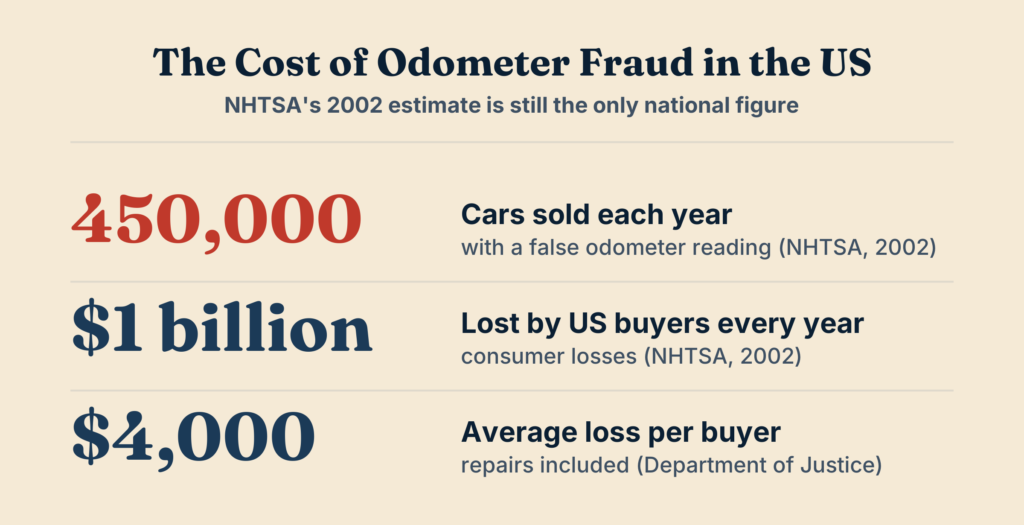
The federal benchmark is the National Highway Traffic Safety Administration’s estimate that more than 450,000 vehicles per year are sold in the United States with false odometer readings, at a cost to buyers of about $1 billion annually. Both figures come from a 2002 NHTSA study, the agency’s only national estimate, and no later study has been published, so they remain the figures the agency publishes today. The Department of Justice puts the average loss per victim at approximately $4,000 once related costs, such as repairs needed sooner than the mileage suggested, are counted, according to the Georgia Attorney General’s Consumer Protection Division.
The loss is more than the price paid: a buyer who believes a car has 60,000 miles when it has 180,000 is driving on brakes, belts and fluids past their service dates. In September 2025 a Maryland man was sentenced to three years in federal prison for a scheme that had already sent his brother to prison for 18 months; both owe about $1.2 million in restitution. As both admitted in their plea agreements, they bought high-mileage cars at auction, cut the readings by an average of 124,000 miles, obtained titles carrying the false figures and resold the cars at auction and to consumers. NHTSA’s administrator said the buyers had paid for vehicles “near or past their expected lifespans”.
The pattern in that case, a false reading on the odometer and a title to match, is why odometer rollbacks and title washing turn up on the same cars. They are separate frauds, but a seller willing to falsify a title has little reason to leave the mileage alone. Both sit in our Scams & Fraud section, and our pillar on how title washing hides a car’s history covers the second one.
How Digital Odometer Tampering Actually Works
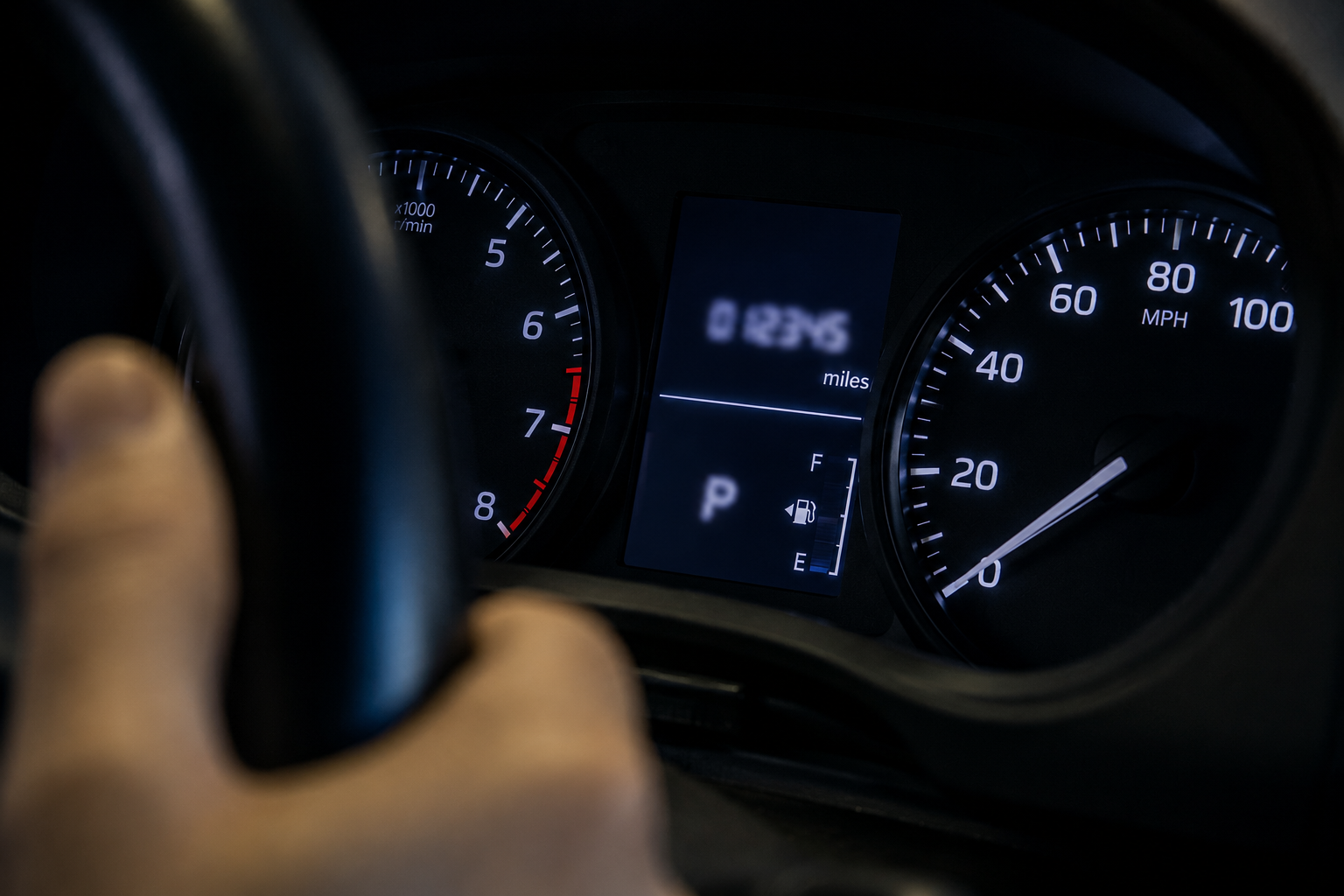
The single most important fact about modern odometer fraud is that digital odometers can be rolled back. The widespread belief that digital displays are tamper-proof is wrong, and the belief is itself part of why the fraud succeeds. NHTSA’s own page says a tampered digital odometer is even harder to detect than a mechanical one, because nothing visible moves. A buyer who assumes the displayed mileage is locked into the vehicle’s electronics will accept the displayed number without question. A buyer who knows otherwise will cross-check.
The tool is a hand-held odometer correction device that plugs into the car and rewrites the stored reading. It is sold openly online as repair equipment because a shop fitting a replacement instrument cluster has to set it to the car’s true mileage, and no licence is needed to buy one. In a demonstration aired by a Philadelphia television station in December 2024, a mechanic took a truck from about 310,000 miles to under 100,000 in seconds, and a speedometer repair shop owner said in the same report that the tool had cost $10,000 when he started out and now sells for a couple of hundred dollars. Criminals buy the same tools and run them the other way.
The older method is to swap the whole instrument cluster for one that shows fewer miles, and it is still in use. In March 2026 a Washington man was sentenced to 15 months in federal prison for replacing the odometers in at least 21 vehicles with units bought from wrecking yards and used parts sellers, according to the US Attorney’s office, and selling the cars as having up to 100,000 miles fewer than they had. A swap at least takes the dashboard apart. A digital rewrite leaves no mark on it at all.
That is why detection has moved from the dashboard to the records. Service visits, state inspections and emissions tests, dealer appraisals, insurance claims and the odometer disclosure at each sale all record a mileage on a date, and a rollback shows up when one of those readings is higher than a later one. A vehicle history report flags that discrepancy, which is why the records now matter more than the display.
What Federal Law Says
The criminal prohibition on odometer tampering is set out in 49 U.S.C. § 32703, which makes it unlawful to disconnect, reset, or alter a vehicle’s odometer with intent to change the mileage it registers; to drive a vehicle with intent to defraud knowing that its odometer is disconnected or not working; or to advertise, sell, or install a device that makes an odometer register a mileage different from the distance the vehicle has been driven.
The penalties sit in 49 U.S.C. § 32709: a civil penalty of up to $10,000 per violation as the statute states it, which NHTSA’s penalty rule adjusts for inflation (not more than $13,676 in its 2025 edition), each vehicle counting as a separate violation, and for a knowing and willful violation imprisonment of up to three years, a criminal fine set under Title 18, or both. The Department of Transportation runs the Office of Odometer Fraud Investigation, which works with state agencies on prosecutions through four regional offices.
The disclosure duty is what makes a rollback provable. The Truth in Mileage Act of 1986 put the odometer reading on the title itself, and the duty now sits in 49 U.S.C. § 32705: a person transferring ownership must give the buyer a written disclosure of the mileage on the odometer, or a statement that the actual mileage is unknown if they know the reading is wrong, and may not give a false statement in it. A seller who certifies a low reading and is later shown to have rolled the odometer back has broken § 32705 as well as the tampering statute, and the disclosure is the document in the prosecution.
Under NHTSA’s rule, 49 CFR Part 580, the seller writes the reading on the title (a dealer may use the state’s reassignment form, and with an electronic title the reading goes into the state’s system), certifies that it is the actual mileage to the best of their knowledge or states that it is beyond the odometer’s mechanical limit or not the actual mileage, and the buyer signs the disclosure too. Vehicles above 16,000 pounds gross vehicle weight rating are exempt at any age (§ 580.17); the age limits are below.
The disclosure window matters. NHTSA’s rule change, finalized in 2019 and in force since January 1, 2021, extended the federal disclosure requirement from 10 years to 20 years for model year 2011 and newer vehicles. NHTSA gave as its reason rising odometer fraud on older vehicles in a fleet that is older than ever; S&P Global Mobility put the average age of a US light vehicle at 12.8 years in 2025. Model year 2010 and older vehicles stay under the old 10-year rule, so all of them are exempt by now. A 2011 model year vehicle does not become exempt until 2031.
The civil remedy for buyers is 49 U.S.C. § 32710. A seller who breaks the odometer law with intent to defraud is liable for three times the actual damages or $10,000, whichever is greater (a floor the same penalty rule adjusts to $13,676), and a buyer who wins is awarded costs and a reasonable attorney’s fee as well. The claim must be filed within two years. State laws layer on top, and state penalties vary: some states treat odometer tampering as a misdemeanor, others, Georgia and Florida among them, make it a felony. State agencies, usually the attorney general, the DMV or the state police, handle individual cases; NHTSA and federal prosecutors take the larger operations.
How to Detect a Rollback Before You Buy
The single most effective defense against buying a rolled-back vehicle is cross-referencing recorded mileage from multiple independent sources. No two of those sources are likely to be tampered together, which means an inconsistency surfaces the fraud. Five sources matter most, in rough order of usefulness. They slot into the pre-purchase routine in our complete fraud prevention playbook.
The first is the vehicle history report, from an NMVTIS-approved provider or a commercial service, which the National Insurance Crime Bureau recommends whenever its free VINCheck flags a vehicle. A report shows the odometer readings reported to its compiler at title transfers, inspections and service visits, and an NMVTIS report carries the most recent reading in the state’s title record. A report shows only what was reported, so a clean mileage history is not proof.
A rolled-back vehicle typically shows a sequence of rising readings followed by a sudden drop, which is the moment the rollback happened. We cover how to spot mileage inconsistencies in a vehicle history report in detail in a separate piece, including the specific patterns that indicate a single-event rollback versus a multi-step deception.
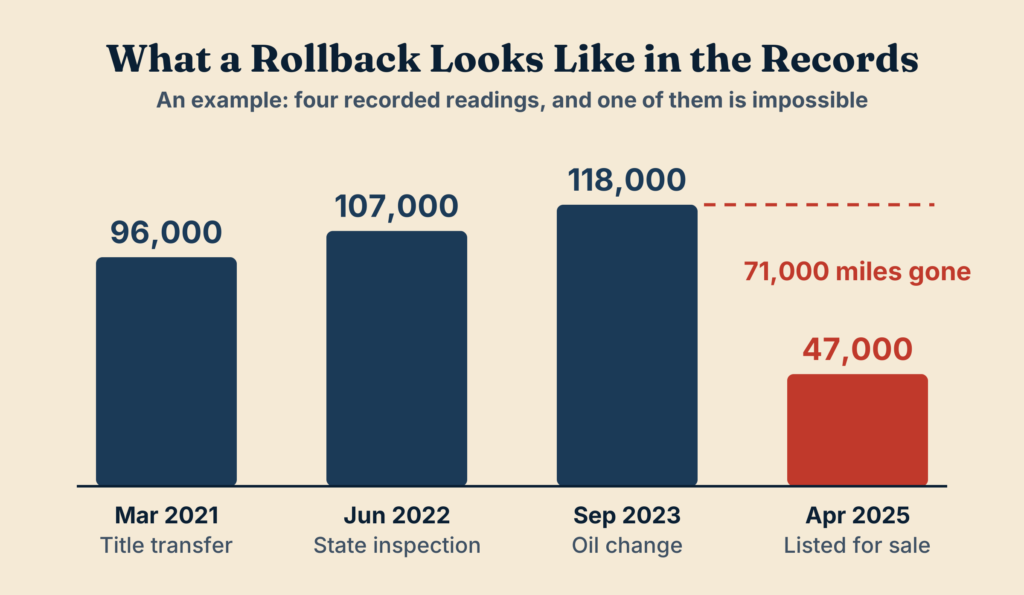
The second source is the title document and the odometer disclosure that went with the most recent transfer. The disclosure carries the previous owner’s certified statement of mileage at sale. Compare that number against the current displayed mileage and against the time elapsed since the previous transfer. A car that read 95,000 miles at the last transfer two years ago should not now read 35,000 miles, and the math is that simple in many cases.
The third source is the maintenance and service record file. Oil change stickers, dealer service records, and independent shop receipts all carry mileage entries, and they are on NHTSA’s own checklist. A car with a windshield reminder sticker for the next oil change at 92,500 miles is unlikely to have a current odometer reading of 47,000. Household vehicles averaged about 14,200 miles a year in the Federal Highway Administration’s 2022 travel survey, so a vehicle’s age divided into its displayed mileage gives a quick sanity check. A 10-year-old car displaying 30,000 miles is improbable absent a verified explanation.
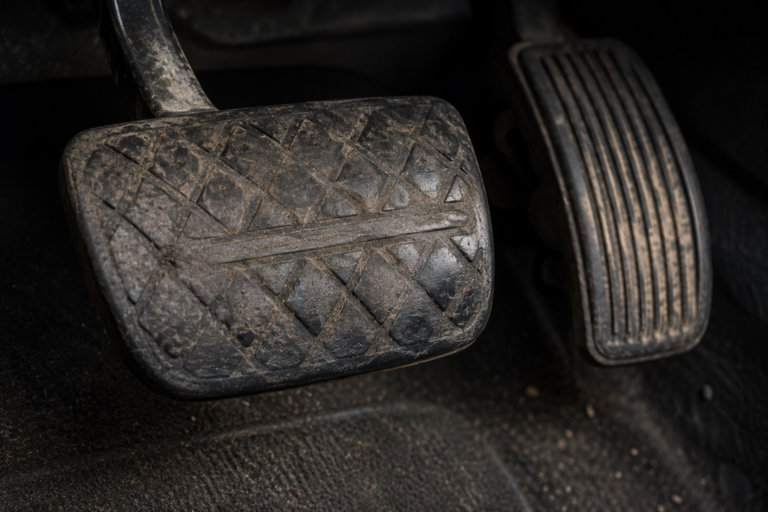
The fourth source is physical wear. Pedal rubber on the gas, brake, and clutch pedals wears with use, and NHTSA’s advice is to check that the wear fits the displayed mileage. A car with 30,000 displayed miles should have pedal rubber that looks close to new, and worn pedals on a low-mileage car are a warning sign. The same logic applies to steering wheel grip wear, driver’s seat bolster condition, the shift knob if applicable, and frequently used controls like the radio dial or climate buttons. A used-car buyer can do this inspection in three minutes during a test drive. We cover the five physical signs that an odometer has been rolled back in detail in a companion guide.
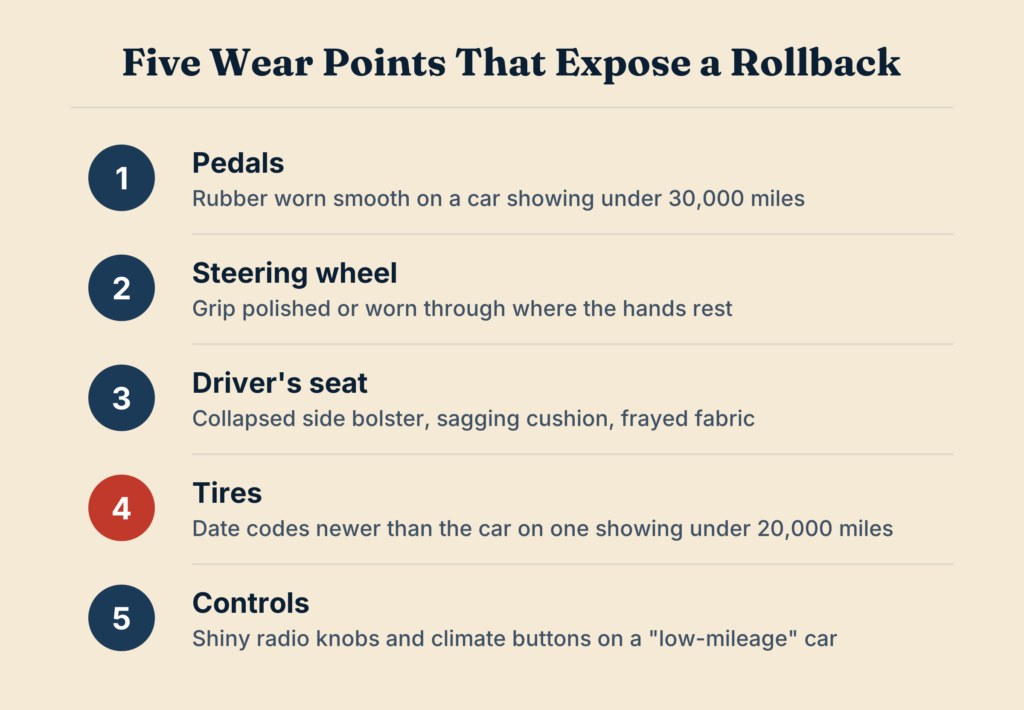
The fifth source is tire age, a cross-check few buyers know to use. Every tire sold in the US carries a tire identification number molded into one sidewall (49 CFR 574.5), and its last four characters are the date code: the first two give the week of manufacture, the last two the year, so “2422” means the 24th week of 2022. NHTSA’s advice is that a car showing 20,000 miles or fewer should still be on its original tires. If a car shows 18,000 miles and its tires carry a date code two years newer than the car, someone replaced tires that, by the odometer, were not worn out, and the seller should explain why.
Beyond cross-referencing, this is also why a professional pre-purchase inspection catches what you might miss, particularly on digital rollback cases. On many cars the mileage is also held in electronic modules other than the instrument cluster, and a shop with the right diagnostic equipment may be able to read them; a stored reading that disagrees with the dashboard is evidence of tampering. A pre-purchase inspection costs about $100 to $200, and on a vehicle suspected of fraud its value is the avoidance of an overpayment that runs into thousands.
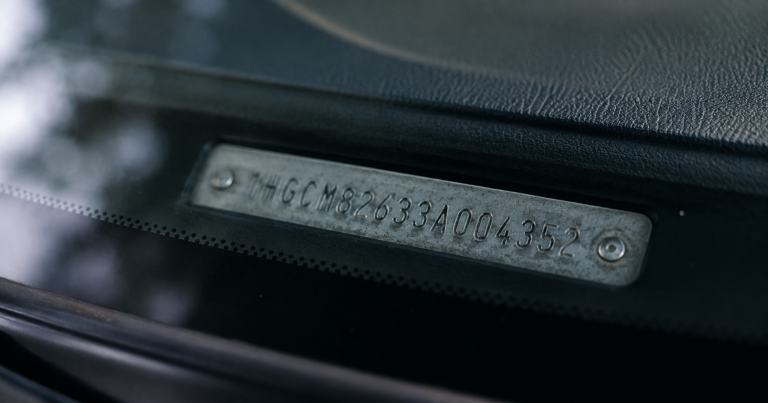
Buyers can also decode the VIN to verify the model year against displayed mileage using NHTSA’s free decoder, or run a free VIN check that returns the same build data, which catches cases where the model year on the listing does not match the VIN.
What to Do If You Already Bought a Rolled-Back Car
A buyer who discovers after the purchase that an odometer was rolled back has more options than most realize, but the clock matters: the federal civil claim has a two-year limit, so the steps below start as soon as the fraud is suspected. The first step is documentation. Print or photograph the original listing, the bill of sale, the title and odometer disclosure, all communications with the seller, the vehicle history report showing the discrepancy, and any service or inspection records that contradict the displayed mileage. Each of these is evidence in a civil claim or a criminal complaint.
The second step is a mechanic’s analysis. An independent shop with the right diagnostic equipment may be able to read the mileage stored in modules other than the cluster and put its findings in a written report. The report is the technical evidence that the rollback occurred, which converts a suspicion into a documented fact. Some shops charge for this on its own, and many combine it with a standard inspection for $100 to $200.
The third step is the regulatory filing sequence. NHTSA routes individual cases to the state agency that enforces odometer law, which depending on the state is the attorney general, the DMV or the state police, and takes tips about larger schemes on its Vehicle Safety Hotline, 888-327-4236; it cannot pursue a claim for an individual buyer. That is how to report odometer fraud to NHTSA: the agency has no online complaint form, and its list of state agencies is undated and partly stale, so check the agency’s own site before filing. File a parallel complaint with the state attorney general’s consumer protection division. If the seller is a licensed dealer, also file with the state’s dealer licensing authority.
The fourth step is the civil action. A formal demand letter to the seller, sent by certified mail with return receipt requested, is the typical opening move. The letter should describe the fraud, attach the evidence, and request a remedy in the form of a refund, a repurchase or a settlement. If the seller refuses, the buyer’s attorney can file under 49 U.S.C. § 32710 for three times the damages or the statutory minimum, whichever is greater, plus costs and attorney’s fees. That fee award is what makes the case worth an attorney’s time when the car itself cost a few thousand dollars, because the seller, not the buyer, pays the fee if the buyer wins.
A note on insurance and finance. If the vehicle was financed, tell the lender, because the loan was priced on a car worth more than this one turns out to be. Tell the insurer too, because the premium may have been set on the wrong mileage. Both calls protect the buyer’s position if the case proceeds to settlement or judgment.
Frequently Asked Questions
Can digital odometers be rolled back?
Yes. NHTSA says a tampered digital odometer is even harder to detect than a mechanical one, because nothing visible moves. A hand-held correction tool, sold online for about a couple of hundred dollars as repair equipment, rewrites the stored reading in seconds. The defense is the paper trail: the title disclosure, service records and a vehicle history report, plus a diagnostic scan by an independent shop.
How much does odometer fraud cost the average victim?
The Department of Justice puts the average loss at approximately $4,000 per vehicle once related costs, such as repairs needed sooner than expected, are counted, as the Georgia Attorney General’s office reports it. Nationally, NHTSA’s estimate is about $1 billion a year, a figure from its 2002 study that no agency has updated since.
Is odometer tampering a felony?
Under federal law a knowing and willful violation is punishable by up to three years in prison, a criminal fine, or both, on top of a civil penalty per vehicle of $10,000 in the statute, $13,676 after NHTSA’s inflation adjustment. Each state grades the offense under its own law, from a misdemeanor to a felony; Georgia and Florida make it a felony. Separately, the federal civil remedy under 49 U.S.C. § 32710 lets a buyer recover three times the damages or a $10,000 floor, adjusted for inflation, whichever is greater, plus costs and attorney’s fees.
How can I check if a car’s odometer has been rolled back?
Compare the displayed mileage with the odometer disclosure on the current title, with the readings in a vehicle history report, with any service stickers or records, and with the tire date codes; NHTSA says a car under 20,000 miles should still be on its original tires. Then have an independent shop inspect it before you pay, including a scan of the car’s electronic modules where the shop can read them.
What should I do if I discover my car’s odometer was tampered with?
Keep every document: the listing, the bill of sale, the title and its odometer disclosure, the vehicle history report, and a written finding from an independent mechanic. Report the sale to your state’s odometer enforcement agency and the state attorney general, and to NHTSA’s Vehicle Safety Hotline at 888-327-4236 if it looks like part of a scheme. Then talk to a consumer protection attorney about a claim under 49 U.S.C. § 32710, which must be filed within two years. Tell your lender and your insurer about the corrected mileage.
Discuss this article on r/VINvestigators. Got a listing that looks off, or a report that does not add up? Post it. Over 1,500 members, buyers and trade among them.
New guides and fraud alerts by email, a few times a month, no more. Subscribe on the home page.
Checking a specific car? Get the full vehicle history report from carVertical, an NMVTIS-approved provider, 20% off through our link. The link applies the discount automatically; if you go to carVertical later, the code VINVEST gives the same 20%. We earn a commission from carVertical if you buy; it costs you nothing extra.